
Integrated Law Enforcement Key to Breaking the Chain of Environmental Crime
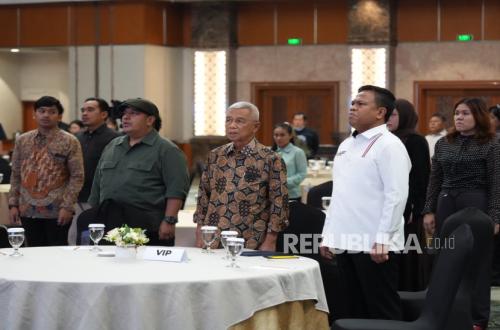
Crimes in the natural resources and environmental sector are considered increasingly organised, utilising regulatory loopholes, corporate instruments, and cross-regional networks. This situation necessitates stronger collaboration among law enforcement agencies to ensure that handling environmental crimes does not stop at field perpetrators, but also ensnares the intellectual actors and the flow of funds behind them.
Brigadier General Pol Muhammad Irhamni, Director of Specific Crimes at the National Police’s Criminal Investigation Agency (Bareskrim), stated that the pattern of environmental crime has evolved, requiring a more comprehensive law enforcement approach. “Environmental crime in the modern era cannot be faced with conventional, reactive methods. Perpetrators now move in an organised manner, exploiting regulatory loopholes and using complex corporate instruments. Therefore, law enforcement officers must have analytical sharpness equal to that of researchers and academics in mapping new modus operandi,” he said during the National Symposium on the 2026-2030 Natural Resources and Environmental Crime Outlook held by Auriga Nusantara in Jakarta on Thursday (16/7).
According to Irhamni, one of the biggest challenges in handling environmental crime so far has been the strong sectoral ego between institutions. He believes that synergy between the Police, the Attorney General’s Office, the Corruption Eradication Commission (KPK), and relevant ministries and institutions is crucial. Strengthening an integrated database system and information exchange is considered a vital step to dismantle structured environmental mafia networks. “Multisectoral collaboration is the key to bringing down organised environmental mafia networks,” he asserted.
Irhamni also assessed that law enforcement must prioritise a ‘follow the money’ approach by tracing the flow of illicit funds and seizing assets obtained from environmental destruction. He argued that this approach is more effective in breaking the chain of crime compared to merely processing field operatives. “Recovering state losses and the ecosystem is far more crucial than just imprisoning field perpetrators. Therefore, the follow the money approach must be applied to pursue destructive corporations and seize their criminal assets,” he stated.
Furthermore, Irhamni stressed the importance of utilising scientific studies in the investigation process. Expert testimony and academic research are seen as capable of strengthening evidence in court while narrowing the opportunity for perpetrators to escape legal entanglement. He reminded that natural resource and environmental crimes not only cause environmental damage but also threaten food security, energy security, and public welfare. Practices such as illegal logging, illegal mining, protected wildlife trade, and environmental pollution often involve cross-regional networks with significant economic value.
For this reason, Irhamni believes environmental crime must be positioned as a serious organised crime requiring a swift, integrated, and intelligence-based legal response. He added that law enforcement officers also need to leverage digital technology, financial analysis, and spatial mapping in every investigation so that law enforcement is not only repressive but also capable of preventing recurring environmental crimes. Irhamni assessed that the 2026-2030 period will be a crucial phase for maintaining Indonesia’s ecological resilience. Without strengthening the capacity of law enforcement and cross-sector collaboration, environmental damage is feared to become increasingly difficult to recover. “A firm, transparent legal commitment that sides with environmental sustainability is a legacy that must be fought for, for the sake of future generations,” he said.
Source: jawawa.id (https://jawawa.id/newsitem/integrated-law-enforcement-key-to-breaking-the-chain-of-environmental-crime-1784296356)
Originally published by Republika (https://esgnow.republika.co.id/berita/tibkmk522/penegakan-hukum-terpadu-jadi-kunci-putus-mata-rantai-kejahatan-lingkungan), translated from Indonesian