
Instead of Addressing the Quality of the Ngera-Puuwada Road, Nagekeo Regent Tends to Sideline Public Criticism
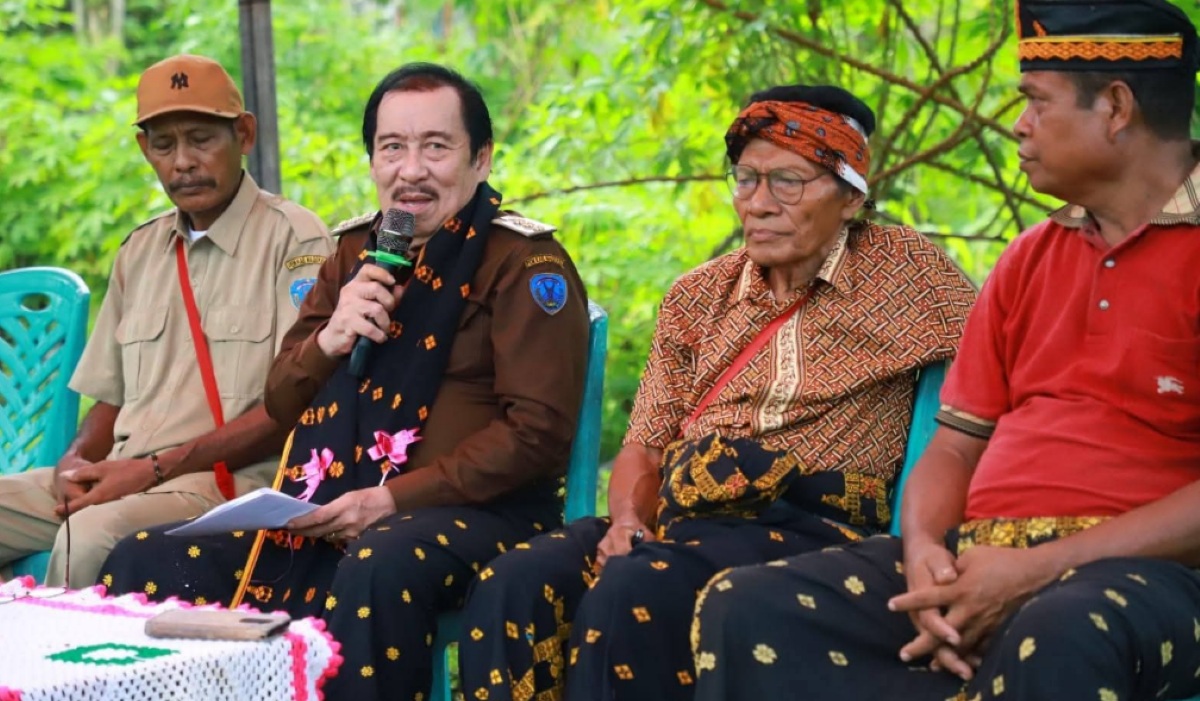
The statement by Nagekeo Regent Simplisius Donatus regarding the controversy over the Inpres Mauponggo-Puuwada road project has once again drawn criticism. Rather than addressing the substance of the road’s damage, which has already undergone Provisional Hand Over (PHO), the regent instead focused on the political aspects and concerns about the central government’s reaction.
The Forum for the Nagekeo District Branch of the Indonesian Midwives Association (IBI), which was supposed to discuss maternal and child health issues, suddenly shifted when Regent Simplisius Donatus raised the controversy over the Rp18 billion Inpres road project on the Mauponggo-Ngera-Puuwada route.
In front of the forum participants, Simplisius claimed he had received questions from the central government about the uproar on social media regarding the road’s quality. He even warned that prolonged controversy could impact the central government’s trust in allocating funds to the region.
However, this statement was seen as diverting the core issue. On-the-ground facts show that the road project had undergone Provisional Hand Over (PHO), but damage was still found even a day after the handover. This condition raises serious questions about the quality of the work and the supervision process.
Instead of responding to these technical issues, the regent emphasised that the Inpres project is under the central government’s authority and has no connection to the local government. “It has nothing to do with the local government,” said Simplisius on Friday (27/3).
Ius, a resident of Mbay who regularly observes social and economic issues in Nagekeo, stated that in governance practices, the local government’s responsibility does not simply disappear even if the project is funded by the national budget through the Inpres scheme.
He responded to the Nagekeo Regent’s statement claiming no connection to the local government in the road project.
“That statement is incorrect. The local government still has functions in social oversight, coordination, and reporting,” he said on Monday (30/3).
According to him, referring to the governance principles applied by the Ministry of Public Works and People’s Housing, the local government should remain actively involved, including knowing the real conditions on the ground, acting as a bridge between the community and the central government, and providing early warnings if damage is found.
“Saying it has nothing to do with it tends to shirk moral and administrative responsibility, whereas the region is the party closest to the project’s impact,” he stressed.
He also highlighted the regent’s statement that public controversy could make the central government reconsider budget allocations.
In his view, such a perspective is a misconception in understanding the role of the community.
“Statements like that are misguided thinking. Public criticism is actually part of democratic oversight,” he said.
He emphasised that community participation in monitoring development is guaranteed under Law No. 14 of 2008 on Public Information Disclosure.
Therefore, equating criticism with a threat to funding is considered dangerous.
“This could silence social control and shift the main issue. Whereas what is being questioned is the quality of the work, not cornering the residents who are vocal and critical about the road project,” he revealed.
Furthermore, he regretted the regent’s statement that the project controversy has political dimensions.
In his view, such a narrative could obscure the real technical issues on the ground.
Based on findings by the Nagekeo Journalists’ Alliance, the road project underwent Provisional Hand Over (PHO) despite the work not being fully perfect. Even damage was still found a day after the PHO was carried out.
On the other hand, the prosecutor’s office clarified that their supervision does not cover technical aspects of the work. Project quality checks fall under institutions like the Financial Audit Board and the inspectorate.
“This means that when the issue is shifted to political dimensions, what happens is the obscuring of the main problem, namely the quality of the work,” he stressed.
He assessed that the focus should be directed towards technical accountability, not narratives that could divert public attention.
Ius emphasised that the controversy over this Inpres Road project should be an opportunity to strengthen transparency and oversight, not weaken public criticism.
He reminded that the quality of development is a shared responsibility and cannot be detached from the active role of the local government as the frontline that directly interacts with the community.