
Inspiration from the 'Pohon Jodoh' at Bogor Botanical Gardens
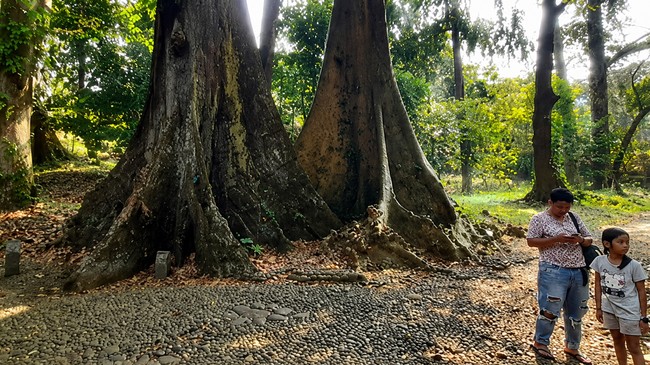
Amidst the greenery of Bogor Botanical Gardens, there is a pair of trees with a story different from the others. Not because of their striking flowers or unique fruit, but because the two grow side by side and have become known to the public by a very familiar name: Pohon Jodoh (Matchmaking Trees).
The story is intriguing because the two trees are not actually from the same species. According to official information from the Gardens, in 1866 two seedlings of different types were planted side by side at the location. One was a Meranti Tembaga (Shorea leprosula Miq.), while the tree next to it was a Beringin (Ficus albipila (Miq.) King).
The public later called the two Pohon Jodoh because of their similar stature. The Gardens also records both types as trees that are already rare in Indonesia, with collection numbers VIII.D.11 and VIII.D.12. If counted up to 2026, the planting has lasted about 160 years. During that time, the two trees have become part of the long journey of Bogor Botanical Gardens.
Two trees, two families
At a glance, the presence of the two trees easily makes people regard them as a similar pair. However, from a botanical perspective, the two actually have a fairly distant kinship.
Meranti Tembaga, long known by the scientific name Shorea leprosula, belongs to the Dipterocarpaceae group. In the latest taxonomy of Plants of the World Online from the Royal Botanic Gardens, Kew, the currently accepted name is Rubroshorea leprosula (Miq.) P.S.Ashton & J.Heck., while Shorea leprosula Miq. is a synonym. This species is a tropical tree with a native distribution covering Java, Sumatra, Borneo, Malaya, and Thailand.
Meanwhile, the Beringin has the scientific name Ficus albipila (Miq.) King. This species belongs to the Moraceae family, the family that also houses various types of beringin and fig trees. Kew records Ficus albipila as the accepted name, with a native distribution including Java, Sumatra, the Lesser Sunda Islands, Malaya, Thailand, and several other tropical regions.
Thus, botanically the two are not ‘close relatives’. Meranti Tembaga is in the Dipterocarpaceae family, while Beringin is in the Moraceae family. However, that difference does not prevent the two from growing side by side. And that is precisely where the story of Pohon Jodoh becomes interesting.
Why is it called Pohon Jodoh?
The name Pohon Jodoh is not a scientific name. It is a name that grew from the stories and perceptions of the public towards two trees standing side by side. The Gardens officially explains that the public calls them Pohon Jodoh because of their similar stature. Two trees of different types then became one object easily recognised by visitors.
In the development of stories in the community, the two later acquired symbolic meaning as a couple. Stories like this make the location have its own appeal, especially for visitors who come with a partner.
But behind the romantic story there is a far more interesting botanical fact: two plants from different families can live side by side in the same space and become part of one landscape for more than a century.
Bogor Botanical Gardens is not merely a park
To understand the importance of Pohon Jodoh, we need to look at the context of its location. Bogor Botanical Gardens is not merely a city park with beautiful trees. The official website of the Gardens explains that a botanical garden is land planted with various types of plants for the purposes of collection, research, and ex situ conservation. Botanical gardens also function as tourism and education facilities.
Bogor Botanical Gardens itself was founded in 1817 and developed into one of the important centres for the development of botanical science in Indonesia. In its historical journey, the area is closely related to the development of various scientific institutions, including the Herbarium Bogoriense and other research institutions.
Therefore, the old trees growing within it do not only have aesthetic value. They are part of a living collection that has scientific, historical, educational, and conservation value. Research published in the Buletin Kebun Raya, a BRIN journal, also confirms that the tree collection of Bogor Botanical Gardens is an important part of landscape management for the purposes of conservation, research, education, tourism, and environmental services.
Old trees are living archives
Imagine a tree that has been growing for about 160 years. It has no diary. No camera. It cannot tell what it has seen. But every year its growth leaves traces.
The tree has passed through changing seasons, landscape changes, social changes, and generations of humans. Children who may have once come to see it with their parents could now have brought their grandchildren to see the same tree.
Therefore, old trees in botanical gardens can be viewed as living archives of life. They are not archives in paper form, but biological archives that continue to grow. Their existence connects the past with the present.
From love stories to conservation
There is something interesting about the way humans view Pohon Jodoh. Some visitors may come because of the story about a couple. Some come because they want to take photos. Others may only be interested in the shape of the trees.
But for a botanist or conservation observer, attention will immediately shift to other questions: What is the species name? Where does it come from? What is its taxonomic status? What is the condition of the tree? How can its existence be maintained? These questions show that a tree can have many layers of meaning.