
Inside the Houthis’ Money Machine and Military Might Behind the Attack on a Saudi Airport
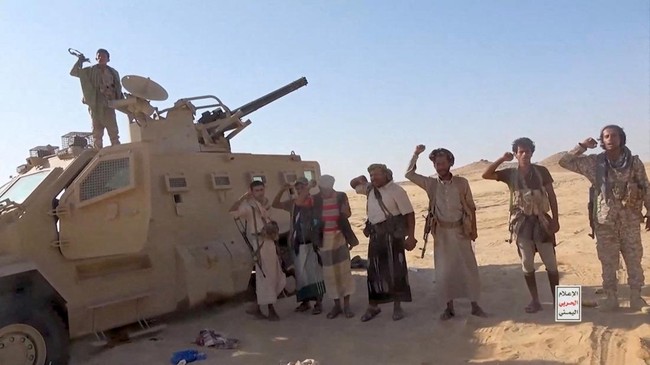
Jakarta, CNBC Indonesia — Yemen’s Houthi movement has come under renewed scrutiny after reports that it attacked Riyadh International Airport in Saudi Arabia with missiles. The attack was said to have killed 12 people and injured 309, according to AFP on Sunday (11 October 2026).
Behind its military capabilities, the Houthis do not rely solely on Iran. The group has its own funding engine in the parts of Yemen it controls.
Taxes and fuel as sources of revenue
The Houthis are often seen as being funded entirely by Iran. In reality, much of the group’s operational needs are supported by the economy in the areas of Yemen under its control.
As the de facto authorities in Sana’a and much of north-western Yemen, the Houthis collect income and corporate taxes, zakat, taxes on cigarettes and fuel, as well as customs duties on imported goods.
The UN Panel of Experts received information that Houthi-controlled revenues reached around 3.392 trillion rials in 2023. About 300 billion rials of that sum came from levies at land checkpoints.
The fuel trade is also an important source of income. Oil products entering through ports in Houthi-controlled territory are subject to customs duties and various fees, and are then marketed through companies linked to the group.
The UN panel estimated that the sector generated around 1.34 trillion rials between April 2022 and June 2024. This figure includes import duties, illegal levies and profit margins.
Meanwhile, the US Treasury Department has claimed that oil sales operations benefiting the Houthis generate more than US$2 billion a year. This is a US government estimate, not an audited financial statement.
Telecommunications provide another source of revenue. The UN panel estimated income from the sector at around US$92 million. Houthi-controlled companies were also said to receive around US$20 million a month from international calls, although the two figures may overlap.
Iran complements this domestic funding base with missiles, drones, electronic components, training, oil and cross-border transaction networks.
Yemen’s economy therefore provides the Houthis with operational cash, while Iran supplies military capabilities and international access that the group would find difficult to establish independently.
Weapons supplies become more diverse
Iran remains an important supplier of missiles, drones, electronic components, training, oil and cross-border transaction networks. However, Houthi procurement networks are now more dispersed, including through Oman, the United Arab Emirates (UAE) and the Horn of Africa.
Some drones are said to be capable of being assembled almost entirely without Iranian components. A diversified supply network makes efforts to disable Houthi weapons more difficult.
Mountains as a defensive stronghold
The Houthis’ resilience is also underpinned by Yemen’s geography. Mountainous areas, caves and bunkers at former military facilities form part of their defences. The group is also considered capable of rebuilding its organisational structure after attacks on its leadership.
Domestic revenue, increasingly diverse weapons supply networks and Iranian support give the Houthis several pillars on which to sustain their military capabilities.
This means the group’s strength lies not only in the weapons it possesses, but also in its ability to finance operations and rebuild its capabilities after being attacked.
Source: jawawa.id (https://jawawa.id/newsitem/inside-the-houthis-money-machine-and-military-might-behind-the-attack-on-a-saudi-airport-1791723031)
Originally published by CNBC Indonesia (https://www.cnbcindonesia.com/research/20261011133153-128-775082/bongkar-mesin-uang-kekuatan-houthi-modal-serang-bandara-arab-saudi), translated from Indonesian