
Inside the Belly of the American War Machine
“BZZZZZZZZZZ….” A buzzing sound, like millions of bees in flight, filled the cabin at the rear of the C-2A Greyhound aircraft. The plane had just parked at Naval Air Station North Island in San Diego, California. The morning weather at the military airbase was grey, with cold and windy air. The propeller-driven iron bird was preparing to transport US logistics, soldiers, and ourselves once again.
Passengers boarded one by one. The smell of aviation fuel and engine oil wafted through the cabin, which was as wide as half a badminton court. The lights were dim. Several other journalists and I scrambled to find seats. There were no seat numbers; we were free to sit anywhere. A few US Navy sailors sat behind us.
I took an aisle seat. Beside me sat Philippine television journalist, Chiara Zambrano. She tightened her seatbelt while I struggled to extend my own strap, pulling it across my chest and waist. Noticing my difficulty, a Marine—part of the personnel logistics crew—approached me.
“Are you okay?” he shouted over the roaring engines.
“Yes.. yes..” I replied, giving him a thumbs up. He nodded and returned to his seat at the front. Shortly after, the rear door of the aircraft closed. We were all seated facing backwards rather than forwards. This meant that upon takeoff, we were thrust violently forward and then slammed back into our seats.
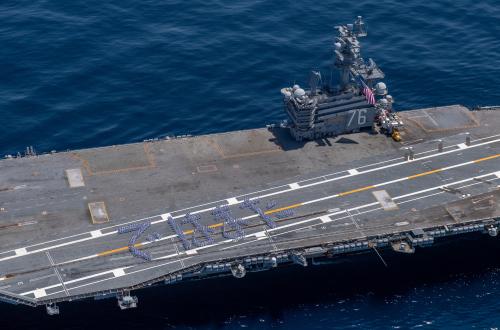
Nine ASEAN journalists, including myself, were granted the rare opportunity to visit the US aircraft carrier, USS Ronald Reagan (CVN 76), in mid-2015. This war machine, carrying dozens of fighter jets and helicopters, was set to be deployed to the South China Sea for ‘patrols’. Naturally, these were unilateral patrols, as no one had requested the US to roam those waters. The US military felt the need to remain on alert following tensions in the South China Sea caused by Chinese claims and the increasing frequency of Chinese patrols near the borders of ASEAN nations. The ship’s bases are located in Japan and the Philippines. At the time of our visit, the USS Ronald Reagan was anchored in the waters northeast of Mexico.
There was not much to see from inside the cabin of this aircraft, known as a COD (carrier on board delivery). The walls were covered in button panels, and a few small windows offered views of grey clouds. The plane flew steadily. I looked left and right; some soldiers appeared to be asleep, while others stared blankly at the walls.
After about 40 minutes of flight, the aircraft manoeuvred to the right and slowly descended. I caught a glimpse of the sea surface through a window, followed by a large, grey section of a ship. The pilot’s command rang out: “Aircraft ready for landing!”
The landing felt much like the takeoff; we were thrust forward and then thrown back. Subsequently, the rear door opened, and US Navy personnel emerged, instructing us to line up to exit the aircraft.
The aircraft carrier’s deck was vast and largely empty, with only a few helicopters parked. The sky over the Mexican waters was heavily clouded, and a cold wind swept across the deck. “Where are the fighter jets?” I wondered. The ship swayed gently from side to side. We were directed towards the main tower, where a door opened.
“Welcome to the USS Ronald Reagan,” said Lara Bollinger, the public affairs officer for the USS Ronald Reagan, with a smile. A petite woman with blonde hair and grey eyes, Lara is a Lieutenant. Carrying a backpack with a hydration bladder, she shook hands with each of us individually.
Source: jawawa.id (https://jawawa.id/newsitem/inside-the-belly-of-the-american-war-machine-1790254485)
Originally published by Republika (https://news.republika.co.id/berita/tlv9tb475/di-dalam-perut-mesin-perang-amerika), translated from Indonesian