
Inside SMA De Britto, the All-Boys School in Jogja Where Long Hair and Sandals Are Welcome
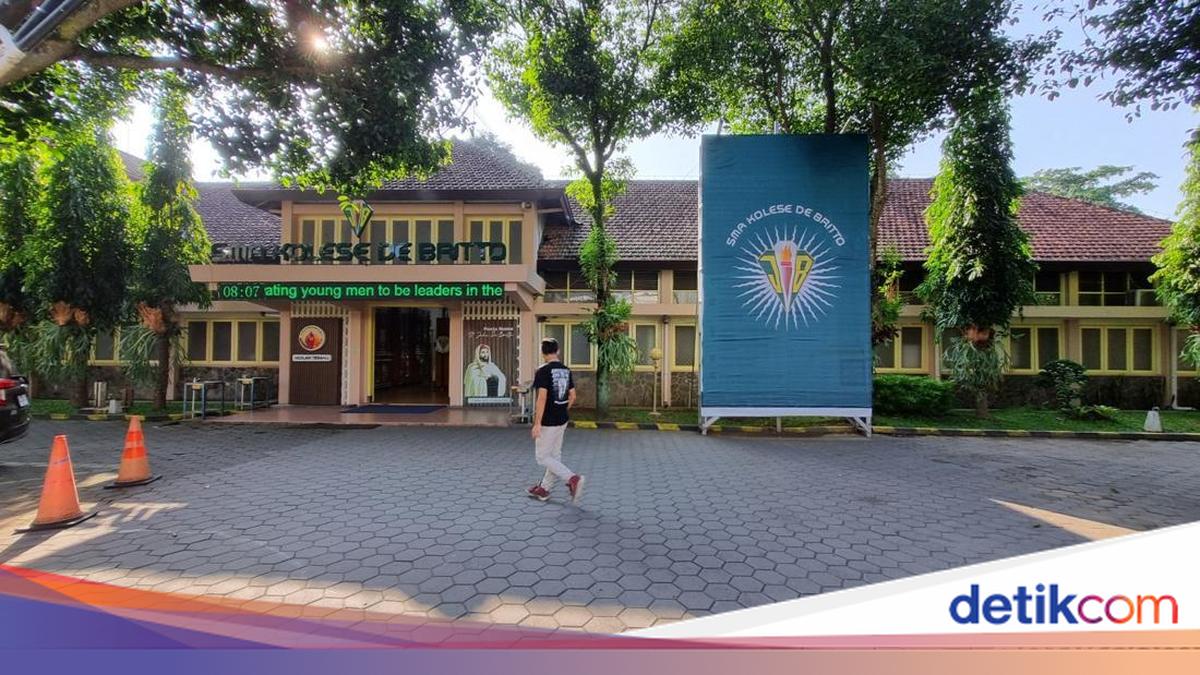
The Special Region of Yogyakarta (DIY) is renowned as a City of Students due to its many schools, one of which is SMA Kolese De Britto. This popular high school in Jogja has a vision of responsible freedom. What is its story? De Britto is an all-boys school located on Jl. Laksda Adisucipto No. 161, Caturtunggal, Depok, Sleman Regency. The high school is famous for its freedoms. It is common to see students with long hair wearing sandals at school. Christophorus Danang Wahyu Prasetio, Vice Principal for Public Relations and Networking at SMA Kolese De Britto, recounted the history and vision of De Britto that might pique curiosity. He explained that SMA De Britto is closely linked to a mission school that was originally SMA Kanisius, founded on 19 August 1948. The first cohort was a mixed group of 65 boys and girls. The school initially operated from the upper floor of the SMP Bruder building in Kidul Loji. “That was in 1948 in Bintaran, when the original name was Kanisius,” he told detikJogja at SMA Kolese De Britto, Demangan Baru, Caturtunggal, Depok, Sleman, on Monday (15/6/2026). Therefore, when discussing SMA Kanisius, Stella Duce and De Britto share a common origin. Each was established with the aim of forming a mission school. “But then the military aggression occurred in 1949, so they were separated. De Britto was for boys, Stella Duce (Stece) for girls. De Britto was under the Jesuit Fathers and Stece under the CB Sisters (Carolus Borromeus),” he said. Subsequently, in 1953, SMA De Britto acquired a new site and began construction in Demangan Baru, precisely at Jalan Laksda Adisucipto No. 161. The school finally commenced teaching and learning activities in 1958. “So, in 2028 we will be exactly 80 years old, or a dasawindu, if we are talking about the history of De Britto,” he stated. Danang then explained the vision and mission of SMA De Britto that distinguishes it from other high schools in Jogja. According to him, the Jesuits are a congregation of priests with a particular excellence in education. “When we talk about Jesuits internationally, schools under the Jesuits certainly have excellence,” he said. This excellence is not limited to academics but is holistic, balancing character and academic achievement. “In Jesuit education or Kolese De Britto education, it is a complete education. Balancing the exercise of thought, feeling, and will,” he said. The bespectacled man revealed that SMA De Britto has a student profile often referred to as 1L+5C. Danang detailed that L stands for leadership. However, a leader must possess five Cs: competence, conscience, compassion, consistency, and commitment. “It is often called 1L+5C. A leader who has the 5Cs: competence relates to knowledge, conscience is inner awareness, compassion is empathy, commitment means having something to be accountable for, and consistency is speaking truthfully about what one thinks,” he said. Danang also shared that SMA De Britto is often called a school of responsible freedom. He explained this stems from the 1960s, a period of transition from the old order to the New Order. “During the New Order, in quotation marks, it overly emphasised strict or rigid rules. Leaders had to be respected and followed,” he said. “The rules made by the government were sometimes stifling. De Britto created something different with a school of responsible freedom,” Danang continued. The concept of responsible freedom, Danang noted, was the thinking of the fathers at the time. When people, especially students, are constrained, creativity and the courage to express ideas and opinions will not emerge. “So, the idea of a free school was introduced, but freedom with responsibility. This responsible freedom is not freedom to do as one pleases, nor is it freedom without rules,” he said. The rules emphasise the importance of thinking before taking steps in life. “There are still rules, values are still prioritised, but what is always stressed is to think before acting. Before making a decision, before making a choice, think first about what you will do. That is what is meant by responsible freedom,” he said. One expression of this freedom is appearance. Therefore, at this all-boys school, it is common to find students with long hair. “Wearing sandals is allowed, but sandals with a back strap,” he said. “Long hair is free, but it must be natural, it cannot be dyed. If it is dyed, the consequence is a haircut,” he said. Regarding education at SMA De Britto, Danang described it as an education that liberates people and is humanistic. A person cannot develop well if their freedom is taken away. “How can students develop well without humanism? At De Britto, we say rules are not to constrain, but to be seen from a broader perspective,” he said. Danang gave an example: every mistake a De Britto student makes does not immediately result in punishment. He said students who make mistakes face consequences aimed at making them aware of what they have done. “Every mistake a child makes is not met with punishment, but with consequences. The purpose of the consequence is for the child to realise the mistake they have made. At De Britto, there is no such thing as a score system where being late scores a certain amount, or fighting scores a certain amount.”