
Inside Pickaxe Mountain: Iran's Nuclear Bunker That Has Trump on Edge
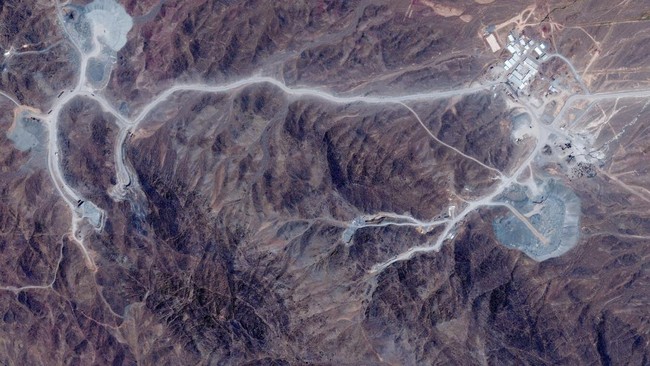
Jakarta, CNBC Indonesia – Tensions between the United States and Iran have flared again after President Donald Trump threatened to attack Pickaxe Mountain, Iran’s underground nuclear facility located near the Natanz uranium enrichment complex. Although its existence has long attracted attention, very little is known about the facility, which is believed to be buried almost 100 metres inside the mountain.
Trump asserted that his administration remains committed to preventing Iran from acquiring nuclear weapons. He even said the US military would “hit that area in the near future, and hit it very hard”. However, Trump also acknowledged that US intelligence had found no activity at the site.
“They’re not performing well with their nuclear situation. Every time we hear about it, we blow it up. We may give Pickaxe a chance in the relatively near future,” he said, as quoted by The Guardian on Thursday (23/7/2026).
Pickaxe Mountain, known in Iran as Kuh-e Kolang Gaz La, lies about 220 kilometres south of Tehran and only around 2 kilometres from the Natanz nuclear facility. Construction of the underground complex began in 2020 after a sabotage incident damaged the Natanz facility.
At the time, former head of Iran’s Atomic Energy Organisation Ali Akbar Salehi said the country was building a facility “more modern, larger and more comprehensive in the heart of a mountain near Natanz” to produce advanced centrifuges.
Director General of the International Atomic Energy Agency (IAEA), Rafael Grossi, said Iran had indeed communicated plans to move part of its nuclear activities underground.
“This is part of their quite systematic intention to place their most sensitive facilities underground,” said Grossi.
According to satellite imagery analysis by the Institute for Science and International Security (ISIS), the complex has two pairs of tunnel entrances and has recently been fitted with security walls. Since attacks by the US and Israel intensified, one of the tunnel accesses has even been reinforced and partially closed to prevent ground vehicles from entering the site.
Sam Lair, a researcher at the Foreign Policy Research Institute, assessed that fortifying the tunnel entrances would make the facility harder to destroy using bunker-busting bombs. According to him, the move shows Iran is continuing to strengthen the facility’s defences even as the threat of attack grows.
The ISIS report also said the Pickaxe Mountain facility is believed not to be fully operational, as construction is still ongoing. Nevertheless, the institute considers that Iran could potentially use the complex as a smaller-scale centrifuge assembly site capable of supporting its nuclear programme once construction is completed.
Experts believe the facility, located deep within the mountain, would be difficult to destroy through airstrikes, even using the most advanced bunker-busting bombs in the US arsenal. For this reason, ISIS judges that a ground operation or act of sabotage would likely be more effective, although airstrikes with earth-penetrating weapons could still exploit certain weak points.
So far there are no indications that Trump intends to deploy ground troops to Iran. However, the latest threat against Pickaxe Mountain shows the facility remains one of the strategic targets amid rising tensions between Washington and Tehran over Iran’s nuclear programme.