
Inside Luxeed’s China Factory, Where 60 Cars Can Be Produced Every Hour
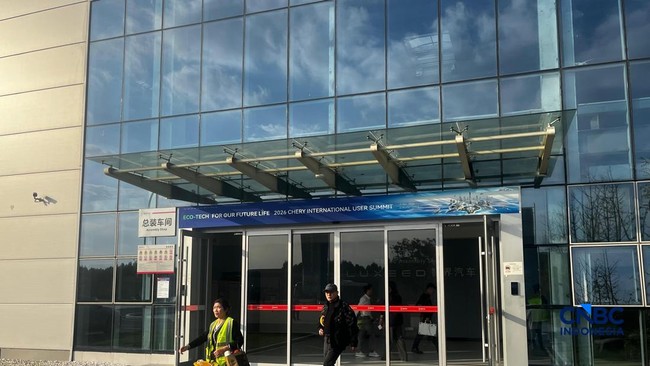
Wuhu, CNBC Indonesia – Chinese luxury carmaker Luxeed relies heavily on robots in its manufacturing process. Tasks that typically require a high degree of precision, from welding bodywork to fitting sunroofs, are carried out with robotic assistance. However, this does not mean the entire production process takes place without human intervention.
CNBC Indonesia and several other Indonesian media outlets had the opportunity to observe the production process at the factory in Wuhu, Anhui province, China. With the support of smart manufacturing technology, the facility is designed to produce up to 300,000 vehicles a year.
One area that attracted particular attention was the body-welding workshop. Hundreds of robots work there, joining metal parts that will form the car’s frame. Certain welding processes can be completed in about a minute.
Despite the high level of automation, workers are still needed to support production. About 200 employees work in the welding section alongside robotic systems that handle repetitive tasks with a high degree of precision. The combination is part of the factory’s effort to maintain both speed and consistent production quality.
The facility operates two shifts a day, each lasting eight hours. This means production runs for a total of 16 hours a day, rather than around the clock. With a line speed of about 60 vehicles an hour, its theoretical capacity could reach 960 vehicles over those 16 hours, although actual output depends on operational conditions and production requirements.
Robots are also used in the assembly area, where the car body is joined with other components. Lifting robots move the vehicle bodies, including during the fitting of major components. Robotic systems also assist with installing seats, a task that requires precise positioning.
Automation technology is used to fit sunroofs as well. The robots not only install the component but are also equipped with systems to detect its position, ensuring that it is fitted at the designated points. This process is important for maintaining accuracy and reducing the risk of assembly errors.
After the major components have been installed, production moves to the underside of the vehicle. The tyres are fitted before the chassis and related components are completed in sequence on the production line. Each stage is designed to allow vehicles to move from one process to the next without disrupting the overall workflow.
The Luxeed facility is also being prepared to produce vehicles with right-hand drive for export markets. This capability shows that the production line is intended not only to meet demand from Chinese consumers but also to support plans for international expansion. Production flexibility is important for a brand seeking to broaden its business reach.
The factory supports production of several Luxeed models, including the S7 saloon, the R7 and RX SUVs, and the V9 MPV. As part of its brand development, Luxeed has also introduced the LLounge and Stormax to global markets in an effort to broaden its premium vehicle line-up. The range requires production lines capable of adapting assembly processes to the characteristics of each vehicle.
Luxeed is scheduled to enter the Indonesian market in the second quarter of 2027, with the LLounge highlighted as a model for its initial expansion. Following the Stormax’s global release, the vehicle may also be launched in Indonesia.
Source: jawawa.id (https://jawawa.id/newsitem/inside-luxeeds-china-factory-where-60-cars-can-be-produced-every-hour-1792752650)
Originally published by CNBC Indonesia (https://www.cnbcindonesia.com/news/20261023154432-4-778964/mengintip-pabrik-luxeed-di-china-sejam-bisa-produksi-60-unit-mobil), translated from Indonesian