
‘Insane scale’: A close-up look at scam compounds along Cambodia's border with Vietnam
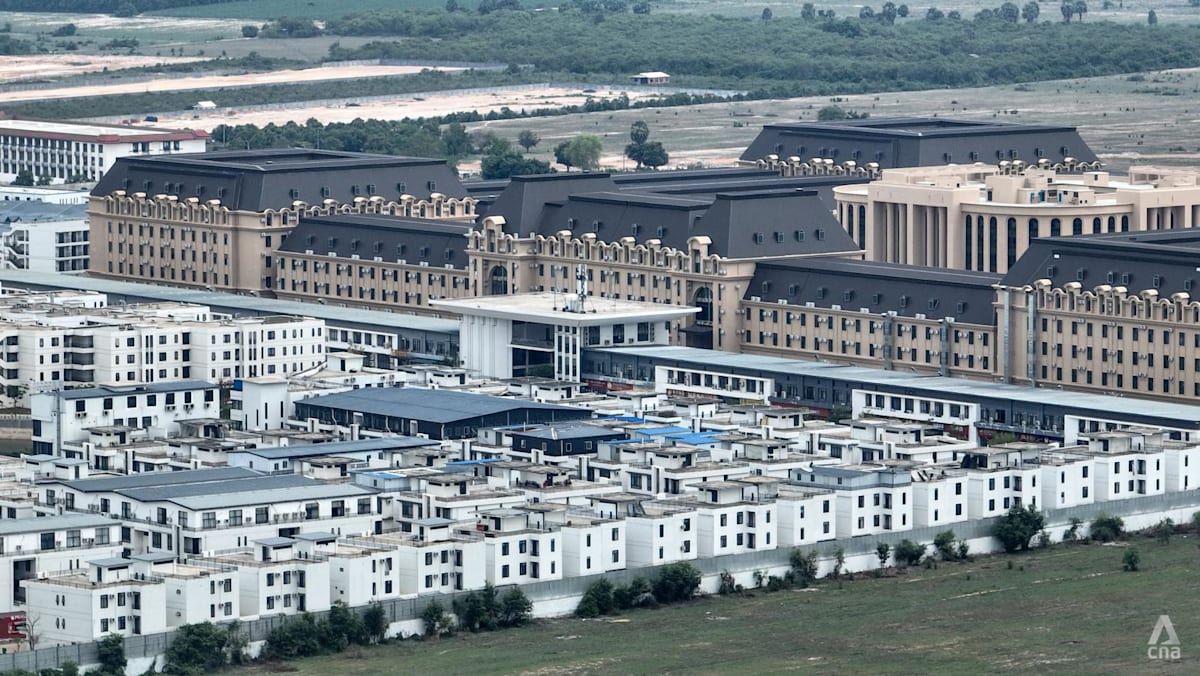
‘Insane scale’: A close-up look at scam compounds along Cambodia’s border with Vietnam
In the second of a two-part series that looks into scam operations in Cambodia, CNA travels along the country’s eastern border with Vietnam, where new roads, casino zones and guarded compounds have transformed agricultural land into a frontier for online scams.
PHNOM PENH: It is a chaotic and dusty artery that links Cambodia to Vietnam through the frontier town of Bavet.
Dozens of workers pack into the backs of trucks, shipped to and from factories and building sites. Children play beside guarded compounds, rubbish burns near golden casino entrances and luxury vehicles pass stark worker dormitories.
There is one thing that stands out among it all: the flood of advertising for online gambling, everywhere despite it being illegal in Cambodia.
The lures of multiple cyber casino brands and Chinese sports betting companies loom over the highway. Security guards shelter from the sun under umbrellas adorned with poker chips and women in bikinis.
They are the signposts to the shady world of vice that has been incubated here for years.
To something larger and hidden, often beyond and above the casino floors, and in the apartment complexes and business parks.
To the human trafficking, the violence and torture, the illegal gambling and the sophisticated scamming operations targeting people all around the world.
“It’s wild. It’s unbelievable. This is a mafia playground,” said Nathan Southern, the operations director of Eyewitness Project, an organisation investigating crime, conflicts and corruption in the region, as he drives through the border traffic, past the seafood restaurants and boxes of Chinese beer.
Bavet and towns like it have long been magnets for casinos, gambling and organised crime that typically thrive in porous border areas.
Now, these same towns have become part of a larger global fraud machine where victims are trafficked into compounds and forced to target others online.
The fraud can look like romance, investment advice, cryptocurrency trading, online gambling or fake job offers.
Researchers have estimated Cambodia’s scam industry may generate between US$12.5 billion and US$19 billion a year, though the figures are difficult to verify because much of the money moves through cryptocurrency, underground banking and offshore structures.
While much attention has focused on better known scamming hotspots like Sihanoukville in Cambodia’s south, and Poipet on the western border with Thailand, along the country’s eastern flank, a parallel ecosystem has quietly emerged.
Cambodian authorities say they are now trying to shut this multi-billion dollar system down. The country has new anti-scam legislation, enacted since April, and has been targeting compounds for months.
But these networks have deep roots. And they have made significant inroads along the Vietnamese border that experts say will be difficult to erase.
“These are highly integrated forms of transnational criminal enterprises. They’re not contained within one country. They don’t recognise borders,” said Jason Tower, a senior expert for the Global Initiative Against Transnational Organised Crime, an international non-governmental organisation headquartered in Geneva.
Large compounds and clustered operations within reach of the Vietnam border appear to be using an old playbook that takes advantage of long-established smuggling routes and cross-border broker networks to move people, equipment and money, said Lindsey Kennedy, research director at the Eyewitness Project.
Casinos were already embedded in these border areas, and they sat alongside older illicit economies such as timber and drug trafficking.
In many cases, the same networks behind those trades also controlled the casinos, using them to move and clean dirty money, she said.
“Often these are already heavily logged areas. The people who’d taken over that land were looking for new ways to exploit the value of the area as well.
“Even though this looks from the outside like a very strange progression, it’s actually been very logical,” she said.
The smuggling of people, especially from China and Vietnam itself, across the 1,158 km long Cambodia-Vietnam border and into scamming compounds, has been widely documented.
“Some of the compounds even appear to be in a kind of no-man’s land between the two countries. It’s really easy to get people in and out,” Kennedy added.
SECRETIVE AND GROWING FAST
Tucked against the Vietnamese border, straddling a small reservoir, the A7 Country and Resort Casino in Bavet is exactly the type of large-scale scam complex the Cambodian government says it will no longer tolerate.
Authorities have launched major crackdowns on scam complexes throughout the country, action that has intensified in the past couple of months.
Some 300 different facilities have been targeted by police action since July, Chhay Sinarith, senior minister and chair of Cambodia’s Commission for Combating Online Scams, told CNA in an interview.
CNA was given access to the A7 facility, which provincial officials from Svay Rieng province said was running scams before being raided earlier this year.
With dozens of heavily armed personnel on hand, the locked complex was opened up to reveal dozens of buildings inside.
One of them, shown to the media, contained a cache of evidence of the alleged criminal activities that took place, including identification cards, household registries, boarding passes, dozens of credit cards, medicine and abandoned food.
More than 2,200 people found to be inside the complex were arrested, authorities said, with the vast majority of them from China, as well as nationals from Myanmar and Vietnam.
For now, Peng Pursa, the governor of Svay Rieng province, said it was unclear who owns the land or who was responsible for running the operations. It had been masked as a housing estate, he said.
“Before they were small in size, so it was highly secretive, which made it hard for