
Innovative Corn Seed Technology Boosts Maize Productivity in Ponorogo
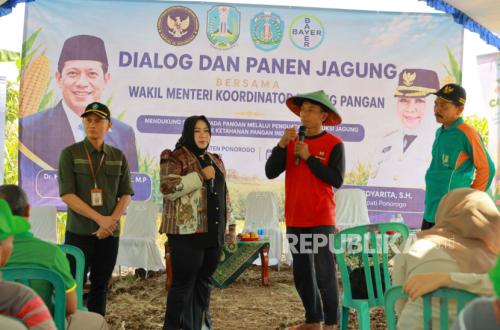
Collaboration between the government, the private sector, and farmers is becoming a central step in strengthening national food security through the application of more modern, efficient, and innovation-based agricultural technology. This commitment was demonstrated during a grand maize harvest organised by Bayer Indonesia alongside the Coordinating Ministry for Food Affairs in Pijeran Village, Siman District, Ponorogo, East Java.
The event was attended by the Deputy Coordinating Minister for Food Affairs, Hanif Faisol Nurofiq; the Regent of Ponorogo, Lisdyarita; the Acting Head of the Ponorogo Agriculture, Food Security, and Fisheries Office, Masun; the Rector of Muhammadiyah University Ponorogo, Rido Kurnianto; the Agriculture Affairs and License to Operate Lead for Bayer Crop Science Indonesia, Aditia Rusmawan; and representatives from farmer groups from Pijeran Village.
Hanif stated that increasing productivity is key to achieving national food self-sufficiency targets amidst land limitations and the challenges of climate change. “Strengthening food security is not enough through the mere expansion of planting areas. We need to increase productivity through the use of agricultural technology and innovation. The collaboration between the government, farmers, and the private sector, such as Bayer, serves as a real example of how innovation can drive regional production centres to become pillars of national maize production,” he said.
The importance of increasing productivity is also reflected in national maize production trends, which continue to show growth. In January 2026, the national area for shelled maize harvesting reached 0.24 million hectares, an increase of 11.17 per cent compared to January 2025, which recorded 0.22 million hectares. During the same period, the production of dry shelled maize with a 14 per cent moisture content is estimated to reach 1.38 million tonnes, up 11.09 per cent from 1.25 million tonnes in January 2025.
As one of the top ten maize-producing regions in East Java, Ponorogo has a maize harvesting area of approximately 39,046 hectares with a production of 284,242 tonnes in 2025, or an average productivity of 7.28 tonnes per hectare. This potential makes Ponorogo a strategic region in supporting national food self-sufficiency targets.
The Acting Regent of Ponorogo, Lisdyarita, stated that as one of the maize production centres in East Java, Ponorlo continues to strengthen cross-sector collaboration to increase agricultural productivity. “Amidst evolving challenges, the use of innovation and technology is a vital step so that farmers can increase their yields while supporting the achievement of national maize self-sufficiency targets,” she said.
In this context, the collaboration with Bayer through the use of the Dekalb DK19C variety serves as an example of implementing seed innovation in the field. Technical evaluations in Pijeran Village, Siman, Ponorogo, showed good agronomic performance.
Aditia Rusmawan, Agriculture Affairs and License to Operate Lead for Bayer Crop Science Indonesia, added that for his company, agricultural innovation must provide real benefits to farmers. “Through Dekalb hybrid maize seed technology, we want to help farmers increase productivity and achieve better economic yields. The use of DK19C maize seeds demonstrates how science-based innovation can be applied in the field to drive more advanced and sustainable maize farming,” he said.
Aditia also added that Bayer will soon introduce Dekalb DK 19S and DK 09S maize seeds, a biotechnology seed technology that provides two unique mechanisms to protect plants from pests above the ground, such as corn borers and fall armyworms. The DK19S and DK09S maize seeds also include tolerance to Roundup Ready 2 herbicide.
From an economic perspective, the benefits of maize seed innovation are directly felt in farming enterprises. High yields and low moisture content at harvest automatically reduce drying costs. Strengthening productivity is not just about harvest tonnage, but also about creating net profit margins for farmers through maximum kernel weight output with optimal input.
Miswanto, a maize farmer from Ronosentanan Village, Siman District, Ponorogo, said that since using Dekalb DK19C maize seeds, plant growth has been more uniform, cobs are better, and harvests have increased. “In addition to higher production, costs are also more efficient because the harvest quality is good. The cultivation assistance from Bayer also makes us more confident in applying new technology to our land,” he said.
The collaboration between the government, local government, Bayer, and farmers serves as an important foundation for building more productive, efficient, and sustainable agriculture, while strengthening Indonesia’s steps towards maize self-sufficiency.