
Infrastructure Projects Should Not Be Built Rashly; Aim for 8% Economic Growth
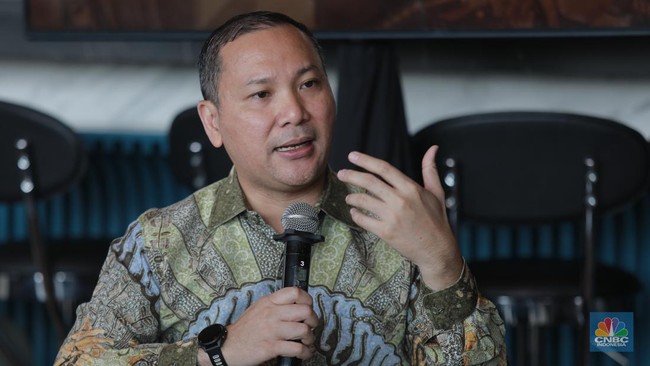
Jakarta, CNBC Indonesia - Rachmat Kaimuddin, Deputy for Basic Infrastructure Coordination in the Coordinating Ministry for Infrastructure and Regional Development, highlighted the importance of infrastructure planning oriented towards real impacts for society.
In the Regional Consultation of the Ministry of Public Works (PU), Rachmat, representing Coordinating Minister for Infrastructure Agus Harimurti Yudhoyono, emphasised the importance of the forum as a strategic space to align infrastructure development plans for the 2027 fiscal year between the central government and regions.
“This forum is a strategic space to ensure that infrastructure planning and programming for the 2027 fiscal year aligns with the national development direction and can also serve as a synchronisation forum between the centre and regions,” he stated during the Ministry of PU Regional Consultation on Thursday (2/4/2026).
This planning relates to the turbulent global situation, particularly due to geopolitical conflicts that directly impact the global energy sector.
“We know that today the world economy is facing challenges, as a result of the Israel-Iran conflict which has caused several situations, including a blockade in the Strait of Hormuz. The Strait of Hormuz handles 25 percent of the world’s sea oil trade and 20 percent of global natural gas through the Strait of Hormuz,” he explained.
This global pressure needs to be considered in formulating national infrastructure policies, particularly in strengthening domestic energy and economic resilience.
“This is something we may also need to consider in our planning, where the impacts are already starting to be seen in various places,” he continued.
He then linked this development direction to the government’s grand vision outlined in the national priority agenda, including strengthening self-reliance in food and energy sectors.
“Infrastructure is certainly not the main goal but serves as support for achieving the goals we want to reach,” he said.
Furthermore, he underlined the change in approach being promoted by the government, from mere physical development to achieving results and impacts.
“Sometimes, when we look at it, we focus on how many kilometres of roads we build. For irrigation, how many kilometres of irrigation we build. For dams, how many cubic metres we have built. But going forward, we will continue to monitor and also help remind that the roads can connect production and distribution,” he elaborated.
In the context of coordination, the need for alignment between ministries and agencies is essential, given the differences in performance targets that often pose challenges.
“We all have performance indicators, we all have targets, and those targets may not necessarily align,” he said.
In addition, he also mentioned the need for substantial funding to achieve the national economic growth target, which cannot fully rely on the state budget (APBN).
“To carry out infrastructure development to achieve 8 percent growth requires very large funds and is not sufficient only from the APBN,” he said.
Alternative financing schemes such as Government and Business Entity Cooperation (KPBU) are key to ensuring projects continue and are attractive to investors.
“Thus, we also need to ensure how to make these projects that need to be built outside the APBN have a bankable structure,” he added.
Closing his statement, Rachmat affirmed several priority sectors that will be the government’s focus going forward, including water resilience, connectivity, and coastal area protection.
“Water sector resilience is very important, connectivity is very important, and also do not forget … coastal protection development or the giant sea wall in northern Java will also be our attention in the coming years,” he concluded.