
Inflationary Pressures Raise Concerns as Economists Forecast BI Rate Rise This Month
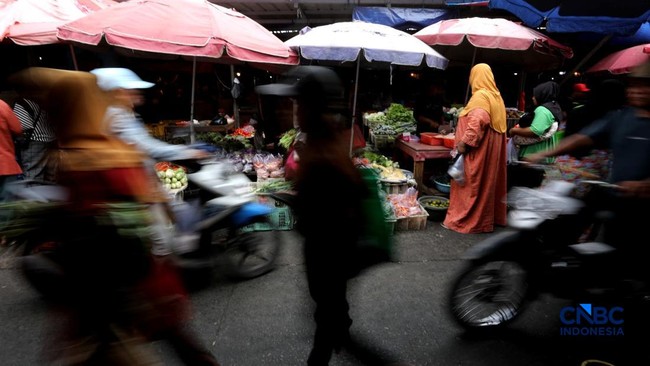
Jakarta, CNBC Indonesia – Indonesia’s October 2026 inflation data has alarmed economists, who warn that pressure could worsen, disrupt domestic economic activity and prompt Bank Indonesia (BI) to raise its benchmark BI Rate.
BCA’s economics team said in its Monthly Economic Briefing that the risk of sustained inflationary pressure was evident in the growing contribution from core components, excluding gold prices, which have recently eased.
Statistics Indonesia (BPS) recorded core inflation of 2.56% year on year (YoY), down from 2.84%, mainly reflecting slower annual growth in gold prices.
However, the contribution of core inflation excluding gold continued to rise, increasing from 1.38% to 1.42% YoY. This indicates that credit growth is expected to remain strong.
“Inflation is becoming an increasingly pressing concern for Indonesia,” BCA’s economists said, as quoted on Tuesday (3 November 2026).
Externally, the threat that MSCI could reclassify Indonesia as a standalone market has triggered capital outflows from both the stock market (Rp13.07 trillion as at 30 October) and government bonds (Rp7.44 trillion in outflows as at 29 October).
This has put further pressure on the rupiah, which weakened to 18,127 per US dollar on 30 October, depreciating by 1.4% month on month and 8.6% year to date, and increasing the risk of higher prices for imported goods.
Meanwhile, energy prices have remained high amid the prolonged Middle East conflict, keeping global inflation elevated.
Another factor, BCA’s economists said, is how the government responds by balancing economic growth against limited fiscal resources.
For now, the government is expected to keep subsidised fuel prices unchanged until the end of 2026. It has also announced stimulus, including transport discounts, worth around Rp32 trillion for the fourth quarter of 2026. Taken together, these measures could keep inflationary pressure moderate for the time being.
Attention then turns to BI. BCA’s economists said the central bank is currently relying on higher hedging incentives to keep capital inflows attractive.
However, they warned that rupiah depreciation and continuing inflationary pressure could prompt BI to adopt a tighter monetary policy stance.
Although the trade balance remained in surplus in September 2026, at US$3.36 billion, supporting domestic foreign-currency liquidity and reserves that month, BCA’s economists believe the result is likely to be temporary. They cited the seasonal nature of the export surge and an impending rush to import oil.
A narrowing trade surplus could renew depreciation pressure on the rupiah and push government bond yields higher, particularly in light of the recent MSCI market warning.
“We therefore maintain our view that Bank Indonesia may signal another policy rate hike to safeguard external stability and reassure the domestic market,” BCA’s economists said.
Permata Bank’s economics team shared a similar view. In its base-case scenario, BI will raise its benchmark rate by a further 25 basis points in November 2026, bringing the BI Rate to 6.00%.
“This view is primarily driven by our expectation that the Federal Funds Rate (FFR) will rise by a further 25 basis points to 4.25% in December 2026, requiring BI to maintain an adequate interest-rate differential to support rupiah stability and contain imported-goods inflation,” Permata Bank’s economists said in their analysis.
They stressed that core inflation would become increasingly dependent on imported-goods inflation, as fragile household purchasing power is likely to restrain demand-pull pressures.
Persistent geopolitical uncertainty, a hawkish US Federal Reserve and the MSCI shock continue to reinforce risk-off sentiment, limiting capital inflows and intensifying depreciation pressure on the rupiah.
“A weaker rupiah will raise the cost of imported raw materials and increase the risk of producers passing higher prices on to consumers,” Permata Bank’s economists said.
Indonesia’s headline inflation was 3.23% YoY and 0.22% month on month in October 2026, easing slightly from 3.28% YoY and 0.30% month on month in September.
Food-price volatility caused by El Niño remained the main driver of monthly inflation, with red chillies, bird’s-eye chillies, tomatoes and mustard greens among the leading contributors.
With El Niño expected to continue into early 2027, the economists expect inflationary pressure to persist over the coming months.
Source: jawawa.id (https://jawawa.id/newsitem/inflationary-pressures-raise-concerns-as-economists-forecast-bi-rate-rise-this-month-1793685114)
Originally published by CNBC Indonesia (https://www.cnbcindonesia.com/news/20261103104715-4-781813/tekanan-inflasi-mengkhawatirkan-ekonom-ramal-bi-rate-naik-bulan-ini), translated from Indonesian