
Industry Ministry Responds to Flood of Refined Sugar into Consumer Market
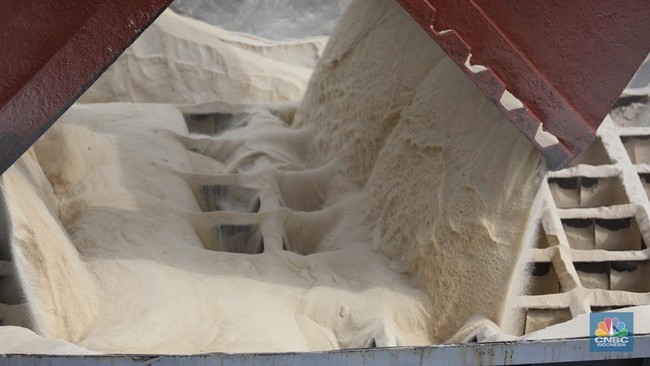
Jakarta, CNBC Indonesia - The Ministry of Industry (Kemenperin) has spoken out following concerns over the leakage of refined sugar into the consumer market. This is feared to disrupt the domestic sugar industry.
Director General of Agro Industry at Kemenperin, Putu Juli Ardika, stated that the trend in industrial sugar demand has shown a decline in recent years.
“With the growing awareness of non-communicable diseases from sugar, demand has dropped. From the industry side, since the enactment of PP 28 (2024) on health, they have started reformulating their food and beverages, so from the Ministry of Industry, three years ago, imports, the RKI (industrial raw sugar), have been continuously declining. From 3.6 million tonnes to 3.4, then 3.2, now it’s around 3 million. Now 3 million. This is a significant decline, quite substantial, over the past four years,” said Putu in a discussion with the media, quoted on Wednesday (22/4/2026).
Amid this decline, the controversy regarding the leakage of refined sugar distribution is not within Kemenperin’s oversight.
“The issue related to leaks and such is indeed under the authority of the Food Task Force and the Ministry of Trade, as distribution is handled there, including inter-island distribution regulations,” Putu said.
Nevertheless, Kemenperin continues to urge industry players to tighten internal controls so that sugar production distribution does not deviate from regulations.
“So from us, we have repeatedly conveyed to the industry to continuously monitor transactions or sales of their sugar production.”
He also reminded of legal consequences for violations in the distribution of such raw materials.
“And we also convey that according to the existing rules, if this happens, it will lead to criminal charges or sanctions for future raw materials.”
Regarding the alleged leaks, Kemenperin does not have precise data because oversight authority lies with other agencies.
“Well, I might not be able to provide definite (data on leaks), because that’s for the Food Task Force and Trade. It’s their concern for circulation.”
However, to date, there have been no official reports or legal actions proving such violations.
“Officially, no one has reported, or been punished for leaks.”
The government, he added, continues to push for law enforcement if violations are found in the field.
“And we and the Minister also wrote a letter to the Police Chief for real law enforcement on that. And from the Ministry of Industry, we strongly support law enforcement for violations if they indeed occur. That’s what we can say, because it’s not our task to oversee distribution,” Putu stated.
The government’s plan to shift the authority to import refined sugar raw materials from private entities to state-owned enterprises (BUMN) has elicited various responses from industry circles.
This issue previously emerged in a Hearing with Commission VI of the DPR on 8 April 2026. The proposal is aimed at curbing the potential leakage of refined sugar into the consumer market, reducing losses to sugar companies, and strengthening efforts towards national sugar self-sufficiency.
Previously, Minister of Agriculture Amran Sulaiman revealed irregularities in the national sugar trade, particularly regarding alleged leaks of refined sugar into the consumer market.
“This is indeed a bit strange, Ma’am (Chair of Commission VI DPR RI). On one side, our production is lacking, but the sugar can’t be sold. So production is short but molasses sugar can’t be sold,” Amran revealed during a Working Meeting at the Parliamentary Complex, Jakarta, on Wednesday (8/4/2026).
He described the situation as an anomaly, because amid production shortages, sugar and its derivatives are not absorbed by the market.
Amran revealed that one cause of this condition is the entry of refined sugar from imports into the consumer market.
“What happens in the field, Ma’am, is a flood of refined sugar. If it leaks a little, it’s a flood. That happened, we immediately called because there were reports from farmers in Central Java, East Kalimantan, South Sulawesi, that refined sugar directly enters the field, the market,” he said.
Meanwhile, Minister of Trade Budi Santoso stated that the Ministry of Trade (Kemendag) is strengthening the regulation of the national sugar trade. This includes controlling imports, organising distribution, and tightening ethanol imports based on molasses to maintain domestic supply and price stability.
This policy is intended to ensure that sugar commodity governance runs more orderly and on target, both for public consumption needs and industry. He conveyed this during a Working Meeting with Commission VI of the House of Representatives in Senayan, Jakarta, on Wednesday (8/4/2026).
It was mentioned that in the meeting, Commission VI of the DPR RI urged that refined sugar imports be conducted only through BUMN. “We are regulating the sugar trade comprehensively, from imports, distribution, to oversight, so that domestic needs remain fulfilled and no deviations occur,” Budi said in an official statement.
Source: jawawa.id (https://jawawa.id/newsitem/industry-ministry-responds-to-flood-of-refined-sugar-into-consumer-market-1776844315)
Originally published by CNBC Indonesia (https://www.cnbcindonesia.com/news/20260422121443-4-728839/kemenperin-bersuara-respons-gula-rafinas-banjir-ke-pasar-konsumsi), translated from Indonesian