
Industry Minister’s Sharp Rebuke Examines the Facts Behind Deindustrialisation
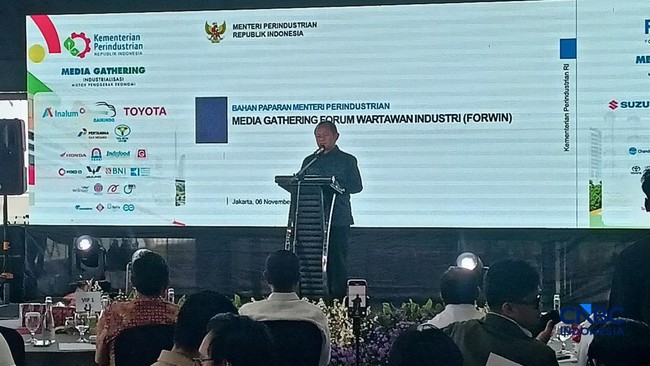
Bogor, CNBC Indonesia – The government says the challenges facing the national industry are not limited to production, investment or export performance. Public perceptions of the industry’s condition also need attention, particularly when claims emerge that Indonesia is undergoing deindustrialisation.
Industry Minister Sarmuji said strong performance in fact is not always matched by positive public perception. This can happen when the government’s work and developments in industry are not communicated effectively.
“Another very important performance measure is perception. These days, sometimes perception matters more than factual performance,” Sarmuji said at a media gathering hosted by the Industrial Journalists Forum (Forwin) in Sentul on Friday (6 November 2026).
He said public communication did not mean the government should cultivate an image or exaggerate its work. Rather, tangible achievements needed to be communicated so the public could gain an accurate picture of the situation.
He said claims of deindustrialisation should be examined more comprehensively, taking into account changes to statistical recording methods. A change in sector classifications by Statistics Indonesia (BPS) in 2010 meant that several subsectors previously recorded as part of manufacturing were subsequently classified as separate sectors.
As a result, comparisons of industry’s contribution to GDP over a long period may not be comparing like with like. Any statistical decline in the contribution should be read with these methodological changes in mind.
“An important fact that has not been presented or disclosed is that in 2010 BPS changed its recording method. It initially recorded just nine sectors, then changed to 17, and subsectors that used to be included in industry were separated into their own sectors. This made it appear as though industry’s contribution had fallen sharply since 2010,” Sarmuji said.
The government is also seeking to strengthen communication with industry associations and businesses to obtain first-hand accounts of problems on the ground. Journalists’ input is another source of information for identifying issues that need to be addressed.
The approach is considered important to ensure policies are not based solely on assumptions or statistical data. The government needs detailed information before deciding how to resolve problems facing industry.
“A doctor who analyses a case incorrectly and makes the wrong diagnosis can be dangerous. If a doctor does not explore what a patient is experiencing before making a diagnosis, we fear the medicine could be more harmful than the illness,” Sarmuji said.
Source: jawawa.id (https://jawawa.id/newsitem/industry-ministers-sharp-rebuke-examines-the-facts-behind-deindustrialisation-1793951429)
Originally published by CNBC Indonesia (https://www.cnbcindonesia.com/news/20261106123141-4-782940/sentilan-tegas-menperin-bongkar-fakta-di-balik-deindustrialisasi), translated from Indonesian