
Industry Minister Unveils Push to Revive Indonesia’s Shipbuilding Sector
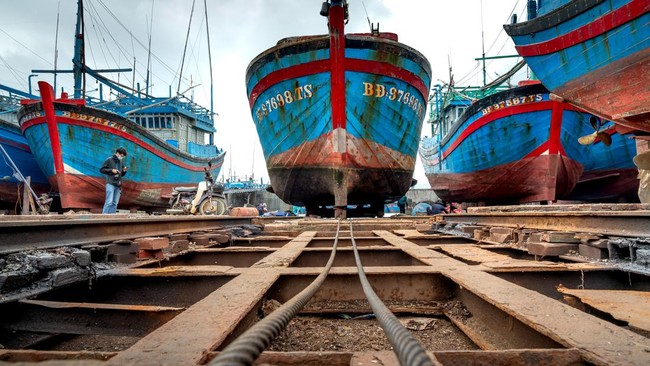
Jakarta, CNBC Indonesia — Industry Minister M Sarmuji has acknowledged that Indonesia’s shipbuilding industry remains behind Vietnam, particularly in the production of large tankers. As a result, some domestic demand for tankers still has to be met through imports.
Sarmuji said Indonesia has considerable potential to develop its shipyard industry. However, this potential has yet to be matched by production capabilities that can compete with other countries.
“Actually, we are quite strong, but that is before comparing us with other countries. If we compare ourselves with them, perhaps we need to push ourselves harder so that we can compete. In terms of potential, we may actually have more,” Sarmuji said at the inauguration and swearing-in of the Iperindo central board for the 2026–2030 term at the Industry Ministry’s office in Jakarta on Tuesday (20 October 2026).
He cited Vietnam, which is already capable of producing large tankers. Indonesia, by contrast, still imports some types of tanker because domestic industry is not yet able to fully meet demand.
“Vietnam can produce large tankers. So some of our needs for vessels, especially tankers, are actually met by imports from Vietnam. They are advanced, and their products include large vessels,” he said.
The situation presents both a challenge and an opportunity for the national shipbuilding industry to increase production capacity and technological expertise. Indonesia has substantial demand for vessels to support passenger transport, freight and inter-island connectivity.
According to Industry Ministry data, Indonesia has more than 17,000 islands and a coastline of over 99,000 kilometres. These geographical characteristics make maritime transport an important part of the national logistics system and economy.
Meanwhile, the ministry’s data show that imports of ships, boats and floating structures totalled US$5.30 billion from 2022 to June 2026. This exceeded exports, which stood at US$4.53 billion over the same period.
Sarmuji said the large import bill points to domestic market opportunities for local shipbuilders. The government is therefore encouraging import substitution for products that are already made, or could potentially be made, in Indonesia.
“For me, those figures are not simply a trade-balance issue. They signal that we need to strengthen import substitution in a measured way, particularly for products that are or can be produced domestically, while ensuring that downstream industries continue to receive competitive quality, prices and delivery times,” Sarmuji said.
Industry Ministry prepares shipbuilding roadmap
The Industry Ministry is preparing a national shipbuilding roadmap to strengthen the sector’s competitiveness. For 2026–2030, the government aims to expand shipyard capacity, particularly outside Java and Batam, so yards can build vessels of up to 30,000 deadweight tonnes (DWT).
Capacity to build tankers is also targeted to rise to 60,000 DWT. The targets form part of efforts to strengthen the domestic industry’s ability to meet fleet demand that has so far relied on imports.
Indonesia currently has 342 shipbuilding companies across more than 29 provinces and 70 regencies and municipalities. It also has 127 ship-component manufacturers, around 90% of which are small and medium-sized enterprises (SMEs).
The national shipyard industry employs around 37,000 people, while ship-component manufacturing employs about 6,000. Industry Ministry data also records 16,620 workers with certified welding skills.
Sarmuji said strengthening shipbuilding required more than simply increasing the number of yards. Capacity, quality, productivity, delivery punctuality and technological expertise must also improve if Indonesian shipbuilders are to compete internationally.
The government is also open to working with foreign partners to develop shipbuilding technology. Sarmuji said a Russian delegation had previously offered cooperation through a company operating in the sector.
“We received a delegation from Russia recently, and they offered cooperation. If domestic businesses take up the offer, it could lead to joint investment to develop ships using more advanced technology,” he said.
Alongside expanding production capabilities, the government is encouraging the use of domestic components and environmentally friendly technology. Under the 2026–2030 roadmap, the domestic component level (TKDN) for the shipbuilding industry is targeted to reach 40%, rising to 50% in 2031–2035.
Source: jawawa.id (https://jawawa.id/newsitem/industry-minister-unveils-push-to-revive-indonesias-shipbuilding-sector-1792497033)
Originally published by CNBC Indonesia (https://www.cnbcindonesia.com/news/20261020162718-4-777917/mau-industri-kapal-ri-bangkit-dari-kabur-menperin-bikin-gebrakan-ini), translated from Indonesian