
Industry Minister: SOEs must become builders of national capability
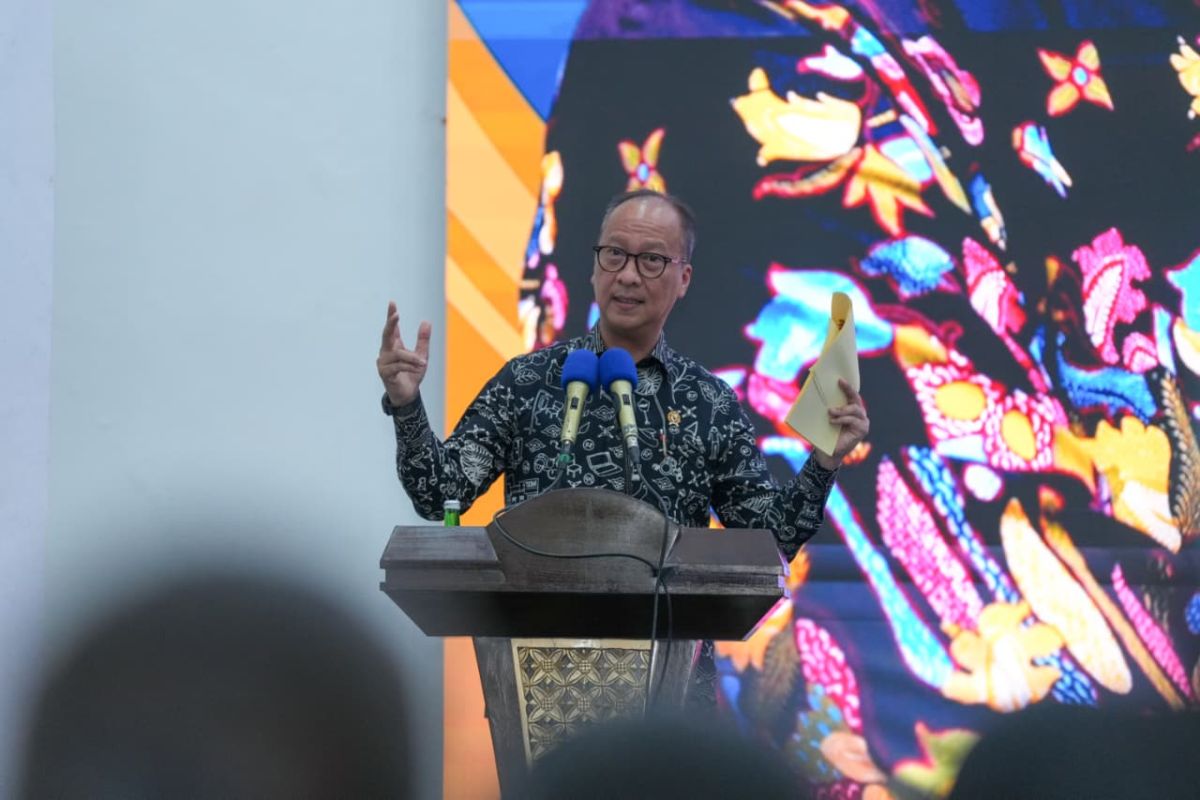
Industry Minister Agus Gumiwang Kartasasmita has said that in the context of industrialisation, state-owned enterprises (SOEs) must take on the role of capability builders, rather than merely acting as asset owners or project implementers.
In a statement confirmed in Jakarta on Thursday, the minister said this should be achieved by strengthening value chains, accelerating downstream processing, opening markets, bringing small and medium industries into supply chains, and building technology and talent.
Agus made the remarks while providing instruction at the Presidential Programme for Future Leaders (P3MD) for SOE Employees Batch 1 of 2026 at the TNI Doctrine, Education and Training Development Command in Serpong, Tangerang, on Wednesday (19/8).
On that occasion, the minister emphasised the importance of SOE leadership quality in facing increasingly rapid and uncertain global change.
He said President Prabowo Subianto has a strong commitment to substantively improving SOE governance through the development of reliable and patriotic human resources.
He assessed that the P3MD programme is an out-of-the-box breakthrough demonstrating the government’s commitment to strengthening SOE leadership capacity.
According to Agus, prospective SOE leaders must be able to read change and ensure that the businesses they manage remain relevant in the long term.
He said this is becoming increasingly important amid geopolitical and geoeconomic dynamics that can alter the competitive landscape, supply chains, technology, and corporate business models.
“When you return to your respective companies, there is a fundamental question that must be answered. Will our company’s business still be relevant five or ten years from now? This question must be a primary concern because the world is changing ever faster and uncertainty is rising,” the minister said.
Agus stressed that the size of assets, number of employees, capital strength, and past corporate success do not automatically guarantee future business continuity.
Many large companies have lost their positions because they were late in reading change, clung to old assumptions for too long, and were slow to transform.
“In a rapidly changing world, size is not security. A company’s size is no guarantee of safety. Likewise, past success is not a guarantee of future relevance,” he asserted.
He explained that SOEs hold a strategic position in the national economy because they control various important sectors, from infrastructure, energy, financing, logistics, minerals, telecommunications, and construction to food.
Therefore, the quality of SOE leadership not only determines the future of the companies but also influences the direction of national economic development.
According to Agus, the challenges facing companies today are increasingly complex. Changes in energy prices, geopolitical conflicts, global supply chain disruptions, interest rate changes, exchange rate fluctuations, the development of artificial intelligence technology, and the energy transition can alter business structures rapidly.
In addition, companies must also adapt to various global regulations related to emissions, traceability, sustainability, labour standards, anti-bribery, cybersecurity, and data protection, which have now become important factors in securing markets, financing, and international partners.
Furthermore, the minister said industrialisation is not merely about building production capacity, but rather a process of structural transformation to increase productivity, create added value, expand employment, and improve public welfare.
He stressed that downstream processing of natural resources must be the starting point for building value-added industries domestically. Indonesia must not stop at being a supplier of raw materials or merely a market for other countries’ products.
He noted that the fundamentals of national industry are currently showing positive performance. In the second quarter of 2026, non-oil and gas processing industry grew by 5.32 percent, higher than the national economic growth of 5.29 percent.
The sector contributed 16.83 percent to national GDP, or approximately Rp1,102.88 trillion.
In terms of investment, realised investment in non-oil and gas processing industry reached Rp199.48 trillion, contributing 38.89 percent of total national investment. Meanwhile, employment in the sector reached 19.99 million people as of February 2026.
From January to June 2026, exports of non-oil and gas processing industry reached 115.50 billion US dollars, contributing 82.03 percent of total national exports.
In addition, the Industrial Confidence Index (IKI) for July 2026 stood at 53.1, and Indonesia’s Manufacturing PMI returned to expansionary territory at 50.2.
In terms of Manufacturing Value Added (MVA), Indonesia’s MVA in 2025 reached approximately 275.61 billion US dollars, placing Indonesia 12th in the world and the largest in Southeast Asia.
According to Agus, these achievements show that the manufacturing sector remains one of the backbones of the national economy.
Source: jawawa.id (https://jawawa.id/newsitem/industry-minister-soes-must-become-builders-of-national-capability-1787208881)
Originally published by Antara (Indonesian) (https://www.antaranews.com/berita/5703011/menperin-bumn-harus-jadi-pembangun-kapabilitas-nasional), translated from Indonesian