
Industry Minister Sarmuji Contacts Amran’s Office Over Broken Rice: Here’s the Issue
Jakarta, CNBC Indonesia — Industry Minister M Sarmuji said he had coordinated with the Ministry of Agriculture about industry’s need for broken rice as a raw material.
He made the remarks after meeting Adhi S Lukman, chairman of the Indonesian Food and Beverage Producers Association (GAPMMI). Sarmuji was accompanied by Putu Juli Ardika, acting director-general of agro industry at the Ministry of Industry.
Sarmuji said GAPMMI had raised several issues affecting the processed food and beverage industry, including raw-material requirements and the need to build a supportive ecosystem. The Ministry of Industry, he said, would provide the necessary support to make national industry more competitive.
“Food and beverage companies are actually quite strong on competitiveness. The sector is growing well, and we export to many countries. But they do have concerns, including about raw materials,” Sarmuji said after the meeting.
“For example, imported broken rice costs around Rp5,700, or at most Rp6,000. But the price of domestic production is set at around Rp11,000, which is a considerable difference,” he added.
He said food processors that use broken rice as an input would struggle because local supplies were much more expensive.
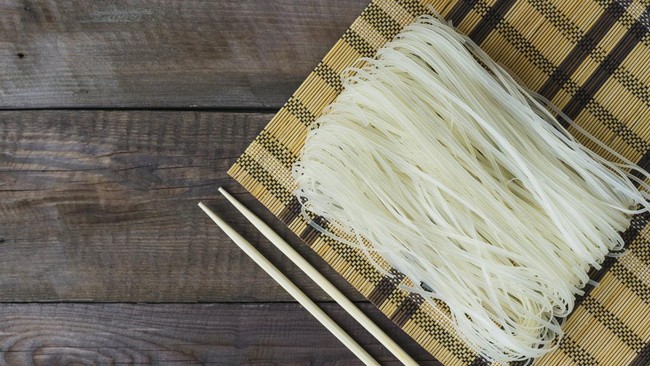
“At Rp11,000, our industries cannot compete. Vermicelli manufacturers and others cannot be competitive,” he said.
“We are looking for a solution. Bulog has a great deal of rice in stock. If it is left for too long, its value will decline and could even approach zero,” he added.
Sarmuji proposed matching industry demand with domestic raw-material supplies, including rice held by Bulog.
“There needs to be a solution for handling this rice. Our industries could take old, broken rice from Bulog’s warehouses, but the price would have to come down to a level they can tolerate. We need to find a way to do that,” Sarmuji said.
“I have coordinated with the Ministry of Agriculture,” he added.
The government still records imports of certain types of rice, including broken rice, for industrial use. Statistics Indonesia (BPS) data show that rice imports totalled 40,700 tonnes in October 2025.
Cumulatively, rice imports from January to October 2025 reached 364,300 tonnes, worth US$178.5 million, or Rp2.97 trillion. All of these imports were speciality and industrial rice, not medium-grade rice for general consumption.
Moch Arief Cahyono, head of the Ministry of Agriculture’s Bureau of Communications and Public Information, said most imported rice was 100 per cent broken rice, or rice grits (HS 1006.40.90), used as an industrial raw material.
Imported sugar, salt and meat
Adhi said the availability of raw materials was key to improving competitiveness and ensuring manufacturers could produce goods at affordable prices for consumers.
“Conditions are very difficult at the moment. We hope food and beverage companies can produce more affordable products while remaining competitive in global markets. The minister gave examples involving other ministries, including the Ministry of Agriculture, the Coordinating Ministry for Food Affairs and the Ministry of Trade, on raw materials and related issues,” he said.
“Some of our member companies have reported raw-material shortages. We found that there were stocks without contracts, or stocks whose contracts had expired. The director-general of agro industry will coordinate this so that supplies are sufficient through the end of 2026. But we have asked for commodity-balance approvals for early 2027 to be expedited, because stocks have run out — for sugar, salt and meat,” Adhi said.
Source: jawawa.id (https://jawawa.id/newsitem/industry-minister-sarmuji-contacts-amrans-office-over-broken-rice-heres-the-issue-1791975020)
Originally published by CNBC Indonesia (https://www.cnbcindonesia.com/news/20261014154710-4-776177/menperin-sarmuji-kontak-kantor-amran-soal-beras-pecah-ini-masalahnya), translated from Indonesian