
Industry Minister Reveals the Skills Companies and Factories Are Now Seeking
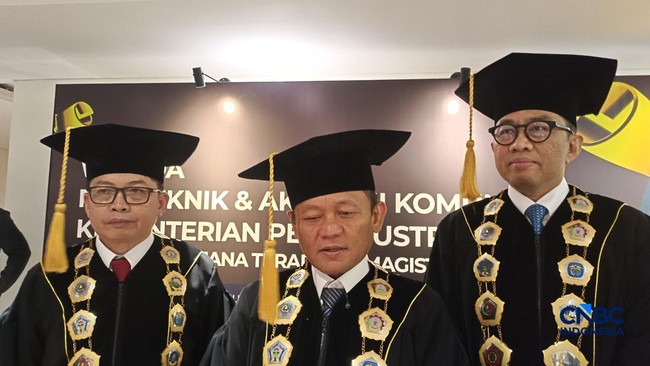
Jakarta, CNBC Indonesia — Industry Minister M Sarmuji is relying on stronger human resources through vocational education to improve the competitiveness of Indonesia’s manufacturing industry. The move is considered important to ensure Indonesian workers can keep pace with technological developments and meet the increasingly complex needs of industry.
Sarmuji said national industrialisation could not rely solely on building factories and increasing production capacity. Industrial investment must be accompanied by a workforce capable of operating and developing technology.
“Investment and factory construction must be matched by workers’ ability to operate, manage, repair and develop the technology being used,” Sarmuji said at the joint graduation ceremony for 13 polytechnics and community academies under the Industry Ministry, at the Jakarta International Convention Center (JICC) on Thursday (12 November 2026).
He said the skills required differed across industrial sectors. Mineral-processing industries need expertise in process control and occupational safety, while battery and electric-vehicle industries require skills in materials, automation, manufacturing and quality testing.
“Energy industries, meanwhile, need expertise in electrical systems, instrumentation, and operations and maintenance,” he added.
Sarmuji said vocational education therefore had to be an important part of the national industrialisation agenda. The Industry Ministry has 13 polytechnics and community academies designed to produce workers with skills aligned with the needs of businesses and industry.
“Vocational education at the Industry Ministry is a best practice for national vocational education because it is designed in line with the needs of businesses and industry. Through 13 polytechnics and community academies specialising in various industrial sectors, we are preparing competent human resources who can adapt to technological developments,” he said.
He stressed that vocational graduates should not focus solely on finding jobs. They were also expected to make a tangible contribution to improving the quality and productivity of national industry.
“Industry Ministry vocational graduates should not merely fill vacancies; they must raise the standards of quality and productivity in Indonesian industry,” Sarmuji said.
Strengthening human resources was also important to capitalise on Indonesia’s demographic dividend. Sarmuji said there were around 66.75 million people aged 15 to 29, representing a significant asset for national industrialisation.
However, a large young population would not automatically be an advantage if its skills did not match industry requirements.
“This demographic dividend can only be harnessed if young people’s skills align with industry needs. Strengthening a competent, productive and adaptable workforce is therefore key to improving manufacturing competitiveness,” he said.
Sarmuji urged the directors and academic communities of the ministry’s polytechnics and community academies to continue improving education quality, including by strengthening institutions and teaching staff’s capabilities.
He said technology was developing rapidly, so vocational graduates needed to keep updating their skills, understand work processes, and master quality and safety standards.
Sarmuji also claimed that graduates of the ministry’s vocational education programmes had strong prospects of finding work relatively quickly.
At the ceremony, the ministry graduated 3,133 students from 13 polytechnics and community academies across Indonesia. A total of 1,578 graduates attended the ceremony in person at the JICC.
“Today we are graduating students from 13 polytechnics and community academies across Indonesia. There are 3,133 graduates in total, with 1,578 graduating here in this Plenary Hall,” he said.
He said some graduates had already found work in various industrial sectors. For those who had not yet secured jobs, Sarmuji expected the wait would not be long.
“Some may not yet have been employed, but hopefully they will be absorbed into industry soon. It usually takes less than a year because of that strong link and match,” Sarmuji said.
He added that graduates’ employment reflected the hard work of students and lecturers, as well as industry’s involvement in their education.
Source: jawawa.id (https://jawawa.id/newsitem/industry-minister-reveals-the-skills-companies-and-factories-are-now-seeking-1794477124)
Originally published by CNBC Indonesia (https://www.cnbcindonesia.com/news/20261112135747-4-784648/menperin-ungkap-syarat-pekerja-yang-kini-diincar-perusahaan-pabrik), translated from Indonesian