
Industry Minister Responds to Vape Ban Fatwa
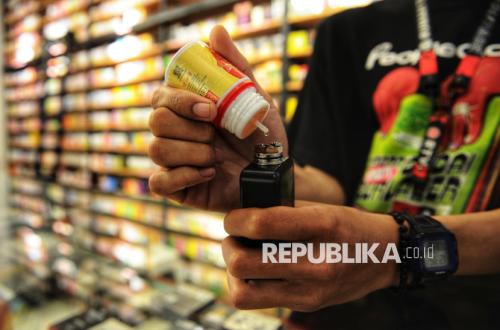
JAKARTA — The Indonesian Ulema Council (MUI) recently issued a fatwa declaring the use of electronic cigarettes, or vapes, haram. Responding to the ruling, Industry Minister Muhammad Sarmuji said he respected the decision and would seek to coordinate with relevant parties on follow-up measures.
“We respect it. People have different perspectives and considerations beyond the remit of the Ministry of Industry,” Industry Minister Muhammad Sarmuji told reporters on the sidelines of the launch of the BINA Made in Indonesia shopping initiative, held to mark Heroes’ Day at Grand Indonesia in Jakarta on Tuesday (10 November 2026).
Sarmuji indicated that the Ministry of Industry had no authority over the decision to prohibit vapes through a fatwa. However, he said the ministry would seek to coordinate with relevant parties.
“We can’t interfere. We’ll look into it and coordinate on what can be done, but the Ministry of Industry can’t issue a halal fatwa in response to a haram fatwa,” he said.
Sarmuji did not elaborate on the ruling’s potential impact on the tobacco or tobacco-products industry. Vapes are classified as Other Tobacco Products (HPTL) and are also associated with the electronic-cigarette liquid industry under Indonesia’s Standard Classification of Business Fields (KBLI).
The MUI Fatwa Commission recently issued Fatwa No. 131 of 2026 on the law governing the use of electronic cigarettes (REL), or vapes. The commission said the prohibition applies not only to their use but to the entire chain, from production to trade.
The decision was signed in Jakarta on 6 November 2026 by MUI Fatwa Chair Professor KH Asrorun Niam Sholeh and Deputy Secretary-General for Fatwa Dr KH Aminuddin Yaqub. It was also acknowledged by MUI Chairman KH Anwar Iskandar and Secretary-General Buya Amirsyah Tambunan.
Asrorun Niam Sholeh outlined the reasoning behind the fatwa, saying that vaping causes tangible harm to society in terms of both health and social impact.
“Using electronic cigarettes (REL), or vapes, is haram because it endangers health, damages the environment, and, as a preventive measure (sadd al-dhari’ah), to ensure they are not used as a means of distributing or consuming narcotics, psychotropic substances and other addictive substances,” Niam said, quoting the first point of the fatwa’s legal ruling, as reported on the MUI’s official website in Jakarta on Monday (9 November 2026).
The fatwa describes an electronic cigarette as a battery-powered device that heats substances containing nicotine, glycerine and flavourings to produce inhalable vapour. The MUI highlighted that nicotine is addictive and can have serious adverse effects on the nervous system and overall health.
The prohibition extends beyond consumers to business activities and misuse. The second and third points of the ruling explicitly state that using vapes to consume narcotics, psychotropic substances or other addictive substances is haram.
The production and/or sale of electronic cigarettes (REL), or vapes, is also declared categorically haram. “Misusing electronic cigarettes (REL), or vapes, to consume narcotics, psychotropic substances and other addictive substances is haram. Producing and/or trading electronic cigarettes (REL), or vapes, is haram,” Niam said, quoting the second and third points of the fatwa.
With the issuance of MUI Fatwa No. 131 of 2026, Niam said he hoped the public, particularly business operators and young people, would understand and comply with Islamic law, in order to protect physical health and the environment and guard against the dangers of narcotics and other addictive substances.
Source: jawawa.id (https://jawawa.id/newsitem/industry-minister-responds-to-vape-ban-fatwa-1794318645)
Originally published by Republika (https://ekonomi.republika.co.id/berita/toadqv423/menperin-buka-suara-soal-vape-haram), translated from Indonesian