
Industry Minister Highlights Challenges Facing Food and Beverage Sector
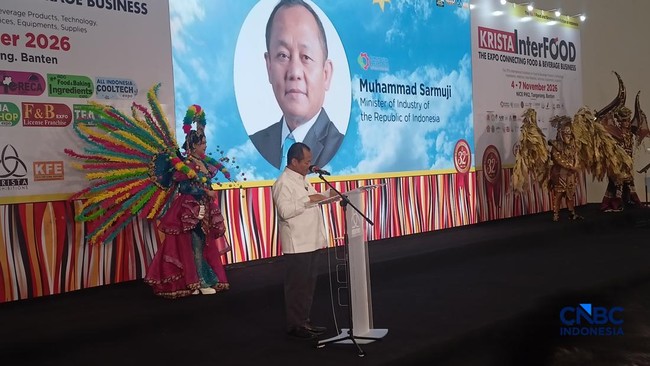
Jakarta, CNBC Indonesia – Indonesia’s food and beverage industry still has work to do to increase its contribution to the economy. Although it has recorded positive growth and investment, the government says existing production capacity needs to be used more effectively. Strengthening supply chains is also a priority so that the industry does not rely solely on sales of finished products.
Industry Minister M Sarmuji said increasing industrial capacity utilisation was one of the goals that needed to be pursued. By making greater use of available production capacity, the food and beverage industry is expected to contribute more to the national economy.
“Utilisation in the food and beverage subsector must also continue to be boosted so that more of the available capacity can be used, increasing the industry’s contribution to the economy, particularly in food and beverages,” Sarmuji said at the Krista Food Expo 2026 at PIK 2026 on Wednesday (4 November 2026).
In addition to utilisation, the food and beverage industry needs to improve productivity and innovation, make greater use of local raw materials, increase value added and expand market access. These steps are considered important so that industrial growth is reflected not only in higher production, but also in the ability to produce more competitive goods.
Sarmuji explained that the food and beverage supply chain is extensive, running from upstream sectors that supply agricultural, plantation and fisheries raw materials to downstream sectors that produce finished goods. In between is the processing industry, which converts raw materials into intermediate products.
“This is where much of the value added comes from. Intermediate products enable food businesses to play a broader role in the value chain—not only selling finished goods to consumers, but also supplying the needs of other businesses and industries,” he said.
He said strengthening the intermediate-products industry was important because a single type of raw material could be processed into a range of derivative products. These processed goods could then be used as inputs for subsequent production, generating greater value added.
With this strategy, food and beverage businesses would not have to rely solely on the consumer market. They would also have opportunities to supply processed raw materials to other businesses and industries, both within the food ecosystem and in related sectors.
However, developing these supply chains still presents challenges. Industry must be able to process goods consistently and efficiently, while meeting market specifications and requirements. Strengthening production capacity in the intermediate segment is one area that needs attention.
“There are challenges in the intermediate links of production that need to be addressed. It is not enough simply to produce goods; businesses must also build the capacity to process them consistently and efficiently, in line with market needs,” Sarmuji said.
Source: jawawa.id (https://jawawa.id/newsitem/industry-minister-highlights-challenges-facing-food-and-beverage-sector-1793782257)
Originally published by CNBC Indonesia (https://www.cnbcindonesia.com/news/20261104134030-4-782253/menperin-soroti-pr-industri-makanan-minuman-belum-memuaskan), translated from Indonesian