
Industry Minister aims to make Indonesia a global manufacturing hub through workforce development
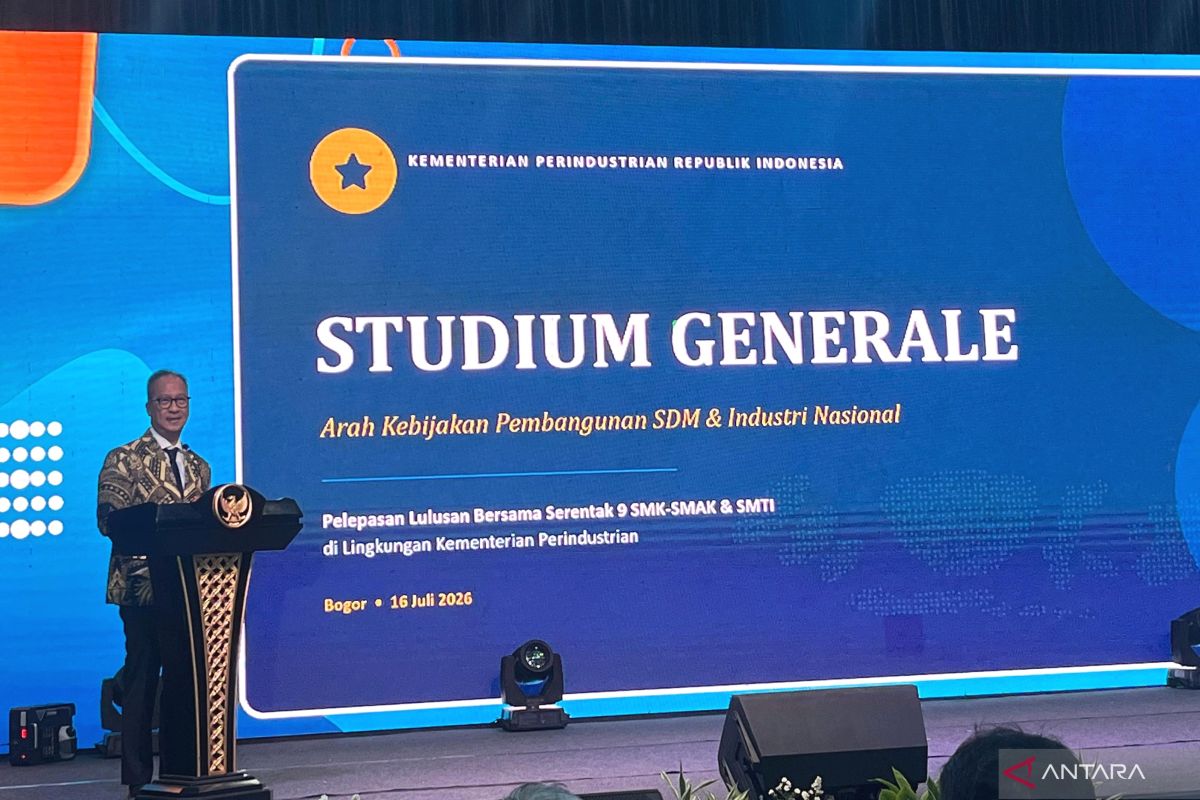
Industry Minister Agus Gumiwang Kartasasmita is striving to make Indonesia a global manufacturing hub by strengthening superior, competent, and work-ready industrial human resources. “By 2045, we want Indonesia to supply the world, we want Indonesia to become the centre of global manufacturing,” Minister Agus said during the ‘Graduation Ceremony for SMK-SMAK and SMTI Students and Studium Generale’ in Bogor, West Java, on Thursday. The Minister further asserted that industrial vocational education is a strategic investment to prepare skilled workers who will be the main drivers of national industrial transformation.
According to data from Statistics Indonesia (BPS), in the first quarter of 2026, the processing industry grew by 5.04 percent, contributing 19.07 percent to the national GDP, absorbing more than 20 million workers, and contributing around 82 percent to national exports. “This means the industrial sector is not a weakening field, but one that continues to grow and requires new, competent workers. The hands of these graduates will become an important part of Indonesia’s industrial future,” the Minister stated.
The event, themed ‘Together Creating Superior, Globally Competitive and Sustainable Industrial Human Resources’, marked the graduation of 2,369 students from nine vocational schools under the Ministry of Industry in 2026. The nine schools are spread across various regions of Indonesia with diverse specialisations, ranging from industrial chemistry, machinery, and industrial automation to mechatronics, tailored to the characteristics and needs of the manufacturing sector in each area. The Minister conveyed that national industrial development aligns with President Prabowo Subianto’s vision to strengthen domestic industrialisation and downstream processing. Therefore, the existence of competent industrial human resources is a key factor for the success of this transformation.
“There is no downstream processing without laboratories, and no laboratories without analysts. No factory runs without skilled technicians. The great ambition to make Indonesia a global manufacturing hub is not realised in meeting rooms, but at laboratory benches and on production floors. This is where the graduates of SMK-SMAK and SMTI will play an important role,” he stressed. The Minister also reminded the graduates to uphold integrity and professionalism when entering the workforce. “Competence must be accompanied by honesty and integrity. The work of an analyst or technician will be trusted because it is carried out with full responsibility. Maintaining integrity means safeguarding the quality of Indonesian products, protecting consumers, and simultaneously strengthening the competitiveness of national industry in the global market,” he added.
Head of the Industrial Human Resources Development Agency (BPSDMI) at the Ministry of Industry, Doddy Rahadi, stated that the quality of graduates from the Ministry’s vocational schools has received recognition from the industrial world. “As of July 2026, a total of 1,483 people, or 63.70 percent of the 2,369 graduates, have been absorbed into various industrial companies. This achievement shows that the competence of Ministry of Industry vocational school graduates meets the needs of the business and industrial world,” Doddy said. According to him, BPSDMI will continue to assist graduates who are still in the job-seeking process. “For graduates still in the recruitment process, BPSDMI together with the vocational schools will provide assistance for the next three months for job searching. Furthermore, if they are still not absorbed within six months, a specific competency strengthening programme or internship facilitation will be provided to accelerate job placement,” Doddy explained. In addition to having a high job absorption rate, Doddy noted that the Ministry’s vocational schools are also increasingly in demand by the public. In the 2026 academic year, the ratio of applicants to capacity reached 1:12.2, an increase from the previous year’s 1:10.7. Doddy stressed that this high level of public interest motivates BPSDMI to continue maintaining the quality of industrial vocational education.