
Industrial Estates Eye Data Centre and Manufacturing Expansion for Second-Half Investment Boost
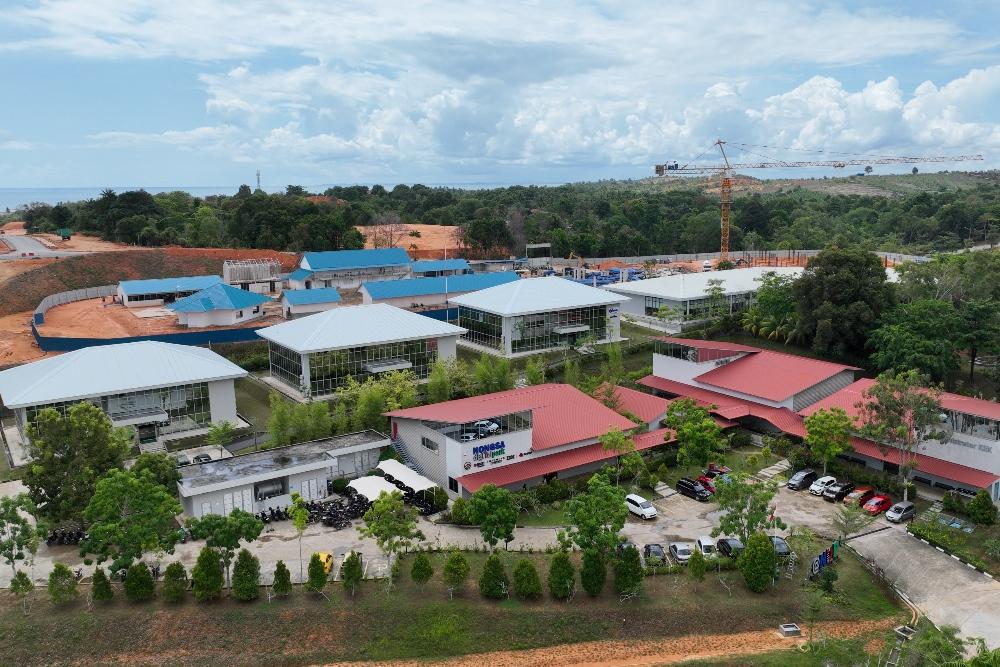
The expansion of manufacturing corporations and the development of data centre technology are expected to trigger a hunt for industrial land in the second half of 2026. This condition is projected to be the main catalyst that will re-ignite investment value in the industrial property sector towards the end of the year.
The Indonesian Industrial Estates Association (HKI) has confirmed that the portion of land absorption is now shifting with the arrival of hyperscale data centre investors. HKI Chairman Akhmad Ma’ruf Muhammad stated that there is an increasing demand trend for land for this technology-intensive sector. This is because the data centre industry requires rigid and extensive land localisation to maintain data sovereignty and regional connectivity transmission efficiency.
“Land demand [in the second half of 2026] will be largely supported by the data centre sector,” he explained on Tuesday (14/7/2026).
At the same time, land demand for the manufacturing sector also remains high. The flow of investment entering Indonesia recently has been recorded as quite significant. Referring to data from the Ministry of Investment and Downstreaming/Investment Coordinating Board (BKPM), investment realisation reached Rp498.8 trillion in the first half of 2026, equivalent to 24.4% of the 2026 target set at Rp2,041.3 trillion. This means there is still a large investment space of Rp1,542 trillion to be pursued for entry into Indonesia this year.
Along with this, HKI projects that demand for industrial plots in several main corridors of Java will experience a significant escalation in the near future. Therefore, there will be a number of new industrial estate developments to answer the need for industrial land. “Expansion will occur in the Riau Islands, Tanjung Pinang, Batam. Meanwhile, in the Java corridor, there are East Java, Gresik, Sidoarjo, West Java, Central Java and new developments in Madura,” he added.
To facilitate the expansion of industrial estate development, HKI also considers the ratification of the Industrial Estate Bill as a concrete step to overcome investment barriers in the manufacturing sector. Previously, Akhmad explained that investment realisation has been hampered by regional licensing bureaucracy and unresolved land limitations. “That is why industrial estates now urgently need the Industrial Estate Bill. We urge that this bill be accelerated, so that it is clean this year,” he said.
He assessed that the success of attracting global investors will be determined by the speed of licensing services at both the central and regional government levels. “This is a classic problem. From year to year, from regime to regime, this is always the problem. Now the condition is getting worse. That is why we need a task force to accelerate investment,” he concluded.
Property consultancy Colliers Indonesia predicts that the industrial estate area in Semarang will become one of the most competitive along the northern corridor of Java. Colliers Indonesia Senior Associate Director Ferry Salanto explained that the area’s investment appeal is no longer solely based on cheap land prices or competitive minimum wage costs. Instead, the Greater Semarang region is beginning to transform by offering mature infrastructure and a high-quality operational ecosystem. “We see that Semarang can now offer a quality industrial ecosystem. So if we look at it, developers there are not just selling land, but are also starting to be concerned with operational certainty for investors,” said Ferry.
He added that the priorities of investors in determining their production bases have now shifted. Global manufacturing investors are now placing more emphasis on guarantees of supporting facility reliability to mitigate business disruption risks. This condition has encouraged industrial estate developers in the Semarang corridor to compete in maturing utilities within the estates, from strengthening drainage systems and ensuring energy supply, to integrating logistics networks.
The spread of industrial growth points in the Greater Semarang area is now increasingly expanding to buffer zones. This expansion covers the western corridor, such as Kendal and Batang regencies, to the eastern side leading to Demak Regency. The presence of two Special Economic Zones (KEK) in the corridor has also become a strong catalyst that boosts the region’s investment competitiveness. The KEK status provides various fiscal and non-fiscal incentives that are highly sought after by large-scale industry players. In addition, the ease of logistics connectivity through the integration of the Trans-Java toll road network and direct access to seaports complements the region’s advantages. This is believed to continue attracting high value-added manufacturing industries and global digital infrastructure to Semarang.
Amidst the significant potential for investment activity in the industrial estate development sector, the government is reportedly preparing the formation of a National Industrial Estate Council (DKIN). The DKIN will later be tasked with cutting through the barriers that have been complained about by industrial estate developers. Based on records, the Director General of Resilience, Regionalisation, and International Industrial Access at the Ministry of Industry, Tri Supondy, stated that industrial estate development requires stronger coordination among ministries and agencies because it involves various aspects ranging from development planning, spatial planning, energy, to infrastructure.