
Indosolar 2026 Drives Strengthening of National Solar Energy Ecosystem
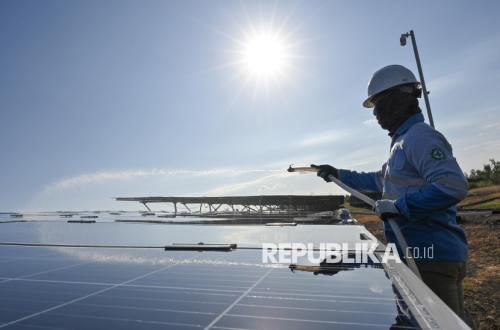
The development of solar energy in Indonesia has entered a phase requiring broader support, not only in terms of policy but also investment, financing, technology, industry, and human resources. The Indonesian Solar Energy Association (AESI) discussed these challenges at Indosolar 2026, held on 19-20 August 2026 in Jakarta.
Indosolar 2026 carried the theme ‘Building the Future of Indonesia’s Solar Energy’ and was held in conjunction with Indonesia Sustainable Energy Week (ISEW) 2026. One of the agendas discussed was the opportunity for quick wins in solar energy development of up to 10 gigawatts (GW) by 2028.
AESI Chairwoman Mada Ayu Habsari said the renewable energy development targets in the 2025-2034 Electricity Supply Business Plan (RUPTL) need to be matched by ecosystem readiness. According to her, the large market potential must be translated into projects that are ready for financing and can be built immediately.
‘With an increasingly connected ecosystem, we can encourage more bankable projects and accelerate the implementation of solar energy in Indonesia,’ Mada said on Tuesday (18/8/2026).
Indosolar 2026 therefore discussed a number of issues directly related to the development of the solar industry. The discussions covered the national solar energy acceleration roadmap, opportunities for rooftop and floating solar PV development, and the use of microgrids and hybrid systems to support de-dieselisation in areas not yet reached by the electricity grid.
From an industry perspective, the forum highlighted strengthening the supply chain and competitiveness of the national solar industry. Independent power producer (IPP) procurement schemes, cross-border solar electricity trading, and investment opportunities were also part of the discussions.
Solar energy development is also beginning to intersect with the electricity needs of the industrial sector and the digital economy, including through rooftop solar PV in industrial estates and the use of solar energy to support green data centres.
Atiek Puspa Fadhilah, Private Sector Cooperation Lead for the GIZ Indonesia & ASEAN Energy Programme, said clean energy development requires close cooperation between the government and market players.
‘The energy transition requires strong relationships between policymakers, investors, technology providers, and industry players,’ she said.
The meeting was not limited to discussions. Indosolar 2026 also brought together developers, engineering, procurement and construction (EPC) companies, consultants, banks, insurance companies, technology providers, and investors through an exhibition and business collaboration hub.
Workforce readiness was also a concern for AESI. The growth of the solar industry requires personnel with technical skills to install, maintain, and manage solar PV systems.
To that end, Indosolar 2026 partnered with JA Solar, Xingtai Polytechnic Institute of New Energy, and ATW Solar in a training programme and Youth Solar Policy Competition.
Meanwhile, Sacha Winzenried, Energy, Utilities & Resources and Energy Transition Leader at PwC Indonesia, assessed that Indonesia has a great opportunity to accelerate solar energy development. However, this opportunity needs to be supported by funding, bankable projects, regulatory certainty, and cooperation among industry players.
‘Ecosystem readiness is needed, from the availability of funding, bankable projects, and regulatory certainty to close collaboration between the government, investors, and industry players,’ Sacha said.
Indosolar 2026 also featured a Global Insight session with PwC, the International Renewable Energy Agency (IRENA), and the Asian Photovoltaic Industry Association (APVIA). The forum discussed global solar market developments, investment, technology cost trends, and solar energy development experiences in other countries.
AESI will bring the results of the Indosolar 2026 discussions to IndoEBTKE ConEx. A number of inputs prepared include strengthening the domestic supply chain, IPP procurement schemes, rooftop solar PV development, and the need for skilled workers.
With strengthening on various fronts, AESI believes solar energy development should be directed not only at increasing generation capacity but also at building an industry and ecosystem capable of supporting its long-term growth.
Source: jawawa.id (https://jawawa.id/newsitem/indosolar-2026-drives-strengthening-of-national-solar-energy-ecosystem-1787053993)
Originally published by Republika (https://esgnow.republika.co.id/berita/tjymvl416/indosolar-2026-dorong-penguatan-ekosistem-energi-surya-nasional), translated from Indonesian