
Indonesia's Trade Balance Slips into Deficit, Rupiah Under Threat
Indonesia’s trade balance recorded a deficit of US$1.61 billion in May 2026, marking the first monthly shortfall in 72 months. The reversal was driven by an 8.30% month-to-month and 5.73% year-on-year contraction in exports.
In a note released on Friday (3/7/2026), PT Bank Central Asia Tbk. economists Jennifer Calysta Farrell and Victor George assessed that the export decline was partly driven by crude palm oil, which fell 26.85% month-to-month. “This was caused by several factors such as weather impacts, rising fertiliser prices (reducing usage and thus affecting productivity), and slowing demand from major countries like India, China, and America,” they wrote.
Looking ahead, BCA sees exports facing a number of headwinds. Firstly, a more hawkish policy stance from the Federal Reserve and other central banks could slow global demand. Secondly, the mandatory B50 biodiesel programme may impact the allocation of CPO for export, in addition to ongoing weather factors. Thirdly, policy certainty regarding production and export restrictions on commodities such as coal and nickel. Fourthly, the effect of the presence of Danantara Sumberdaya Indonesia (PT DSI), which may influence the trade balance in June.
On the other hand, BCA assesses that the rise in imports could continue, with high government spending able to offset the impact of currency depreciation on demand. “The combination of these factors creates a feedback loop leading to a weakening of the rupiah, which we expect will be addressed by an additional 50 bps increase in the BI policy rate this year,” the economists stated.
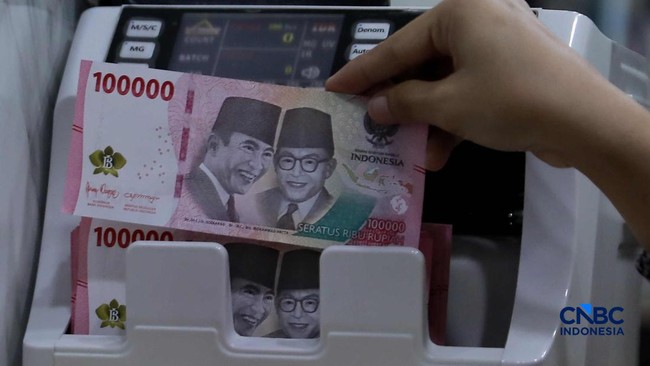
The rupiah managed to start trading ahead of the weekend with a strengthening against the US dollar. Referring to Refinitiv data, the Garuda currency at the opening of trading on Friday (3/7/2026) strengthened 0.27% to a level of Rp17,940/US.Thisstrengtheningreversedtherupiah′spositionatthepreviousclose.OnThursday(2/7/2026), therupiahcloseddown0.32. Meanwhile, the US dollar index (DXY), which measures the greenback against six major world currencies, was observed weakening 0.05% to 100.803 as of 09.00 WIB.
Trimegah Sekuritas Indonesia Chief Economist Fakhrul Fulvian assessed that the ongoing rupiah weakening should be seen as part of the financial market adjustment process, rather than a reflection of deteriorating economic fundamentals. He said Indonesia has now entered a stabilisation phase following various monetary policy adjustments and liquidity management by Bank Indonesia.
“I think we are starting to see positive signals. Foreign investors have returned to the government bond market in recent times. This shows that the market is beginning to appreciate the change in policy direction undertaken by the authorities, especially in liquidity management and efforts to restore healthier price formation mechanisms in the bond market,” Fakhrul explained.
He explained that the exchange rate stabilisation process does not happen instantly. In current conditions, the bond market is the most decisive factor for the rupiah’s direction because it is the main entry point for foreign portfolio capital flows. “The rupiah is essentially waiting for larger capital inflows. To generate sustainable capital inflows, the Indonesian bond market needs to offer sufficiently attractive yields compared to the still-high global risks. Foreign investors are indeed starting to buy Indonesian bonds again, but I think the process is still in its early stages.”
Fakhrul further stated that coordination between Bank Indonesia and the Ministry of Finance is crucial at this phase. Both institutions need to provide room for the formation of bond yields that reflect market conditions so that Indonesia regains competitiveness compared to other emerging market countries.
“Consistency is a very important factor. When Bank Indonesia has tightened liquidity and the market has begun to adjust, the process needs to be maintained until completion. If there is policy inconsistency that restrains the rise in yields prematurely, the process of foreign investor entry could be delayed again and the results of rupiah stabilisation will be suboptimal.”
He added that Indonesia has now moved from a phase of pressure towards a phase of stabilisation. However, this stabilisation still requires one important stage, namely an increase in foreign capital flows into the government bond market to strengthen the balance in the foreign exchange market. “What is needed now is not additional intervention, but policy consistency. When the market sees that the normalisation process is truly being carried out consistently by Bank Indonesia and the Ministry of Finance, investor confidence will increase, capital inflows will grow larger, and the rupiah will gain a much stronger foundation.”
According to Fakhrul, during this process exchange rate volatility will still be influenced by global developments, especially expectations regarding Federal Reserve policy. However, from the domestic side, the foundation for stabilisation is beginning to form and the downside for the rupiah is considered much more limited compared to several months ago. “I think the next challenge is no longer stopping the pressure on the rupiah, but building investor confidence that the bond market normalisation process will be carried out consistently until Indonesia once again becomes one of the main destinations for portfolio investment in the region. When capital inflows strengthen again, the rupiah will gain much stronger support and the stabilisation process will become more sustainable,” he concluded.