
Indonesia’s Rubber Industry in Crisis: Plantations Shrink, Production Plummets and Exports Take a Beating
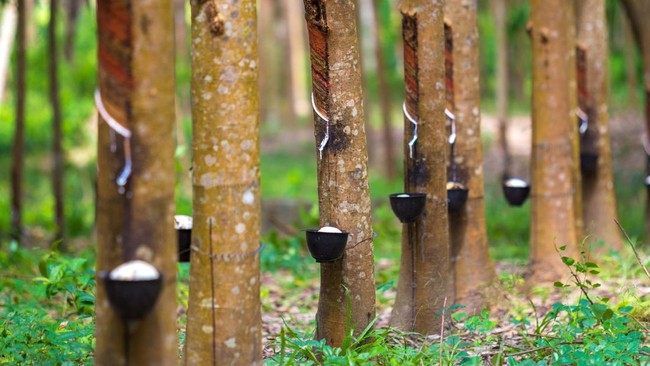
Indonesia’s former prominence as a major rubber exporter is fading. Production is falling, dozens of processing plants have closed, and farmers are switching to oil palm.
Data from the Indonesian Rubber Farmers Association (Apkarindo) show that national rubber production has declined, as have exports. In January-July 2026, natural rubber export volumes were just 85.4% of the level recorded in the same period a year earlier, while export value stood at 87.5%.
Supartijo, head of Apkarindo’s South Sumatra regional board, said ageing rubber plantations meant that higher prices did not automatically translate into higher farmer incomes. Many farmers were consequently switching to oil palm.
Apkarindo is urging the establishment of a Rubber Plantation Fund Management Agency (BPDP Karet) to support plantation replanting, research and the development of downstream industries.
Supartijo warned that without government intervention, the national rubber industry risked having no future.
“If this is allowed to continue for another 10 years, rubber will be nothing but a name. Everything will close. Every day, rubber trees are being felled, their wood sold and the land replanted with oil palm,” Supartijo said at a public hearing with Commission IV of the House of Representatives at the parliamentary complex in Jakarta on Tuesday (6 October 2026).
In rubber statistics, natural rubber refers to the commodity produced from rubber trees and used as a raw material for various industrial products.
The Central Statistics Agency (BPS), meanwhile, records production as dried natural rubber. BPS explains that plantation-crop production is reported in the form of processed products, with rubber recorded as dry rubber.
Crumb rubber is one form of natural rubber that has undergone processing. BPS classifies crumb-rubber manufacturing as the processing of rubber into crumb rubber, which is then used as a raw material by various downstream industries, including tyre and vehicle-component makers.
Indonesia’s rubber plantations remain extensive, but are slowly shrinking
BPS data show that Indonesia still has a substantial area of rubber plantations. In 2025, the national area totalled 3,129,436 hectares, down from 3,676,036 hectares in 2019 — a decrease of around 14.9%.
However, the decline in planted area does not capture the full extent of the pressure facing Indonesia’s rubber industry.
Smallholders account for the largest share of the area. In 2025, smallholder plantations covered 2,856,356 hectares, or around 91.3% of the national total.
State-owned plantations accounted for just 117,509 hectares, while privately owned large-scale plantations covered 155,571 hectares.
Smallholder rubber plantations shrank from 3,269,078 hectares in 2019 to 2,856,356 hectares in 2025, a decrease of around 12.6%.
The dominance of smallholders means the condition of farmers’ plantations is crucial to the future of national rubber production. But the problem goes beyond the area of land under cultivation.
Rubber production continues to come under pressure
BPS reports rubber production as dry rubber, the processed output of the commodity.
National production reached 3.30 million tonnes in 2019, fell to 3.04 million tonnes in 2020, and then remained relatively stable at 3.05 million tonnes in 2021.
Production subsequently weakened to 2.72 million tonnes in 2022 and continued falling, reaching 2.04 million tonnes in 2025.
This represents a decline of around 38.2% in national rubber production since 2019, far steeper than the 14.9% contraction in planted area. This indicates that Indonesia’s rubber-sector problems are not limited to shrinking plantations: plantation productivity is also falling.
The pressure is most pronounced among smallholders.
Smallholder rubber production stood at 2.93 million tonnes in 2019, fell to 2.78 million tonnes in 2020, and edged up to 2.83 million tonnes in 2021. It then declined again to 2.51 million tonnes in 2022, 2.05 million tonnes in 2023, 1.94 million tonnes in 2024 and 1.87 million tonnes in 2025.
The figures are consistent with findings from Apkarindo. Supartijo said only around 300,000-400,000 hectares currently maintained high productivity.
He said many rubber trees were old, received insufficient fertiliser and were being tapped excessively, a practice known as overtapping.
The tapping profession is also increasingly being abandoned because workers consider the income unattractive.
“Rubber tappers who work as labourers no longer want to do the job because they cannot earn Rp100,000 a day; they get only Rp50,000-Rp60,000,” he said.
Rubber exports are also under pressure
The pressure on production is reflected in trade.
BPS data show that Indonesia exported 2.44 million tonnes of dry rubber in 2012, with exports peaking at 2.99 million tonnes in 2017.
The trend has generally weakened since then.
Exports fell to 2.28 million tonnes in 2020. After a brief rise to 2.33 million tonnes in 2021, they declined to 2.04 million tonnes in 2022, 1.75 million tonnes in 2023, 1.62 million tonnes in 2024 and 1.57 million tonnes in 2025.
Compared with 2017, dry-rubber export volumes in 2025 were down around 47.7%.
In less than a decade, the volume of dry rubber exported from Indonesia has therefore almost halved.
Crumb-rubber exports have also faced long-term pressure, with volumes in 2025 down around 47.6% from 2017.
Apkarindo said that of the 157 crumb-rubber processing plants recorded as at 30 September 2026, 60 had ceased operations and only 97 remained open.
In South Sumatra, one of Indonesia’s main rubber-producing regions, Supartijo said the number of operating factories had fallen from around 30 to 19.
Some of those factories, he added, were unable to operate at full capacity because of a shortage of raw materials.
Source: jawawa.id (https://jawawa.id/newsitem/indonesias-rubber-industry-in-crisis-plantations-shrink-production-plummets-and-exports-take-a-beating-1792054241)
Originally published by CNBC Indonesia (https://www.cnbcindonesia.com/research/20261007160216-128-774155/karet-ri-sekarat-kebun-menyusut-produksi-ambles-ekspor-babak-belur), translated from Indonesian