
Indonesia's Rice and Paddy Production Suddenly Declines, What is the Cause?
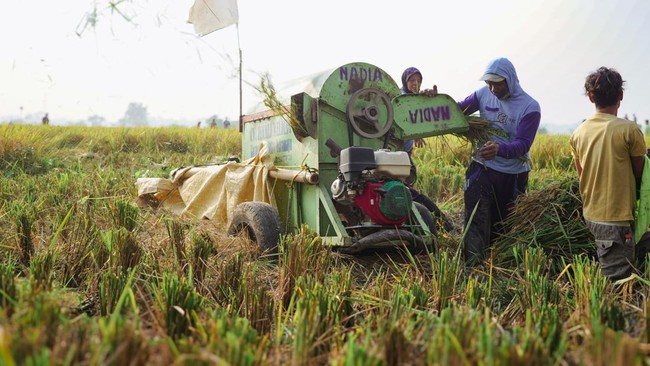
Jakarta, CNBC Indonesia - Statistics Indonesia (BPS) has recorded that national rice production from January to July 2026 reached 21.95 million tonnes, a 0.35% decrease compared to the same period in 2025. Meanwhile, rice production from May to July reached 7.92 million tonnes, representing a 1.16% decline.
In detail, BPS noted that paddy production (milled dry grain/GKG) for January-July 202le is estimated to reach 38.11 million tonnes, down 0.34% from the same period last year. “Paddy production in April 2026 was 7.63 million tonnes of milled dry grain, a decrease of 16.03% compared to April 2025, which stood at 9.09 million tonnes,” stated Pudji Ismartini, Deputy for Methodology and Statistical Information, during a press conference at the BPS Office in Jakarta on Tuesday (2/6/2026).
BPS also estimates that potential paddy production for May-July 2026 will only reach 13.75 million tonnes of GKG, a decrease of 0.16 million tonnes, or 1.14% compared to the same period in 2025. Consequently, cumulative production from January to July 2026 is expected to reach 38.11 million tonnes of GKG, a decline of 0.13 million tonnes or 0.34% year-on-year.
This decline in paddy production is closely linked to dynamics in harvested areas. In April 2026, the harvested area was recorded at 1.40 million hectares, a 15.47% drop from 1.65 million hectares in April 2025. For the following period, BPS expects a slight decrease, with potential harvest areas for May to July 2026 estimated at 2.69 million hectares, a 0.65% decline. However, cumulatively, the January-July 2026 harvest area is expected to reach 7.20 million hectares, a slight annual increase of 0.02%.
“These potential figures are subject to change depending on the conditions of rice cultivation throughout May to July 2026, such as pest attacks, floods, droughts, and the timing of harvests by farmers,” she explained.
Pudji explained that the planting area conditions are reflected in the Area Sampling Frame (KSA) results for April 2026. The majority of the land is still in the ‘standing crop’ phase, meaning the rice is currently growing. Specifically, 34.85% of the land is in the standing crop phase, 22.90% is being planted, 17.37% has been harvested, 12.45% is left fallow, and 12.27% is in land preparation. Of the standing crops, 20.25% have entered the generative phase and are nearing harvest.
BPS also provided insights into rainfall conditions for April 2026. Based on BMKG analysis, rainfall in most parts of Indonesia fell into the medium to high category, which influences rice cultivation across various regions.
According to the mapping of potential harvest locations for May-July 2026, the majority of the potential harvest is concentrated in Java (West Java, Central Java, East Java, and Banten), Sumatra (Lampung, South Sumatra, North Sumatra, West Sumatra, and Aceh), Sulawesi (South Sulawesi), Kalimantan (South Kalimantan), and Nusa Tenggara (West Nusa Tenggara and East Nusa Tenggara). At the regency/city level, significant potential harvest areas include Indramayu, Karawang, Subang, Cianjur, Sukabumi, and Cirebon in West Java; Pati, Sragen, Blora, Demak, Grobogan, and Kebumen in Central Java; Bojonegoro and Lamongan in East Java; Pandeglang and Lebak in Banten; and Banyuasin and East Lampung in Sumatra.