
Indonesia’s Religious Affairs Minister Urges Religious Diplomacy to Become Concrete Action for Peace
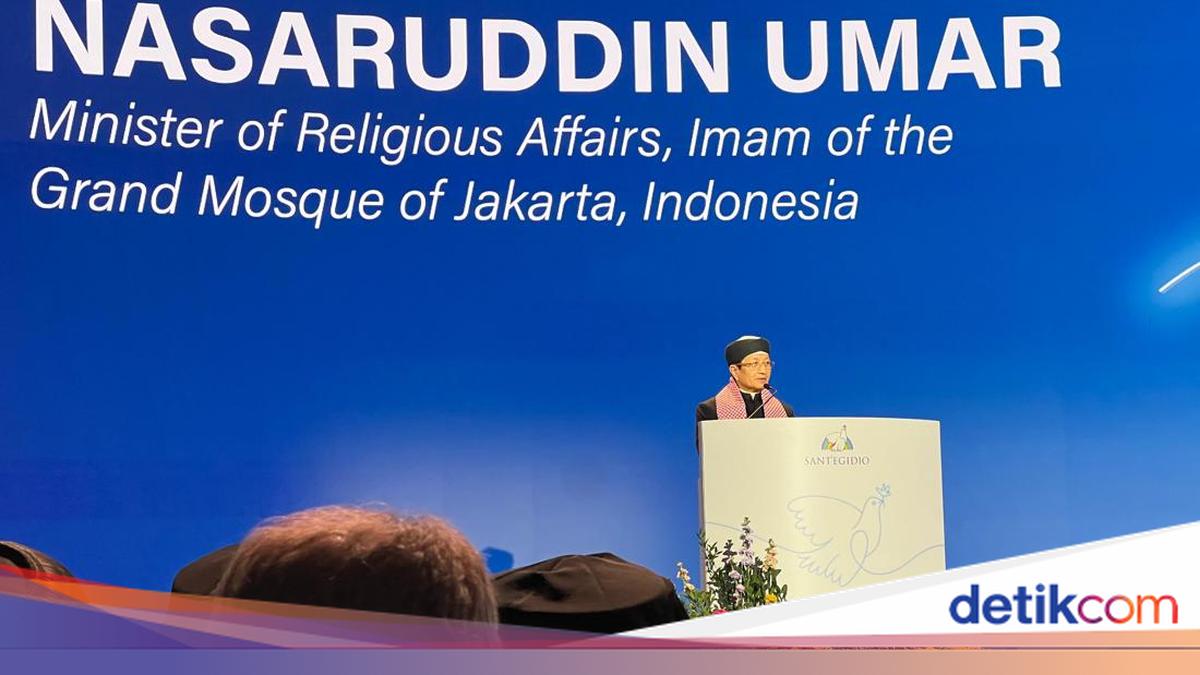
Indonesia’s Religious Affairs Minister Nasaruddin Umar has urged religious leaders around the world to translate interfaith dialogue into concrete action that has a direct impact on communities. The proposal received support from several international religious figures at the Sant’Egidio International Meeting for Peace in Assisi, Italy.
Nasaruddin, who is also the Grand Imam of Istiqlal Mosque, put forward the idea at the high-level opening session, titled “Opening Assembly – Unarmed and Disarming Peace”, on Tuesday (27 October). He said religious diplomacy needed to go beyond symbolic statements and be put into practice through concrete humanitarian work.
“Interfaith dialogue must not stop at formal joint declarations, signatures or agreements on paper. True peace requires dialogue to be actively transformed into practical action and environmental conservation movements that directly ease the burden on people at grassroots level,” Nasaruddin said, according to the official website of Indonesia’s Ministry of Religious Affairs on Tuesday (27 October 2026).
As well as stressing the importance of practical action, Nasaruddin urged world leaders to make religious values an important part of international diplomacy. He said a spiritual approach could help ease deep-rooted hostilities when conventional political and military channels reach an impasse.
To support his argument, Nasaruddin outlined Indonesia’s experience of applying pluralism and social harmony to manage diversity and maintain peaceful relations in society. This experience also forms part of Indonesia’s efforts to promote religious moderation, or Islamic Wasatiyyah, and harmony across borders.
The proposal for diplomacy focused on humanitarian action was supported by several religious leaders attending the international meeting. They highlighted the importance of reducing hostility and strengthening interfaith cooperation.
In response, Cardinal Matteo Zuppi, president of the Italian Episcopal Conference, backed the need to move away from rigid, aggressive and conflict-driven ways of thinking. He also stressed that religious institutions should play an active role in easing cross-border hostilities and upholding human dignity.
In a similar vein, France’s Chief Rabbi, Haïm Korsia, emphasised the need to move beyond ceremonial activities in peacebuilding. He said cooperation between religious leaders on humanitarian projects at local level could build a stronger foundation for peace than political agreements alone.
Support for an approach centred on harmony also came from Eastern Orthodox and ecumenical Christian delegates, who welcomed Indonesia’s model of pluralism. They cited the 2024 Istiqlal Declaration, signed in Jakarta by Nasaruddin and Pope Francis, as an example of how theological differences need not lead to conflict.
The meeting concluded with panellists pledging to carry forward the spirit of Assisi 1986 through practical steps in international diplomacy. Their commitment focuses on humanitarian action, environmental conservation and efforts to achieve lasting world peace.