
Indonesia’s Profitable ‘Miracle Insect’ Under Threat: Here’s Why
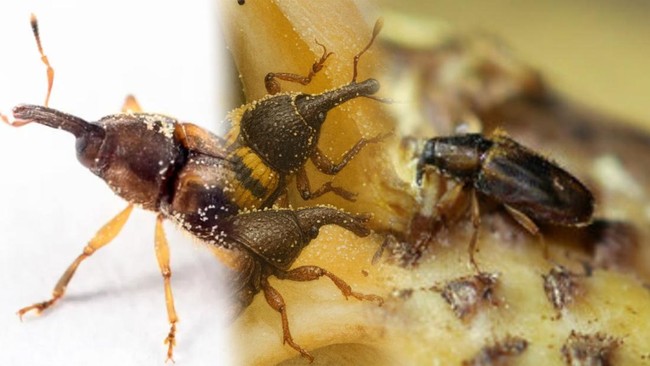
Jakarta, CNBC Indonesia – Thick haze from forest and land fires does more than affect people’s breathing. According to a Bloomberg report, smoke blocking sunlight is now threatening a small insect that underpins global palm-oil production. Disruption to the insect could reduce fruit formation by up to 20% and diminish global supplies of vegetable oil.
The beetle is Elaeidobius kamerunicus, a tiny insect from West Africa that is now the main pollinator of oil palms in Indonesia. Before it arrived, Indonesian oil-palm plantations relied on natural pollination by wind and several local insects, which were not very effective. Farmers had to pollinate flowers manually by applying pollen themselves, a process that required considerable time, labour and expense.
The beetle was deliberately introduced to Indonesian oil-palm plantations in the 1980s. The move transformed the industry: fruit formation rose sharply without the need for manual pollination, labour costs fell dramatically and productivity per hectare surged, helping make Indonesia the world’s largest palm-oil supplier.
Today, almost all oil-palm plantations in Indonesia depend on the beetle. Without it, fruit bunches become sparse, individual fruits grow smaller and harvests fall sharply.
The beetle’s life cycle revolves around oil-palm flowers. Male flowers emit a distinctive scent that attracts the insects, which gather and shelter among the petals. When they move to female flowers, pollen clinging to their bodies is transferred to the stigma, enabling fertilisation.
The beetle’s activity is strongly affected by sunlight and air temperature. It flies most actively in warm, sunny conditions. When thick smoke covers the sky, sunlight diminishes and temperatures fall, making the beetles less active. Pollination is then incomplete: many flowers remain unfertilised, the fruit that develops is small, and some fruit drops before ripening.
According to Bloomberg, disruption caused by smoke can reduce fruit formation by up to 20%. Such a decline would have far-reaching effects: global vegetable-oil prices could rise, farmers’ incomes could fall and processing supply chains could be disrupted. Of particular concern, fires and the resulting haze are becoming more frequent and lasting longer, coinciding with critical periods in flower development on plantations.
According to Andalas University, when beetle populations are optimal—around five to 10 individuals per male flower stalk—the fruit set, or the proportion of productive fruit in a bunch, can reach 80–90%. One study found that a population of 24,185 E. kamerunicus on male flowers per hectare produced a fruit set of 82.18%.
The beetle’s effectiveness as a pollinator is highly specialised and cannot be replicated by artificial technology. Its timing is precise: it is active when female flowers are fully open, usually between 7am and 11am, carrying viable pollen freshly collected from male flowers that bloomed that same day.
It also visits flowers frequently. A single beetle can visit dozens of female flowers a day. At the ideal population density, each female flower is visited repeatedly, helping ensure that no stigma is missed. The beetle does not damage the plant’s reproductive tissue either. Unlike pests, E. kamerunicus consumes only excess pollen and does not feed on the ovaries or structures of female flowers.
Finally, after more than 40 years in Indonesia, the beetle has adapted fully to the wet tropical climate, including heavy rainfall and fluctuating humidity. Its population can recover quickly after the dry season, provided male flowers are available as a food source and breeding habitat.