
Indonesia's Plastic Imports Reach Rp 46.3 Trillion: Which Countries Are the Suppliers?
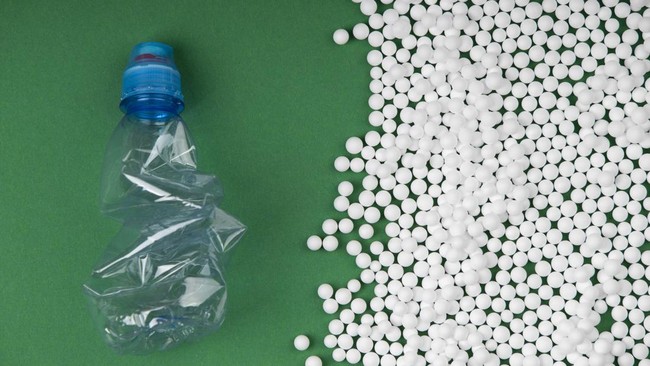
Plastics are inseparable from daily life. They appear in forms that are hard to notice, from thin layers on food packaging and clothing fibres to vehicle components. Their traces can be tracked through a single code, HS 39, which encompasses the entire plastics chain from raw materials to finished goods.
According to data from the Ministry of Trade’s satudata, imports of plastics and articles thereof reached US$2.72 billion in 2025, equivalent to approximately Rp 46.32 trillion (US$1 = Rp 17,030). This figure is lower than 2024’s US$2.79 billion. Over the past five years, the trend has declined by 1.62%, with an annual contraction of 2.36% in 2025.
Its share of total national imports is around 1%, a small figure on paper but one that supports many industrial sectors.
In the first two months of 2026, the import value reached US$444.9 million, up 1.22% from the same period the previous year. The movement is starting to reverse direction, albeit on a limited scale.
From Oil to Pellets: How Plastics Are Born
All plastics originate from the earth’s depths. Crude oil and natural gas are extracted to the surface and then enter the refining stage.
In the refinery, oil is heated until it separates into light fractions. One crucial fraction is naphtha, the main raw material for the petrochemical industry.
Naphtha is then broken down into small molecules such as ethylene and propylene. This is where polymerisation takes place.
These small molecules are assembled into long polymer chains through two main pathways: addition and condensation. The result is resin in the form of small granules.
These granules enter the next stage: mixing and moulding.
The resin is melted, mixed with additives, and then formed into products ranging from bottles and pipes to textile fibres. This entire cycle forms the foundation of the global plastics industry.
Polypropylene (PP) - HS 3902
Import value reached US$913.6 million in 2025, down nearly 20% from the previous year. The main supplies come from China, Thailand, and Malaysia. PP is widely used for rigid packaging and automotive components—two sectors sensitive to consumption and manufacturing cycles.
Polyethylene (PE) - HS 3901
Divided into two main types:
LDPE recorded imports of US$433.6 million, down 28.27%
HDPE at US$508.6 million, down 16.88%
Both serve as basic materials for plastic bags, bottles, and food containers. The sharp decline indicates a slowdown in domestic demand, particularly from mass consumption sectors.
Polystyrene (PS) - HS 3903
Imports of US$31.51 million, contracted by 30.82%. PS is commonly used for foam packaging (EPS). This figure typically moves in line with logistics and e-commerce activity.
Unlike commodity polymers, engineering plastics groups have specific roles in manufacturing industries.
Polyamide (PA / Nylon) - HS 3908
Imports reached US$162.3 million, down 25.68%. Used in textile fibres and vehicle components. The decline reflects pressure on the textile and automotive industries.
Polyurethane (PU) - HS 3909.50
Import value of US$202.7 million, nearly stagnant with a slight increase of 0.29%. PU appears in forms such as foam, coatings, and insulation materials. The stability of this figure indicates relatively sustained demand.
Polyvinyl Chloride (PVC) - HS 3904
Moving in the opposite direction. Imports of US$111.7 million, surging 49.39%. PVC is widely used for pipes and construction. This spike is often linked to infrastructure projects.
Polyester (PES) - HS 3907
Imports of US$31.34 million, down 8.09%. Used in textiles and coatings. Its movement follows the garment industry.
The decline in most basic polymers signals weakening consumption and mass production of goods. Meanwhile, the rise in PVC indicates ongoing construction activity. Stable PU supports the higher-value-added industrial side.
Although the import trend is declining, dependence on foreign raw materials remains unchanged. Polymers like PP and PE still dominate, while domestic capacity has not fully met needs.
On the other hand, the small shift at the start of 2026 opens up new readings. The slight increase hints at recovering demand, though it is too early to conclude the direction, it is enough to mark a change in rhythm.
CNBC Indonesia Research
Source: jawawa.id (https://jawawa.id/newsitem/indonesias-plastic-imports-reach-rp-46-3-trillion-which-countries-are-the-suppliers-1775634683)
Originally published by CNBC Indonesia (https://www.cnbcindonesia.com/research/20260406115504-128-724138/impor-plastik-ri-tembus-rp-463-triliun-siapa-negara-pemasoknya), translated from Indonesian