
Indonesia's Oil Production Still Below Target, Here Are the Triggers
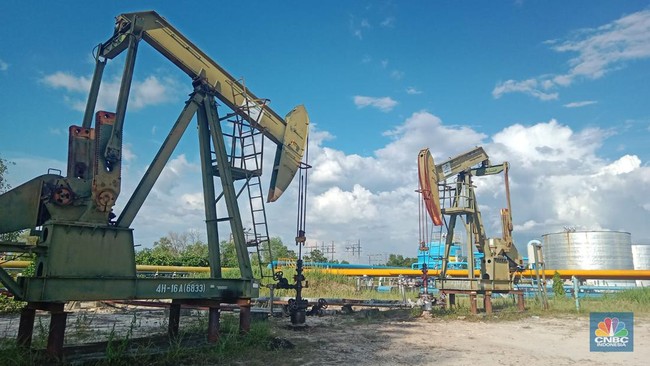
Jakarta - The Ministry of Energy and Mineral Resources (ESDM) and the Special Task Force for Upstream Oil and Gas Business Activities (SKK Migas) have revealed a number of factors causing national oil production to remain below 600,000 barrels per day (bpd).
Director General of Oil and Gas at ESDM Laode Sulaeman said the average national oil production up to 31 July 2026 was recorded at 578,156 bpd. Therefore, his office is still trying to pursue the oil and gas production targets set for this year.
“Up to 31 July, the average oil production is at 578,156 bpd. Likewise with the realisation of natural gas production. Both are still being pursued to achieve the production target in 2026,” Laode said during a hearing with Commission XII of the Indonesian House of Representatives (DPR RI), quoted on Thursday (27/8/2026).
As is known, the Ministry of ESDM is targeting Indonesia’s ready-to-sell oil production, or oil lifting, to reach 610,000 barrels per day in 2026.
According to Laode, the decline in production has been influenced by a number of operational disruptions since the beginning of the year. One of them occurred at the Rokan Block due to a pipeline leak belonging to PT Transportasi Gas Indonesia (TGI), which disrupted gas supply to the field and affected production activities.
Not only that, production at the Rokan Block also faced constraints in the electrical system. His office and the operator are still working to repair the MCTN power plant so that it can return to optimal operation.
Apart from the Rokan Block, another factor came from the Cepu Block, which experienced a fairly extreme natural decline in production in 2026.
Laode said his office has held discussions with the operator to take a number of steps to curb the rate of production decline. Currently, efforts are focused on maintaining Cepu Block production so that it remains flat and does not decline further.
“We have held a series of discussions with field operators and working area operators, and steps have been taken to reduce this natural decline so that the current condition in the field is to keep it flat. So don’t let it fall again, that is what we are doing with the Cepu field,” he said.
At the same occasion, Head of SKK Migas Djoko Siswanto added that the TGI pipeline disruption also had a significant impact on national oil production. According to him, the pipeline leak occurred twice in January 2026 and caused disruption to gas supply to oil and gas fields.
Besides the TGI pipeline disruption, Djoko said ExxonMobil’s production also declined. The company’s production, which in the previous year reached around 151,000 bpd, is now in the range of 124,000 bpd.
Meanwhile, Pertamina Hulu Rokan (PHR) production in the previous year was around 151,000 bpd. This year, its production target is set at 163,000 bpd, but realisation is only around 133,000 bpd.
“In addition, 270 rigs were stopped by Pertamina, with the largest operations at PHR. Then there was also a shutdown at BP that has not yet returned to 100% until today. At Pertamina Subang, there was also a pipeline fire,” he added.
Source: jawawa.id (https://jawawa.id/newsitem/indonesias-oil-production-still-below-target-here-are-the-triggers-1787799105)
Originally published by CNBC Indonesia (https://www.cnbcindonesia.com/news/20260827081955-4-762583/produksi-minyak-ri-masih-di-bawah-target-ternyata-ini-pemicunya), translated from Indonesian