
Indonesia’s Nuclear Journey from Agriculture to Healthcare, Now Moving Towards Nuclear Power
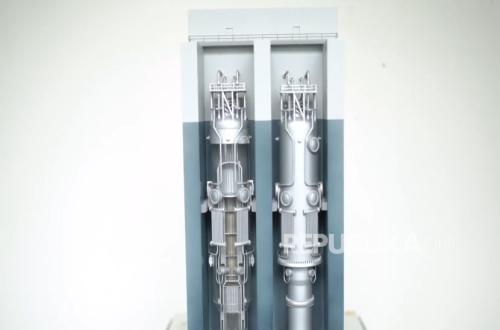
BANTEN – Indonesia is continuing to strengthen the foundations for developing nuclear power plants (PLTNs) as a source of electricity to meet long-term demand and support the energy transition towards Net Zero Emissions (NZE) by 2060.
This policy direction has been reinforced by Government Regulation No. 40 of 2025 on the National Energy Policy (KEN). The regulation promotes the development of new energy sources, including nuclear power, and sets out requirements for safety, security, safeguards, a reliable supply of nuclear materials and waste management.
Syaiful Bakhri, head of the Nuclear Power Research Organisation at the National Research and Innovation Agency (BRIN), said that at least 19 infrastructure elements must be prepared for nuclear power development, including technology, human resources, sites and funding.
“For us at BRIN, I think Indonesia is actually ready in terms of these various components. We already have sites and human resources; we are not short of them,” Syaiful said at a focus group discussion titled ‘A Close Look at the Energy of the Future’ on Thursday (8 October 2026).
On technology, Syaiful said Indonesia did not need to wait for new developments before beginning construction of a nuclear power plant. A range of commercially available reactor technologies could be considered, particularly large nuclear reactors.
Under the long-term energy policy framework, nuclear power is expected to make an increasingly significant contribution. The government projects nuclear capacity of about 35–42 gigawatts (GW) by 2060, accounting for around 11.7–12.1 per cent of the primary energy mix.
As an initial step, the first commercial nuclear power plant is targeted to start operating in 2032, with a capacity of 250 megawatts (MW), according to PLN’s 2025–2034 Electricity Supply Business Plan (RUPTL).
“We just need to choose, really. Many options are ready for us to order now, especially large reactors, rather than small modular reactors,” he said.
Syaiful linked the need for nuclear power to projections of tens of gigawatts in additional national generating capacity. If Indonesia requires an additional 7 GW, 35 GW or even 45 GW of nuclear capacity over the longer term, using commercially available reactor technology could speed up development.
BRIN has also identified 28 potential sites for nuclear development that could undergo further study.
Sripeni Inten Cahyani, a member of the National Energy Council (DEN), said Indonesia already had a sufficient foundation for developing nuclear energy. Several basic requirements, including resources, regulations and potential sites, were in place.
“Basically, all that is left is for the President to say, ‘Indonesia goes nuclear’, and then it is done. BRIN is ready,” Sripeni said.
She said the next challenge was to bring together the resources and institutions that have so far operated separately and turn them into a clear national programme.
Several regions are also under consideration for nuclear power development. Sripeni named West Kalimantan and the Bangka Belitung Islands as potential locations. Site selection, she said, must take account of local electricity demand, particularly the needs of industrial development.
“We already have the resources, but they have not been consolidated, and no decision has been made to mark the start. So we need a task force,” she said.
Small modular reactors (SMRs) are one option considered relevant for the initial phase. They could be considered to supply electricity to industrial areas or locations with substantial, specific power requirements.
Sripeni added that nuclear development must be linked to rising electricity demand. Future consumption, she said, would come not only from households but increasingly from industry, economic zones, data centres and artificial intelligence technologies.
Djarot S. Wisnubroto, chairman of the Indonesian Nuclear Society (HIMNI) and a former head of the National Nuclear Energy Agency (BATAN), said public acceptance of nuclear technology tended to come more easily when people could see its direct benefits.
In agriculture, he said, radiation technology could accelerate plant breeding, producing varieties with shorter growing cycles, stronger stems and higher yields.
“Crops that used to be harvested once a year can be harvested every few months. Plants that were tall and prone to lodging can be shorter and use less water; yields that were previously only five tonnes per hectare can reach nine tonnes,” Djarot said.
He stressed that using radiation in plant breeding did not make food unsafe to eat. The technology speeds up natural processes to produce desired plant characteristics.
“It is simply a natural process that has been accelerated. What normally uses sunlight instead uses radiation,” he said.
Djarot acknowledged that some members of the public still question the safety of agricultural products developed using nuclear technology. Public outreach is therefore needed to explain the process and its benefits.
One example is a product known as “nuclear rice” in Central Sulawesi. Djarot said it was already being marketed and had been well received. A technopark in the region has also supported the development of agricultural products using nuclear technology.
Yustia Tuti, chair of the Indonesian Nuclear Medicine Association (PKNTMI), said safety was also central to education about nuclear applications, particularly in medicine. Every form of radiation carries some risk, she said, but medical procedures use carefully calculated doses.
“Every form of radiation carries a risk, but it is very small,” Yustia said.
She added that concerns about nuclear medicine sometimes came from medical professionals as well as patients who remained worried about radiation effects. In her view, the side effects of treatment could generally be managed.
Nuclear applications already in use across various sectors show that the technology in Indonesia is not limited to plans for power plants: it is also part of healthcare services, food and agricultural development, and industrial activity.
Source: jawawa.id (https://jawawa.id/newsitem/indonesias-nuclear-journey-from-agriculture-to-healthcare-now-moving-towards-nuclear-power-1791539652)
Originally published by Republika (https://esgnow.republika.co.id/berita/tmmvg5522/jejak-nuklir-indonesia-dari-pertanian-hingga-kesehatan-kini-menuju-era-pltn), translated from Indonesian