
Indonesia’s Nickel Production Remains Excessive, Flooding the Global Market and Driving Prices Down
Jakarta, CNBC Indonesia — The government has acknowledged a global nickel oversupply of nearly 800,000 tonnes, attributed to Indonesia’s still-rampant production. The increase in Indonesian output has pushed global nickel prices below US$16,000 per tonne.
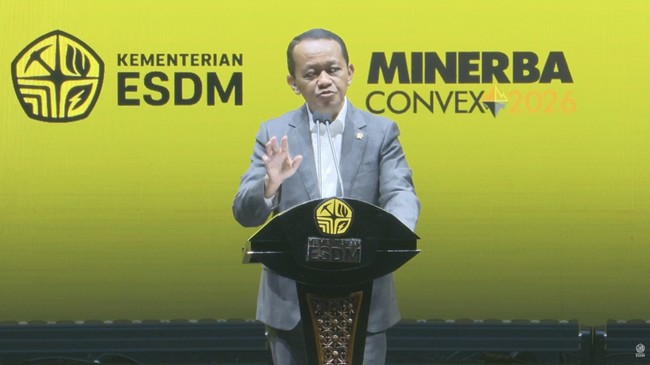
Bahlil Lahadalia, Coordinating Minister for Downstreaming and Energy Transition as well as Energy and Mineral Resources Minister, said global nickel demand currently stands at 3.5 million tonnes a year.
He said the fall in prices to around US$15,800 per tonne had been caused by an imbalance between high domestic production and the market’s capacity to absorb it.
“On nickel, ladies and gentlemen, the price is now below 16,000, at 15,800. Why has the price fallen? Because our production is excessive. Total global demand is only 3.5 million tonnes a year. There is now an oversupply of nearly 800,000 tonnes. How can prices be good?” Bahlil said at the 2026 Minerba Convention & Exhibition (Convex) at Jiexpo on Monday (2 November 2026).
The Energy and Mineral Resources Ministry said excessive nickel production without due consideration of the supply chain risked harming the national mining industry. If prices continue to fall, other countries could buy Indonesian semi-processed products cheaply, stockpile them and wait for prices to recover.
“So I ask those in industry and mining businesses to exercise restraint. If we produce too much, it is fortunate when prices are good; but if they are not, a particular country may stockpile these semi-finished goods at low prices, then wait for prices to rise and play the market,” he said.
To address the threat of oversupply, Bahlil instructed the Directorate General of Minerals and Coal to manage the balance between supply and demand. The government will adjust nickel production quota allocations by cutting back the Work Plan and Budget (RKAB) mechanism.
“So, Director General, in my view, use the RKAB to manage supply and demand in nickel. I will take responsibility for what is in the interests of the nation and state. Do not hesitate. I know there will be many protests,” he said.
Processed nickel production
The Indonesian Nickel Industry Forum (FINI) previously recorded domestic processed nickel output from downstreaming at 2.5 million tonnes in 2025. This made Indonesia the leading supplier, meeting as much as 60% of global nickel demand.
FINI chairman Arif Perdana Kusumah said total capacity at Indonesia’s nickel refining facilities reached 2.7 million tonnes of nickel in 2025. The output came from domestic pyrometallurgical and hydrometallurgical processing.
“In 2025, national nickel production reached 2.5 million tonnes of nickel in intermediate products, comprising 2.05 million tonnes of NPI, FeNi and matte products, and 450,000 tonnes of nickel in MHP and nickel sulphate,” Arif told CNBC Indonesia on Wednesday (14 October 2026).
FINI estimates that Indonesia’s processed nickel output will fall by 3.5% to 4% in 2026 compared with 2025. However, production is projected to rise again in 2027 as new projects add capacity.
“2027 will see additional production capacity from HPAL-based hydrometallurgical projects whose construction is due to be completed, with commissioning and full operations expected to follow shortly,” he said.
The additional HPAL capacity is focused on processing nickel feedstock for electric vehicle batteries. National MHP production capacity, which stood at 450,000 tonnes in 2025, is expected to exceed 900,000 tonnes of nickel by the end of 2027.
“Production at that level has made Indonesia the world’s largest nickel supplier, at around 60%,” he said.