
Indonesia's Nickel Exports Forecast to Drop by 5 Million Tonnes in 2026 Amid Regulatory Uncertainty
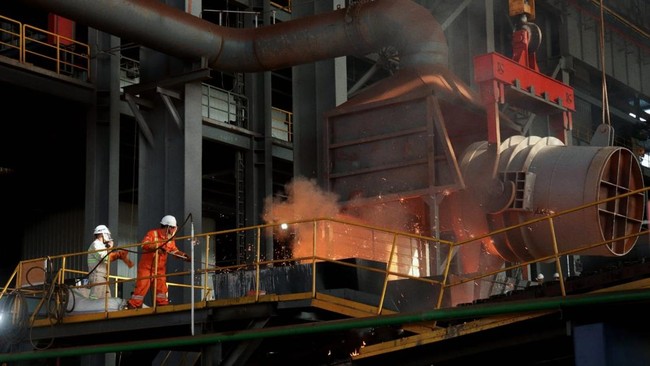
Jakarta, CNBC Indonesia - The Indonesian Chamber of Commerce and Industry (Kadin) estimates that 3.5 to 5 million tonnes of nickel exports could be lost throughout 2026. This is due to a lack of certainty over the Work Plan and Budget (RKAB), including for nickel commodities this year.
Indeed, the government is currently trying to reduce national nickel production this year, partly to manage global nickel prices so they do not continue to decline. This year, the Ministry of Energy and Mineral Resources (ESDM) has set a nickel production target of around 260 million tonnes.
Kadin Deputy Chairman for Membership Widiyanto Saputro said the data could be seen through a Strategic Response Meeting (SRM) involving various business players. Constraints on the schedule, quota, and duration of the RKAB are the main obstacles for mining entrepreneurs throughout 2026.
“At the Kadin SRM, the business community has already warned that RKAB certainty, as a priority of our SRM, has projected a lost in action of 3.5 to 5 million tonnes of nickel exports that will disappear, from a 0.3 to 0.5% decline. Well, this has apparently happened,” he explained at the HIPMI Grand Seminar in Jakarta on Thursday (6/8/2026).
He explained that the reduction in the nickel ore quota in 2026, as well as the evaluation process for RKAB revisions which had still not been confirmed by the end of July, is considered to have triggered a decline in nickel production. This is also in line with data from Statistics Indonesia (BPS) which recorded a contraction of 1.56% in the mineral and coal mining industry.
“We see that what was discussed at the SRM is actually happening in the field, and the sequence is visible. So we believe that the input from our colleagues when we compiled it is also valid from all sectors, including those directly affected,” he said.
He asked the government to provide certainty in RKAB governance so that long-term business operations remain predictable for investors. According to him, improving the RKAB is important considering that nickel is a prime investment for downstreaming in eastern Indonesia, such as North Maluku and Central Sulawesi.
“The hope is certainly that we want improvements, and discussions are ongoing. Formally, we will wait for the government. We do not want to get ahead of ourselves either,” he added.
Thus, regulatory certainty is considered key so that the downstream supply chain from upstream to downstream remains integrated without any missing links.
“These certainties are a source of anxiety, a matter of thought and input. We have received so many policy proposals and we are voicing them to the government,” he concluded.
Minister of Energy and Mineral Resources (ESDM) Bahlil Lahadalia stressed that setting RKAB targets for mining companies must be done very carefully. This is to ensure that production volume remains balanced with market demand, so that commodity prices can be maintained properly.
According to Bahlil, in preparing the RKAB, the government considers the balance between supply and demand, both in domestic and international markets. The government’s main goal is not merely to increase production volume, but to ensure that mining commodities can be sold at high prices.
“I said that the preparation of this RKAB is carried out with great care, taking into account supply and demand. Actually, the goal is just one, friends: ideally we can mine in large quantities, but the price must also remain good,” said Bahlil when met at the Ministry of Energy and Mineral Resources on Thursday (6/8/2026).
Bahlil added that uncontrolled production increases would actually harm the country if they cause commodity prices to plummet in the market. In addition, mineral resource management must also consider the principle of sustainability, so that existing reserves can still be utilised by future generations.
“If we do it without care, there are two impacts: first, prices could fall sharply. Second, our mines should be able to be sold at good prices over a long period of time, and that could also be disrupted. Regarding the RKAB, we remain open to opportunities and provide measured relaxation. What is meant by measured relaxation? Meeting domestic needs while also paying attention to price developments in the international market,” he explained.
Therefore, the government will prioritise RKAB approvals, especially for mining companies that contribute greater royalties to the state.
Bahlil explained that current policy no longer focuses on how large the production volume is, but rather on efforts to optimise Non-Tax State Revenue (PNBP) from the mineral and coal mining sector.
“Which is better: producing 1 billion tonnes with PNBP of Rp120 trillion, or producing 800 million tonnes but PNBP reaching Rp130 trillion? Which would you choose? That is what I am implementing now. The goal is so that our natural wealth is not sold cheaply,” Bahlil asserted.
Source: jawawa.id (https://jawawa.id/newsitem/indonesias-nickel-exports-forecast-to-drop-by-5-million-tonnes-in-2026-amid-regulatory-uncertainty-1786009909)
Originally published by CNBC Indonesia (https://www.cnbcindonesia.com/news/20260806143615-4-757146/ekspor-nikel-ri-di-2026-diramal-hilang-5-juta-ton-gegara-hal-ini), translated from Indonesian