
Indonesia’s MPR Explains Parliamentary System and Special Autonomy to Bangsamoro Delegation
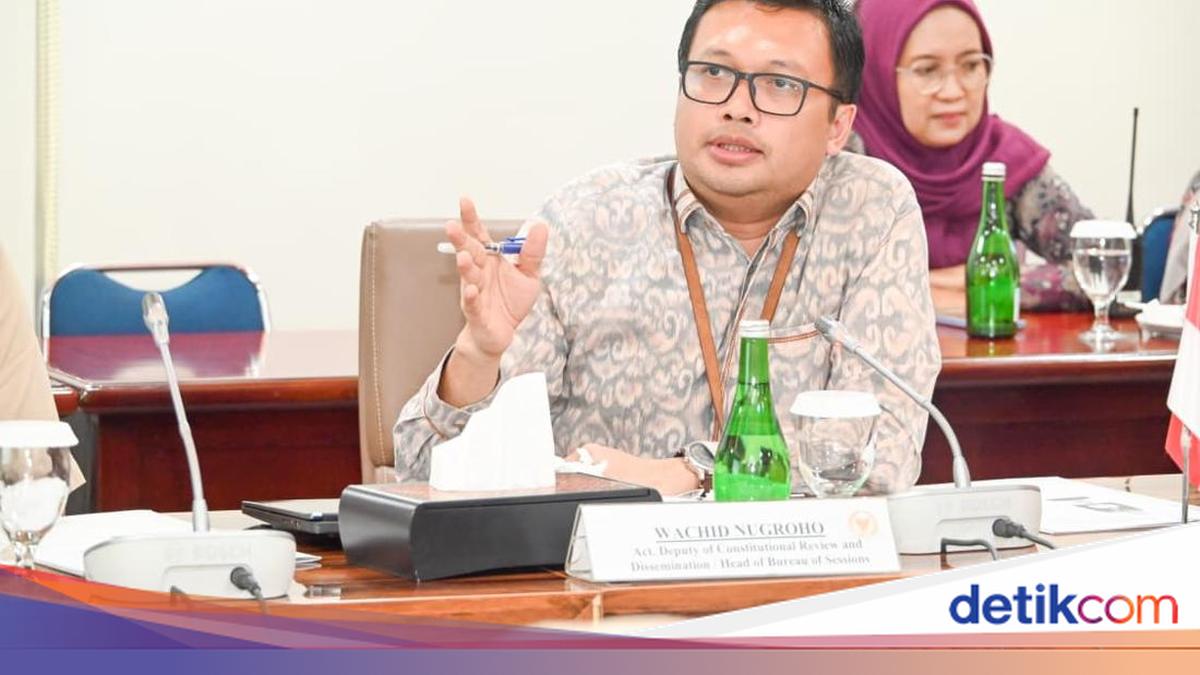
The Secretariat-General of Indonesia’s People’s Consultative Assembly (MPR) received a delegation from the Parliamentary Committees Support Service (PCSS) of the Bangsamoro Transition Authority (BTA) and the Bangsamoro Autonomous Region in Muslim Mindanao (BARMM) at the Parliament Complex in Senayan, Jakarta, on Tuesday (3 November 2026). The visit formed part of a learning-exchange programme focused on Indonesia’s parliamentary system, governance and regional-autonomy practices.
The 10-member delegation was received by Wachid Nugroho, Acting Deputy for Constitutional Studies and Outreach at the MPR Secretariat-General, accompanied by officials and staff. The delegation was led by Jehan D. Alangca-Madid, Supervising Legislative Staff Officer II for the Rules, Ethics, and Accountabilities Division (READ).
During a cordial meeting in the Nusantara III building, Jehan said the visit was part of a learning-exchange programme. The delegation wanted to gain a direct understanding of how parliamentary institutions operate and how government is administered in Indonesia.
The PCSS, Jehan added, provides technical, administrative and analytical support to members of the Bangsamoro Parliament. This assistance is intended to help them fulfil their mandate effectively, particularly in legislation, representation and governance.
Jehan said that, as a relatively new parliamentary institution, Bangsamoro needed to draw on other countries’ experience in building democratic governance. Indonesia was chosen as a learning destination because it has a presidential system and an instructive framework for relations between central and regional government.
“Because the Bangsamoro Parliament is still relatively ‘young’, we believe choosing to benchmark against the Indonesian parliament was the right decision. Our systems are broadly similar, as both operate under a presidential system. We want to learn about Indonesia’s distinctive democratic governance model, particularly how it balances a presidential system with effective regional autonomy,” he said on Wednesday (4 November 2026).
Jehan said the lessons were expected to help the Bangsamoro Parliament’s secretariat and committees support parliamentarians. The delegation was particularly interested in parliamentary rules and ethics, revenue, audit and accountability, and the drafting and codification of regulations.
MPR explains constitutional powers and special autonomy
Wachid Nugroho briefed the delegation on the MPR’s institutional structure, including its membership, position in Indonesia’s constitutional system and constitutional powers under the 1945 Constitution and relevant legislation.
He explained that the MPR comprises members of the House of Representatives (DPR) and the Regional Representative Council (DPD), elected in general elections. This is provided for in Article 2, paragraph 1 of the 1945 Constitution, as amended.
“The MPR is an institution whose entire membership consists of members of the House of Representatives (DPR) and the Regional Representative Council (DPD). Under the official text of the amended 1945 Constitution, Article 2, paragraph 1 states that the People’s Consultative Assembly consists of members of the DPR and the DPD elected through general elections,” Wachid said.
He said the MPR had 732 members for the 2024–2029 term: 580 members of the DPR and 152 members of the DPD. Following amendments to the 1945 Constitution, the MPR ceased to be the country’s highest state institution and now holds equal standing with other state institutions.
Wachid outlined the MPR’s main powers, including amending and enacting the Constitution, inaugurating the President and Vice-President elected in a general election, and dismissing the President and/or Vice-President in accordance with constitutional procedures.
The MPR may also elect a Vice-President or a President and Vice-President when a vacancy arises, as provided for in the Constitution.
Indonesia’s special-autonomy and special-status regions were among the topics that drew the delegation’s interest. Wachid said that Aceh and Papua have special-autonomy status, while Yogyakarta and Jakarta have special status and specific powers in the administration of regional government.
“Experience in Aceh is considered relevant for study because the establishment and implementation of its special autonomy are linked to sharia, rather than peace. This gives the Bangsamoro delegation an opportunity to explore further how Indonesia manages regional diversity while maintaining national unity,” he said in closing.
Earlier, the PCSS delegation had outlined the history and development of the Bangsamoro Parliament. It has 80 seats divided among three categories: 40 seats, or 50 per cent, for representatives of regional political parties; 32 seats, or 40 per cent, for parliamentary-district representatives; and eight seats, or 10 per cent, for sectoral representatives.
The meeting continued with an interactive discussion between the Bangsamoro delegation and MPR Secretariat-General officials. The two sides exchanged views on institutional practices, parliamentary secretariat support, and experience in carrying out government and oversight functions.
At the end of the visit, Jehan D. Alangca-Madid thanked Wachid Nugroho and the MPR Secretariat-General for their welcome and briefing. He said he hoped the knowledge and experience gained would provide an important reference for strengthening the institutional capacity of the Bangsamoro Parliament.
Source: jawawa.id (https://jawawa.id/newsitem/indonesias-mpr-explains-parliamentary-system-and-special-autonomy-to-bangsamoro-delegation-1793785977)
Originally published by detikcom (https://news.detik.com/berita/d-8738230/mpr-ri-paparkan-sistem-parlemen-otonomi-khusus-ke-delegasi-bangsamoro), translated from Indonesian