
Indonesia's Manufacturing Stagnation Raises Deindustrialization Risk: Economist
Indonesia’s Manufacturing Stagnation Raises Deindustrialization Risk: Economist
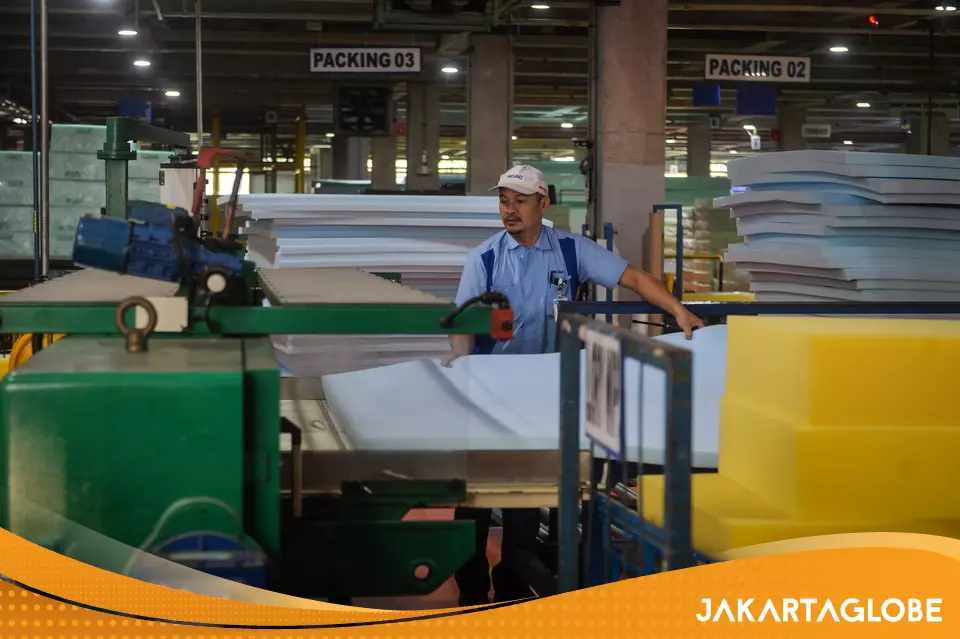
Depok. Indonesia risks slipping into deindustrialization as manufacturing has remained stuck at around 19% to 20% of gross domestic product for two decades, while more than 60% of its exports remain commodity-based, economist Lili Yan Ing warned.
“Is Indonesia experiencing deindustrialization?” Secretary General of the International Economic Association (IEA) Lili Yan Ing said at the 5th International Conference on Muslim World Economy and Business in Depok on Tuesday. “Because remember, we have to reach our peak. If we now move back to deindustrialization, what will happen to our employment, to our jobs, to our workers?”
The concern is particularly significant as around 60% of Indonesia’s population is of working age, she said, making the country’s ability to develop productive industries and create quality jobs increasingly important.
Indonesia’s manufacturing sector accounted for 31.9% of GDP at its peak in 2002 before declining to 19% in 2025, according to World Bank data.
Lili said the country’s export structure points to a broader problem in its economic transformation. Nine of Indonesia’s top 10 export products in the early 1960s were natural-resource-intensive goods, she said. More than six decades later, coal, palm oil and minerals including nickel, bauxite and aluminum still make up a large share of the country’s exports.
“After 81 years of independence, the story remains the same,” she said. “If we can increase our value added, it will be followed by higher value-added jobs and higher-quality jobs,” Lili added.
She also warned that some domestic policies could make it harder for industries to expand, citing local content requirements and non-tariff measures as potential barriers to trade and industrial development.
The country therefore needs to focus not only on attracting investment but also on ensuring that capital translates into greater productivity, she said.
“It’s not just about how much money is invested in Indonesia, but about how much of that investment is turned into productivity gains,” Lili explained.
She also called for a clearer division between the government’s role and that of the private sector, arguing that state involvement should create conditions for businesses to expand rather than compete with them.
“It is important for the government to take a significant role, but the role of the government is to create a conducive environment for the private sector to grow,” Lili said. “It’s not for the government to crowd out private-sector activities.”
Tags: Keywords:
Source: jawawa.id (https://jawawa.id/newsitem/indonesias-manufacturing-stagnation-raises-deindustrialization-risk-economist-1789476627)
Originally published by jakartaglobe.id (https://jakartaglobe.id/business/indonesias-manufacturing-stagnation-raises-deindustrialization-risk-economist)