
Indonesia's Legendary 'Island of Gold' Proves to Be Real, Stunning the World
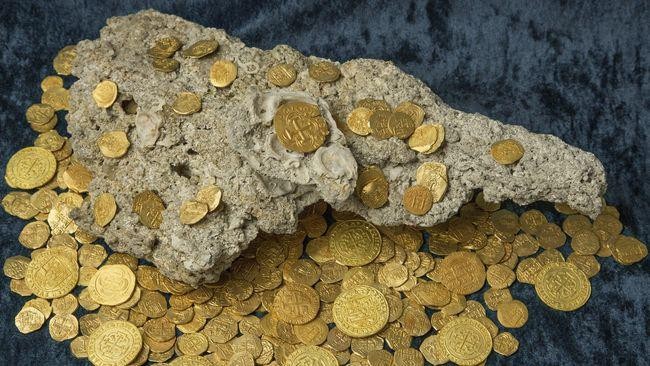
Jakarta, CNBC Indonesia – The rise in gold prices in recent years has prompted more and more people to invest in the precious metal.
Its relatively stable nature is certainly the main reason people want to own gold. On this basis, whenever there is news of a gold island somewhere on earth, people scramble to find it.
Who would have thought that the gold island which became a legend for hundreds of years was not merely fiction. The gold island proved to be real and, interestingly, it is located in Indonesia.
Sought After by the Whole World
Since classical times, people and poets in various parts of the world have had stories and records of a gold island in a faraway land.
In India, various classical works and poems tell of the existence of a gold island across the sea. The Ramayana already described voyages to a gold island called Suvarnabhumi.
Greek and Roman scholars who lived between 31 BC and 416 AD, thousands of years ago, said the same. They always spoke of an island rich in gold to the south of India. There is even a text from the 1st century AD that specifically mentions its location. The text states that “the gold island lies beneath the sun directly overhead” — meaning it sits on the equator.
Then, in China, an ancient manuscript from the Ming Dynasty era (14th century) mentions the land of San Fo Tjai, rich in gold. That land lay in the southern region.
Whatever the version from the various ancient civilisations of the world, all agree that the gold island, true to its name, was rich in gold. Anyone who went there was bound to prosper, for every layer of soil contained gold.
These stories could only be verified in the age of ocean exploration, around the 15th century. Once people were able to sail, it emerged that the gold island which had been the stuff of legend for thousands of years across the world was in fact located in the archipelago that is now Indonesia. The island’s name: Sumatra.
At this point, the historian O.W. Wolters, in The Rise and Glory of Srivijaya, Third to Seventh Centuries (2017), noted that these various records serve as evidence of the prominence of Southeast Asia and Sumatra as an important source of gold.
Land Layered with Gold
The development of knowledge increasingly confirmed that the gold island of Sumatra was no fiction. The inhabitants began digging.
In West Sumatra, for instance, William Marsden in The History of Sumatra (1811) writes that in the 19th century, Padang received 10,000 ounces, or 283 kg, of gold from 1,200 mines in the interior.
Each mine was estimated to have an economic value of 1 million guilders. One can only imagine the profits from gold mining in Padang.
Meanwhile, in Aceh the situation was even more spectacular. Denys Lombard, in The Sultanate of Aceh (1986), explains that the kingdom possessed 300 gold mines. It was said that each mine could yield endless quantities of 24-carat gold.
In addition, a record by the European Augustin de Beaulieu mentions something similar. He observed that in Aceh the layers of soil could produce gold, sometimes even in lumps.
Building on these facts, the colonial era marked the starting point of large-scale exploration and exploitation in Sumatra, given that gold was a potential source of profit alongside spices.
Beyond that, local communities also made gold a source of income. They frequently processed gold for sale. From this emerged newly wealthy entrepreneurs thanks to the gold business and gold ownership. In the independence era, these entrepreneurs would later contribute to Indonesia’s development.
To this day, gold mining still continues. However, output has declined compared with other regions of Indonesia, such as Papua.
Source: jawawa.id (https://jawawa.id/newsitem/indonesias-legendary-island-of-gold-proves-to-be-real-stunning-the-world-1784433052)
Originally published by CNBC Indonesia (https://www.cnbcindonesia.com/news/20260719080528-4-751921/pulau-berlapis-emas-ternyata-ada-di-ri-bikin-heboh-asing), translated from Indonesian