
Indonesia’s Islamic Finance Reform: LPS Chief Backs Creation of Danantara Syariah
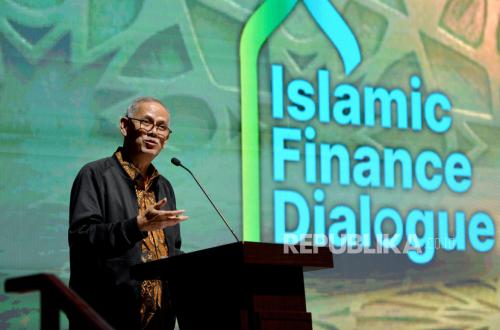
BOGOR — Lembaga Penjamin Simpanan (LPS) Chairman Anggito Abimanyu has called for structural reform of Indonesia’s Islamic economy and finance to begin in 2027. He said the main challenge to developing the Islamic economy was no longer a lack of ideas, but the need to translate them into government policies and priority programmes. One proposal he supports is the establishment of Danantara Syariah.
“2027 must be the year structural reform of Indonesia’s Islamic economy and finance begins,” Anggito said in his opening address at the discussion titled Indonesia’s Islamic Economic Outlook 2027: Assessing Resilience, Advancing a Sustainable Direction at Tazkia University on Monday (16 November 2026).
Anggito said Indonesia had considerable potential to develop its Islamic economy. That potential, however, needed to be converted into a productive, integrated economic force that made a tangible contribution to national development.
He said total Islamic finance assets stood at Rp3,231 trillion as of August 2026, up 8.19 per cent year on year. Nevertheless, Islamic finance accounted for only about 11.16 per cent of the financial industry as a whole.
Anggito said the composition of Islamic finance assets was also unbalanced. Around 60 per cent of assets were in the capital market, 33.7 per cent in banking and just 6.2 per cent in the non-bank financial industry.
This composition indicated that the development of financial instruments had not been matched by deeper intermediation, insurance, financing and public financial services.
In Islamic banking, total assets reached around Rp1,089 trillion in August 2026. Financing stood at Rp748.7 trillion, while third-party funds (DPK) reached Rp849.98 trillion. Islamic banking financing grew by 11.61 per cent year on year, while DPK increased by 12.12 per cent.
Anggito said the challenge facing Islamic banking was not simply to increase the number of banks or expand branch networks, but to improve economies of scale, funding-cost efficiency, financing capacity, innovation and the quality of digital services. He proposed several integrated measures to address these issues.
One was the consolidation of Islamic financial assets and institutions owned by central and regional governments. He noted that there were eight groups of commercial Islamic financial assets belonging to the state and regional governments, worth around Rp928 trillion.
However, those assets had not yet been fully brought together under a single investment and financing strategy. Preliminary analysis estimated that around Rp150 trillion in additional capital would be needed to support gradual consolidation through to 2030. The capital strengthening was projected to comprise 53.3 per cent cash and 46.7 per cent non-cash contributions.
The consolidation is intended to increase productive financing capacity, lower intermediation costs and strengthen the competitiveness of Islamic financial institutions.
Anggito also said the proposal to establish Danantara Syariah was an institutional reform opportunity that merited serious consideration. The platform is expected to bring together capital, investment, financing, the halal industry and entrepreneurship within a single ecosystem.
He said Danantara Syariah could connect long-term investment with the financing needs of productive sectors, including the halal industry, food security, healthcare, education, energy, infrastructure and the development of micro, small and medium-sized enterprises (MSMEs).
He said the ecosystem’s share was projected to rise from 12.3 per cent to 17.3 per cent over the next five years. However, he stressed that this remained an illustrative projection requiring further testing.
Another priority was to promote innovation in digital financial instruments, including crypto-assets, asset tokenisation and blockchain-based instruments. Anggito said policy should not focus solely on accepting or rejecting technology.
More important, he said, was distinguishing digital innovation with economic value from speculative activity that could harm the public. Development of these instruments needed to be backed by clear business models, certainty over asset ownership, investor protection and sharia compliance.
He also called for reform in the management of funds from the hajj, zakat, infaq, sadaqah, waqf and Islamic cooperatives. Their management needed to take account of liquidity, security, returns, portfolio transparency and risk management.
Meanwhile, the management of Islamic social funds needed to move beyond simply increasing collections and distributions towards measuring their sustainable economic impact.
Anggito also highlighted the gap between Islamic financial literacy and inclusion. According to the 2026 National Survey on Financial Literacy and Inclusion, conducted by the Financial Services Authority (OJK), LPS and Statistics Indonesia (BPS), Islamic financial inclusion was only about one-third of the literacy level.
For that reason, education programmes needed to be integrated with access to financial products, business support, digital services and consumer protection. Particular attention should also be given to MSMEs, women, young people, rural communities and low-income groups.
Source: jawawa.id (https://jawawa.id/newsitem/indonesias-islamic-finance-reform-lps-chief-backs-creation-of-danantara-syariah-1794873062)
Originally published by Republika (https://halalhub.republika.co.id/berita/toltci490/reformasi-keuangan-syariah-indonesia-bos-lps-dukung-pembentukan-danantara-syariah), translated from Indonesian