
Indonesia's investment lags behind Malaysia and Vietnam, senior economist reveals the reasons
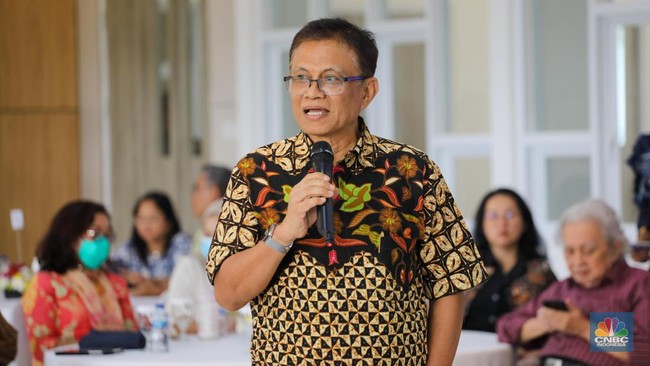
Jakarta, CNBC Indonesia – The industrial sector should be the locomotive of Indonesia’s economic growth to avoid stagnation at around five percent. To that end, policies to support export performance are needed.
Senior INDEF economist Didik J. Rachbini laments that industry—expected to be the locomotive—has grown slowly, thus failing to support higher growth.
‘To do this, a conducive business climate is required so that foreign investment enters and export performance grows rapidly as a sign that Indonesian products are competitive and thriving in international markets,’ Didik said.
Didik emphasised that the structural problem is one of competitiveness and national economy institutions. From his view, foreign investment has been reluctant to enter Indonesia.
‘Trelatively, compared to other countries, it is starkly behind. Indonesia receives foreign investment at only 1.8% of GDP. Meanwhile, foreign investment into Vietnam is 4.2%, Malaysia 3.7% and Singapore 27.8%,’ he said.
One of the structural issues Didik highlighted is weak institutions, criticised by President Prabowo, especially bureaucratic inefficiencies hindering many businesspeople.
‘To invest in Indonesia you have to wait a long time—up to one or two years. Meanwhile, in other countries the same process can be completed in just two weeks,’ Didik said.
According to him, overly complex regulations actually open the door to unhealthy practices in bureaucracy. Not surprisingly, the President plans to form a special task force for deregulation to cut rules and permits deemed to hinder investment and business activity in Indonesia.
In this, Didik argues the idea of forming a deregulation task force is actually logical.
‘East Asian countries that succeeded in industrialisation used a “war room” of bureaucratic reform directly controlled by the top political leadership. For example, Vietnam through Đổi Mới reforms, which now sustains growth of around 8%,’ he said.
Indonesia managed to do so in the late 1980s and early 1990s, achieving growth of 7%. And all advanced economies did so too, such as South Korea in the industrialisation era, Singapore under Lee Kuan Yew, and China during Deng Xiaoping’s era.
‘Truly, without bureaucratic reform and institutional improvement, it is impossible for industry and the economy to grow rapidly,’ he added.
Meanwhile, Didik also touched on export performance, saying Indonesia’s exports already lag far behind newcomer countries like Vietnam. International trade or Vietnam’s exports and imports grew very quickly, reaching about US$1 trillion in value—the double of Indonesia’s international trade.
Therefore, the economy could grow up to 8% in 2025, he argued. While export performance and foreign investment are blocked, do not expect us to escape the 5% growth curse.
In addition, Didik sees broader issues in Indonesia’s vision, mindset and economic orientation, which are regressing. He said Indonesia’s economic vision in the 1980s was outward-looking, but ideologically it has become more socialist with a larger role for the state and inward-looking.
‘If this vision and orientation of the economy continues to be pursued by the government, then do not expect the economy to grow rapidly. Not only the government, but the private sector and state-owned enterprises are also regressing inward,’ he warned.
According to him, this changed mindset causes the foreign-oriented sector to stagnate and fall behind new entrants like Vietnam. This shift would slow the foreign industrial sector, causing moderate growth at best like now. Foreign investment is weak and even mostly attracted into low-quality activities such as restaurants, consulting services, and extractive economic activities with little added value and significant environmental impact. The dimensions of Indonesia’s economic structure are weak, leading to a weak exchange rate and vulnerability to capital flight.
Didik sees the President’s deregulation idea as economically rational and indeed needed. Indonesia has become too ‘overregulated’, so the economic costs are high and investment slows.
‘In this, the spirit of deregulation and debureaucratisation akin to the PAKTO 88 era is relevant to revive the economy’s dynamism. But it’s not easy because the current conditions are more challenging than the 1980s due to a more complex economic structure, bloated bureaucracy, larger rent-seeking interests, and a changed global environment,’ he said.
Therefore, he considers the key to success not merely ‘cutting permits’ but reforming institutions, law enforcement, central–local coordination, bureaucratic digitisation, and political courage to challenge rent-seeking, profligate interests.
‘Deregulation and debureaucratisation policies must be implemented as a milestone in Indonesia’s economic transformation. A practical example and best practice are in view: the 1980s deregulatory and debureaucratising policy, or there’s no need to be ashamed to imitate Vietnam,’ he concluded.
(haa/haa) add as preferred source on Google