
Indonesia's Industry Enters Red Zone: Performance Over Six Months in 2026
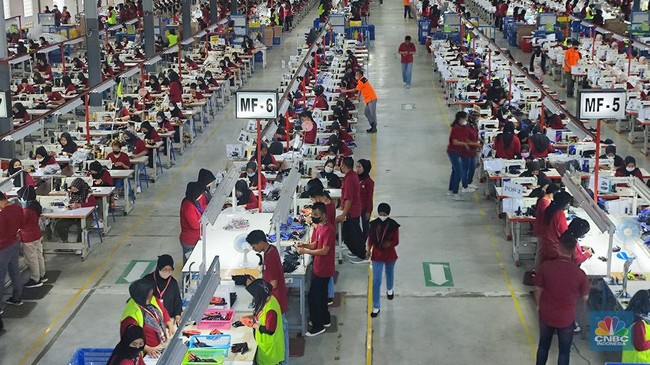
Jakarta - Indonesia’s industrial condition is tending to be sluggish, marked by the Purchasing Manager’s Index (PMI) for manufacturing slowing into the contraction zone at the end of the first semester of 2026, specifically in June.
Based on data from S&P, Indonesia’s manufacturing PMI for the June 2026 period fell to 46.9. The PMI uses 50 as the starting point. If it is above 50, it means the business world is in an expansion phase, while below that indicates contraction.
S&P revealed that this PMI shows a further decline in the health of the goods production component. Additionally, there is an indication of a solid decline in factory operational conditions, one of the largest in a year.
“The main cause of the decline in June was a decrease in demand for Indonesian manufactured goods. New orders fell for the first time in three months and at the fastest rate in a year,” S&P wrote, as quoted on Monday (6/7/2026).
S&P assessed that the negative demand trend pushed companies to reduce output for four consecutive months, with the sharpest decline since April 2025.
Reasons for the Manufacturing PMI Decline
Coordinating Minister for Economic Affairs Airlangga Hartarto revealed the reason for the fall of Indonesia’s manufacturing condition into the contraction zone.
“It is related to the supply chain. So the supply chain is very disrupted, and we, Indonesia, are lagging. So we are late in experiencing the disruption,” he told reporters at the Coordinating Ministry for Economic Affairs office in Jakarta, Wednesday (1/7/2026).
Airlangga stated that this global supply chain issue is a topic of discussion worldwide. “Whether it’s the OECD, whether it’s ASEAN, therefore, that must be a concern,” he continued.
Nevertheless, Airlangga said that Indonesia’s manufacturing condition is actually still good when looking at the 12-month projection. “But if we look at the 12-month outlook, they are relatively more optimistic,” Airlangga revealed.
Behind the Sluggish Industrial Performance
Trimegah Sekuritas Chief Economist Fakhrul Fulvian said the decline in Indonesia’s manufacturing PMI into the contraction zone in June indicates that the industrial sector needs policy direction certainty and optimism signals from the government.
“When businesses face increasing cost pressures, the government needs to reduce various forms of intervention that add to uncertainty. What is needed now is to restore confidence,” Fakhrul said in a statement.
According to him, the business world will invest again if they see that the government has a clear and consistent policy direction and provides space for the private sector to grow.
Fakhrul also assessed that the government needs to immediately prepare a stimulus that directly reduces industrial production costs. When the pressure comes from the cost side, he said, the best solution is to help businesses reduce their production cost burden so they can maintain production capacity and workforce.
Meanwhile, Bank Permata Economist Josua Pardede said the decline in the manufacturing PMI indicates that business actors are increasingly cautious due to weakening demand, rising production costs, an unstable rupiah, and declining market certainty.
“The manufacturing PMI fell not solely because the business world does not trust the government. However, this data clearly shows that business actors are increasingly cautious because demand is weakening, production costs are rising, the rupiah is not yet stable, and market certainty is declining,” Josua said.
Moreover, according to him, policy uncertainty can worsen the situation, such as regulations that are always changing.
“Policy uncertainty can worsen the situation if business actors see rules changing frequently, high logistics costs, and misdirected industrial support,” Josua explained.
The government is asked to provide policy certainty, maintain industrial raw material supplies, reduce logistics and energy costs, and accelerate support for labour-intensive and export-oriented sectors.
There Are Still Signals of Industry Growth
Although the Manufacturing PMI indicator is sluggish, several other industrial performance indicators are actually still experiencing improvement. Total electricity sales, for example, were still able to grow, especially for the business and industrial sectors in the January-April 2026 period. The growth rate of industrial electricity sales was still able to grow by 17.1% and business by 11.9%.
The growth rate in this first semester continues the electricity sales performance of PT PLN (Persero) throughout the previous year. PLN recorded electricity sales reaching 317.96 terawatt hours (TWh), growing 3.75% year-on-year (YoY) in 2025, compared to 306.22 TWh in 2024.
Electricity consumption in the industrial sector reached 93.35 TWh or grew 2.5% YoY, equivalent to 2.31 TWh. This growth was driven by the food and beverage, iron, steel and metal, and non-metal mineral goods industries.
In addition, fuel consumption was also recorded to have experienced growth throughout the first quarter of 2026. Fuel for industry grew by 17%, while retail fuel also still grew by 11.9%.