
Indonesia’s Healthcare Market Continues to Grow, with Government as Its Biggest Buyer
Indonesia’s healthcare market continues to grow as public demand for healthcare services increases. The government is the sector’s biggest buyer, particularly through funding for the National Health Insurance (JKN) programme.
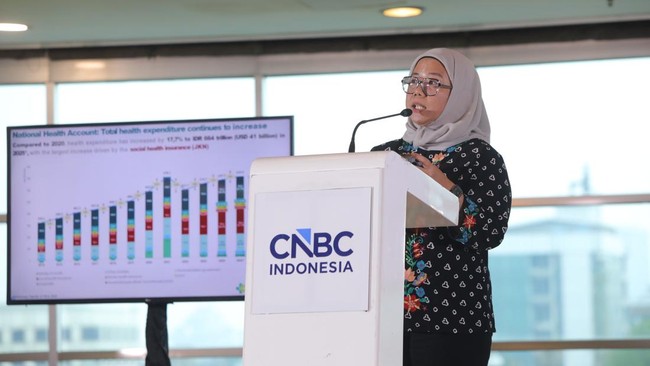
Wenny Indriasari, Director of Pharmaceutical and Medical Device Resilience at the Ministry of Health, said Indonesia’s total healthcare spending reached Rp664 trillion in 2025, an increase of 17.7% from 2020.
“The message is clear from this graph: our healthcare market continues to grow, and the government is its biggest buyer,” Wenny said at the CNBC Indonesia Health Summit 2026, during a panel discussion on “Pharmaceutical and Medical Device Innovation for Strengthening Public Health Resilience” on Thursday (8 October 2026).
Wenny said national healthcare market growth was also driven by increased government spending through JKN. She said government expenditure under the programme rose from about Rp93.6 trillion in 2020 to Rp206.5 trillion in 2025.
Meanwhile, local government healthcare spending remained stable at around Rp140 trillion to Rp150 trillion. This shows that opportunities in the healthcare market are not limited to central government procurement, but are also spread across regions.
“The approach does not have to focus only on central government, because regions also have their own pockets of spending,” she said.
Indonesia’s large healthcare market is also underpinned by a population of about 290 million. Of these, 98.3% are covered by JKN.
Healthcare needs are served by more than 3,300 hospitals, 10,300 community health centres (puskesmas), 20,000 private clinics and 1,100 laboratories across the country. Wenny said much of the healthcare spending at these facilities is financed through public funding schemes.
This has helped create relatively large and sustained demand for pharmaceutical and medical device products. However, despite the domestic market’s considerable potential, Indonesia’s healthcare industry still faces the challenge of dependence on imported products.
Wenny said Indonesia already had a pharmaceutical and medical device industrial base capable of reaching international markets. Pharmaceutical exports were worth about US$744 million, while medical device exports reached US$589 million. Nevertheless, imports still supply much of domestic demand, particularly for raw materials and certain healthcare products.
“Our market is large, and spending is more certain because it comes from government funds. We also have production capacity, but much of the demand is still met by imported products,” Wenny said.
Indonesia’s pharmaceutical market was worth about Rp145.7 trillion in 2024. Yet around 90% of the country’s pharmaceutical raw material requirements are still met through imports.
In addition to the raw-materials issue, Indonesia faces challenges in expanding access to innovative medicines. The medical device and diagnostics industries are similarly reliant on foreign products.
According to Wenny, the healthcare industry’s main challenges are upstream dependence on imports and downstream inefficiencies. The government is therefore seeking to help domestic industry seize opportunities arising from the strong demand in the national healthcare market.
Measures include strengthening the research and development ecosystem, including clinical research, and improving pharmaceutical and medical device manufacturing capabilities. The government is also introducing policies to widen market access for domestic products, including the Domestic Component Level (TKDN) requirement and a consolidated catalogue mechanism.
On investment, the government is allowing up to 100% foreign ownership and offering various fiscal and non-fiscal incentives to encourage development of the healthcare industry. Wenny said she hoped these policies would strengthen domestic production and reduce reliance on imported products.
“The message is simple: Indonesia’s market is large and growing, policies are broad, the door is open, and the government is ready to provide support,” she concluded.
Source: jawawa.id (https://jawawa.id/newsitem/indonesias-healthcare-market-continues-to-grow-with-government-as-its-biggest-buyer-1791456708)
Originally published by CNBC Indonesia (https://www.cnbcindonesia.com/lifestyle/20261008152217-33-774464/pasar-kesehatan-ri-terus-tumbuh-pemerintah-jadi-pembeli-terbesar), translated from Indonesian