
Indonesia's Growth Has 'Plateaued' at 5%, Economist Says
Indonesia’s Growth Has ‘Plateaued’ at 5%, Economist Says
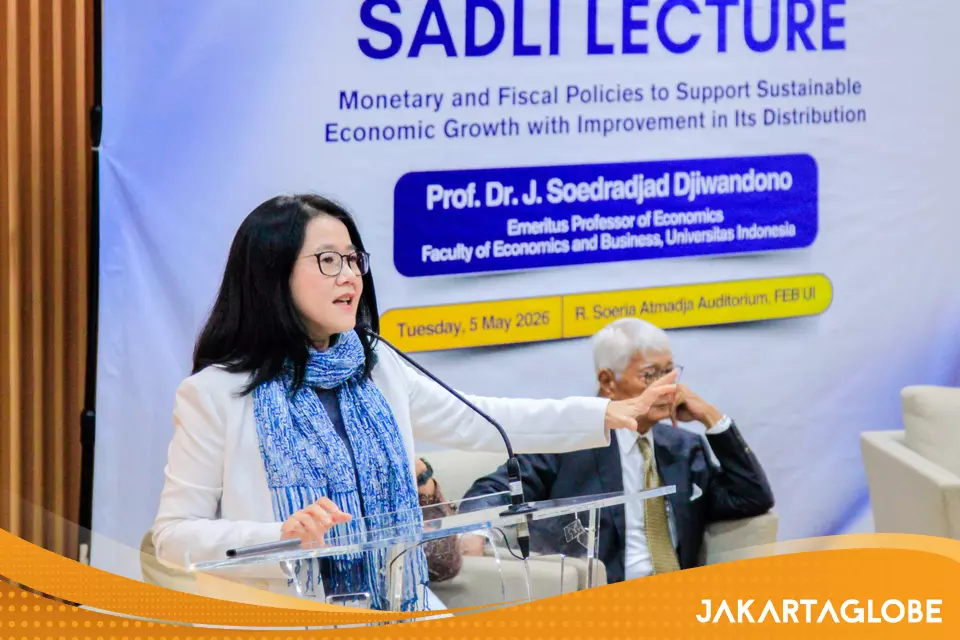
Jakarta. Indonesia’s growth has “plateaued” at around 5% for decades, raising concerns over its quality and inclusiveness, International Economic Association (IEA) Secretary General Lili Yan Ing said.
“The global economy based on nominal GDP has increased from $3.3 trillion in 1970 to $117 trillion in 2025, about 35 times,” Lili said on Tuesday at the 20th Sadli Lecture, hosted by the University of Indonesia’s Social Economic Research Institute (LPEM FEB UI) and the Australian National University in Depok.
But she cautioned that expansion has come with trade-offs. “Globalization has brought positive impacts, but it also brings negative consequences, rising inequality,” she said.
Lili highlighted a major structural shift over the past five decades, with economic power gradually moving from advanced economies to developing countries, particularly in manufacturing, trade, investment, and overall GDP share. “Countries that used to manage global economic power now have to relinquish their powers to developing countries led by China, South Korea, and others,” she said, adding that the transition has fueled geopolitical tensions and protectionist policies.
These pressures, she noted, are weighing on global growth, which is projected at 2.3% this year and 2.4% next year, alongside rising inflation and weakening purchasing power.
For ASEAN, growth is expected to reach 4.6% this year and 4.3% next year. However, Lili struck a more cautious tone on Indonesia. “My personal estimation is that Indonesia will be growing at 3.8% to 4.3%,” she said, below many official projections. “It is good to be optimistic, but the most important thing is to be realistic.”
Lili argued that Indonesia’s core challenge is not just growth, but how that growth translates into welfare. While GDP based on purchasing power parity has reached about $5 trillion with per capita income of around $17,000, growth has remained stuck at roughly 5% for the past 25 years.
“We have a plateau economic growth,” she said. “How can we translate economic growth into job creation, poverty alleviation, and improved welfare?”
She also flagged stagnant human capital, noting Indonesia’s index of 0.554 lags behind regional peers such as Singapore and South Korea.
On policy, Lili called for a “strategic shift” in fiscal management, emphasizing better targeting over higher spending. Indonesia’s debt remains manageable at around 39–40% of GDP, but the tax ratio has stagnated at 10–11%.
“The key is wise spending,” she said, suggesting tighter targeting for social programs. “From our calculations, the maximum of the free lunch program (MBG) is only Rp 8 trillion per year, targeting those who are really in need.”
She also proposed tax reforms to support purchasing power, including exemptions for incomes below Rp 100 million, lower income tax rates, and reducing VAT to a maximum of 8% from the current 12%, alongside more progressive taxation.
Lili further warned about declining private sector space. “The private sector has been squeezed by state-owned enterprises, and the establishment of Danantara has compounded this crowding-out effect,” she said, urging policymakers to ensure fair competition, particularly for small and medium enterprises.
Beyond fiscal measures, she stressed the importance of institutional independence – including the central bank, anti-corruption agency, and judiciary – as well as economic diversification.
“Diversification is not an option, it is a must,” she said, pointing to the need to expand trade partners, investment sources, and local currency usage in payments.
She also underscored the urgency of transitioning to renewable energy, particularly as demand rises from digital infrastructure such as data centers, AI, and robotics.
Lili delivered a direct message to President Prabowo Subianto, urging him to heed academic input. “Indonesia is now at a crossroads,” she said. “This is your legacy, whether you want to listen to Indonesian people or ignore us, whether you want to stand with the people or put us aside.”
“We are saying this because we love Indonesia, because we care about Indonesia, and because we want Indonesia to be a great nation,” she added.
Tags: Keywords: