
Indonesia's Geothermal Potential Touted as Key Replacement for Fossil Fuel Power Plants
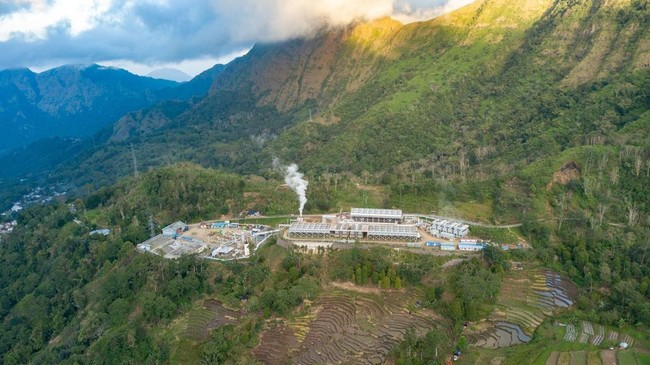
The Ministry of Energy and Mineral Resources (ESDM) has identified geothermal energy as a primary source capable of replacing fossil fuels such as coal and diesel for power generation. The ministry emphasised that the country possesses abundant clean energy potential in this sector.
Director General of New, Renewable Energy, and Energy Conservation (EBTKE) Eniya Listiani Dewi stressed that the characteristics of geothermal energy make it suitable for substituting fossil-based generation due to its continuous supply, unaffected by climate variability. “The renewable energy that can be an apple-to-apple replacement for fossil fuels is geothermal. Hydro is affected by the climate; during the dry season, water discharge decreases, but geothermal is continuous,” Eniya stated at the Parliament Complex in Jakarta, as quoted on Wednesday (15/7/2026).
According to her calculations, 1 MW of diesel generation can be directly replaced by 1 MW of Geothermal Power Plant (PLTP) capacity because of its ability to operate around the clock. In comparison, solar photovoltaic plants would require up to four times the installed capacity plus battery storage systems to achieve the same level of reliability. “So, if we talk about 1 MW of diesel, that means 1 MW of PLTP. For solar PV, you would need 4 MW to equal that, not yet including the batteries,” she explained.
The government is currently adjusting regulations, including a planned revision of Government Regulation (PP) Number 7 of 2017 concerning Geothermal Energy. A review of the pricing scheme through a revision of Presidential Regulation (Perpres) 112 of 2022 is also underway to attract investment in the sector. “Regarding future development, we are revising PP 7. Related to pricing, there is the revision of Perpres 112, but we will prioritise the Presidential Regulation on 100 GW first, as directed by the Minister,” she concluded.
Regarding the national electricity roadmap, the 2025-2034 Electricity Supply Business Plan (RUPTL) serves as the operational translation of the General National Electricity Plan (RUKN) and the National Energy Policy (KEN). The Prabowo-Gibran administration has placed energy sovereignty and transition as a national priority. The RUPTL targets an additional 69.5 GW of new generation capacity, with 42.6 GW coming from New and Renewable Energy (EBT). The EBT breakdown includes 17.1 GW of solar power, 11.7 GW of hydropower, 7.2 GW of wind power, 5.2 GW of geothermal power, 0.9 GW of bioenergy, and 0.5 GW of nuclear power. Energy storage systems will account for 10.3 GW, while fossil-based generation will still see an addition of 16.6 GW, consisting of 10.3 GW of gas and 6.3 GW of coal.