
Indonesia’s Geothermal Potential Reaches 24 GW, with Significant Scope for Development
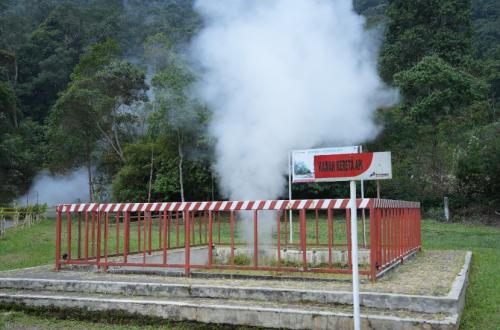
Indonesia’s geothermal industry is considered to have long-term growth prospects despite global sentiment weighing on the stock market. The country has geothermal potential of around 24 gigawatts (GW), but only about 11 per cent has been developed, leaving substantial scope to add power-generation capacity.
The Korea Investment and Sekuritas Indonesia (KISI) research team says geothermal development is also supported by demand for low-emissions electricity that can provide a reliable supply. Unlike renewable sources that depend on weather conditions, geothermal power plants can provide baseload electricity around the clock.
Under the Electricity Supply Business Plan (RUPTL), the government is targeting an additional 5.2 GW of geothermal capacity by 2034. KISI says, however, that tariff certainty remains a key factor in the development of geothermal projects.
“The main obstacle to geothermal development is not geology, but tariffs,” KISI’s research team said in a statement on Wednesday (21 October 2026).
One listed company in the sector is PT Pertamina Geothermal Energy Tbk (PGEO). KISI says the company’s prospects should be assessed in light of its electricity sales contracts, operational performance, financial position and delivery of development projects.
KISI notes that around 96 per cent of PGEO’s revenue comes from 30-year contracts with state-owned electricity utility PLN. The contracts use take-or-pay arrangements covering 69–90 per cent, providing long-term revenue certainty.
“For PGEO, around 96% of revenue is contracted with PLN for 30 years under a take-or-pay scheme of 69–90%. This means cash flow does not fall when the index declines,” KISI’s research team said.
In the first half of 2026, Pertamina Geothermal Energy (PGE) recorded revenue of US$235.027 million, up 14.7 per cent from the same period a year earlier. Net profit reached US$79.605 million, an annual increase of 15.48 per cent.
Operational performance also grew. From January to September 2026, PGE’s geothermal electricity production reached around 4,114 gigawatt-hours (GWh), up 9.8 per cent on the same period last year.
The cumulative Equivalent Availability Factor (EAF) reached 98.51 per cent through September 2026, exceeding the company’s target of 92.20 per cent.
In the first half of 2026, PGE managed 727 megawatts (MW) of installed capacity independently. The company reported an EBITDA margin of 78.3 per cent and a net-debt-to-EBITDA ratio of 0.1 times.
PGE’s balance sheet showed equity of US$2.006 billion, with cash and cash equivalents of US$656.6 million as at June 2026. KISI says financial strength, contract structures and debt levels are important indicators of the resilience of geothermal businesses.
PGE is developing several projects, including Lumut Balai Units 3 and 4, Hululais Units 1 and 2, and Lahendong Units 7 and 8. The company is targeting installed capacity of 1 GW by 2028, rising to 1.8 GW by 2034.
KISI nevertheless cautioned that several factors could affect PGEO’s outlook. One is the pending revision of Presidential Regulation No. 112 of 2022 on tariffs for renewable electricity.
Other factors include the execution of the Hululais project and development of a 45 MW co-generation project. Investors should also monitor the company’s public shareholding, or free float, of 3.9 per cent, which needs to be increased gradually, as well as changes in interest rates and the rupiah exchange rate.
Sentiment in the stock market came under pressure after Morgan Stanley Capital International (MSCI) announced on 16 October 2026 a proposal to reclassify Indonesia from an Emerging Market to a Standalone Market. The proposal is under consultation until 30 April 2027, with a final decision due no later than 30 June 2027.
KISI says the proposal has contributed to risk-off sentiment among investors. The Jakarta Composite Index (IHSG) reportedly fell by 11.57 per cent, while pressure from foreign fund outflows could continue gradually until April 2027. “The market tends to be selective towards stocks with clear cash flows and low debt,” KISI’s research team said.
KISI stressed the importance of distinguishing share-price movements driven by market sentiment from changes in a company’s fundamentals. Before making investment decisions, investors are advised to consider installed capacity, plant utilisation, electricity contracts and tariffs, EBITDA margins, and debt levels.
According to KISI, financial and operational performance should be assessed alongside project development strategy and industry prospects. Short-term share-price movements remain subject to various market factors, making the timing and direction of any recovery uncertain.