
Indonesia's Geothermal Energy Turns 100 Years Old, Here's Its Impact on the Economy
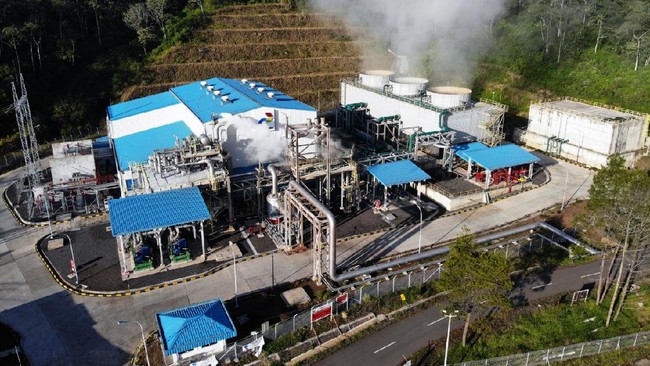
PT Pertamina Geothermal Energy Tbk (PGEO) has emphasised the substantial economic impact and multiplier effect of geothermal development for the Indonesian people. Geothermal energy is now entering a century, or 100 years, of operation in the country and has contributed to regional and national economic growth.
President Director of PGE Ahmad Yani explained that the company’s success in integrating industrial operations with local community empowerment across various working areas has been able to create new economic growth centres around power plant locations. “Of course, with project development, it will provide a multiplier effect to the surrounding community. The multiplier effect from the project will open employment opportunities, and the local economy will grow,” he said on the sidelines of The 12th Indonesia International Geothermal Convention & Exhibition (IIGCE) at JCC Senayan, broadcast in CNBC Indonesia’s Energy Corner programme on Thursday (20/8/2026).
He cited the successful economic impact in the Kamojang operational area in Garut, West Java, which has been managed for more than 40 years. In that area, the company has built public trust through strengthening knowledge capacity and community development that has proven capable of becoming economically self-reliant. “Kamojang proves that for more than four decades, PGE and the community have grown together in building the economy and developing the community there, growing together in terms of knowledge and community development to strengthen the local economy. It is proven,” he explained.
This sustainability commitment has yielded results with the company receiving the Proper Emas award 15 times consecutively from the government. This serves as evidence that the geothermal industry is able to provide energy security guarantees while also delivering environmental protection and welfare for surrounding residents. “There is a sustainability impact from geothermal development, where energy provides energy security, environmental protection, and the welfare of the surrounding community,” he stressed.
According to records from the Ministry of Energy and Mineral Resources (ESDM), Indonesia currently ranks second in the world in installed geothermal capacity. Indonesia’s total geothermal potential reaches 23,202.77 MW, while installed capacity is around 2,776.39 MW. Thus, only about 11.6% of the geothermal potential has been utilised, with around 88.4% still untapped.
Indonesia’s geothermal potential is spread widely across various regions. Sumatra has potential of around 9,441.10 MW, Java around 7,587.80 MW, Sulawesi around 3,006 MW, and Nusa Tenggara around 1,272.87 MW. Meanwhile, Kalimantan, Bali, Maluku, and Papua also have geothermal potential, but according to the presentation materials, they do not yet have installed capacity.
For 2026, the government is preparing development at two Preliminary Survey and Exploration Assignment (WPSPE) locations and four Geothermal Working Areas (WKP), with total resources of around 131 MW, additional capacity of around 185 MW, and projected investment value of around US$1.16 billion.
The government is also preparing a number of regulatory and investment catalysts to accelerate geothermal development, including through revision of Government Regulation Number 7 of 2017, which is directed at supporting indirect utilisation of geothermal energy and increasing the rate of return on investment, as well as revision of Presidential Regulation Number 112 of 2022 to accelerate the development of New and Renewable Energy (EBT).
Director General of New Renewable Energy and Energy Conservation (EBTKE) at the Ministry of Energy and Mineral Resources Eniya Listiani Dewi said that realisation of Non-Tax State Revenue (PNBP) from geothermal currently reaches Rp 2.45 trillion. “The target for this year has indeed increased again; we are enthusiastic about delivering Rp 2.6 trillion because there is a lot of drilling that must be done,” she said at the opening of The 12th IIGCE at JCC Senayan on Wednesday (19/8/2026).
In terms of investment, geothermal investment this year is targeted to increase to US$1.1 billion. However, with new auctions, geothermal investment is expected to rise to US$2.2 billion, or around Rp 39 trillion, in 2026.
Eniya also said that although geothermal energy in Indonesia has reached 100 years of age, the steam is still flowing and contributing to clean energy sources in the country. The Kamojang Geothermal Power Plant is now managed by PT Pertamina Geothermal Energy Tbk (PGEO). “Today is indeed the right moment to commemorate 100 years, where the first geothermal drilling well was initiated in 1926, first drilled in Kamojang, and even now, at 100 years old, the steam is still flowing. This is a gift from God Almighty. If that steam is not utilised, we would certainly be among those who are at a loss,” she said.
“So it seems that the geothermal energy we know will be very able to compete with diesel, very able to compete with fossil fuels, coal or diesel, because it can deliver electricity 24 hours a day,” she said.
“It is one of the renewable energies we rely on greatly, and the largest potential is in Indonesia. As was also mentioned, our installed capacity is still number 2 in the world. But with the PLN RUPTL that has been approved, we hope this achievement will rise by 5.2 GW, so that the share of new renewable energy in the energy mix can increase,” she said.
In front of Minister of Energy and Mineral Resources Bahlil Lahadalia and IIGCE participants, Eniya explained that the current new renewable energy mix has reached 17%. She explained that the EBT mix in the first quarter of 2026 had reached 18%, but because other non-EBT power plants began operating, the new renewable energy mix fell to 16.8-17%. Of that EBT portion, she said the largest contributor is geothermal.
Source: jawawa.id (https://jawawa.id/newsitem/indonesias-geothermal-energy-turns-100-years-old-heres-its-impact-on-the-economy-1787219525)
Originally published by CNBC Indonesia (https://www.cnbcindonesia.com/news/20260820150703-4-760981/panas-bumi-ri-sudah-berumur-100-tahun-begini-dampaknya-bagi-ekonomi), translated from Indonesian