
Indonesia's Food Self-Sufficiency: Minister Amran Admits Mafia Cannot Be Completely Eradicated, Why?
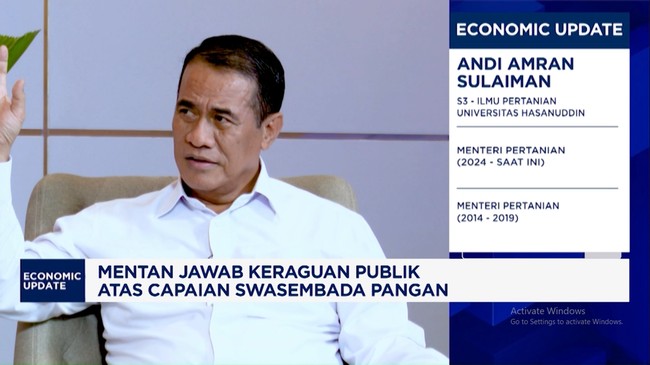
Jakarta, CNBC Indonesia - Minister of Agriculture Amran Sulaiman has outlined the series of measures taken by President Prabowo Subianto’s administration to achieve food self-sufficiency in Indonesia, noting that rice production has surged to a surplus of approximately 1.5 million tonnes. As of Tuesday, 19 May 2026, state logistics agency Perum Bulog revealed that government rice reserves (CBP) had reached 5,372,359 tonnes, a record high in Indonesian history, surpassing the 3.3 million tonnes recorded in 2025. Speaking at the CNBC Indonesia Economic Update 2026 on Monday, 22 June 2026, Amran stressed that the definition of self-sufficiency being used is not merely the government’s own, but that of the UN’s Food and Agriculture Organization (FAO), which stipulates that imports must not exceed 10% of domestic needs. He confirmed that Indonesia has now reached that level, as declared by President Prabowo Subianto on 7 January 2026. Amran dismissed critics, stating that the data is exact and verifiable, pointing out that out of 11 key food commodities regulated under Presidential Regulation No. 125 of 2022, eight have achieved self-sufficiency, including rice, maize, and shallots. He noted that for the remaining commodities, such as beef, garlic, and soybeans, total imports represent only 4-5% of overall production. He challenged sceptics to verify the data with the FAO, the United States Department of Agriculture (USDA), and the Central Statistics Agency (BPS). Amran attributed the success to President Prabowo’s major policy overhaul, including the issuance of 16 Presidential Instructions (Inpres) within just over a year to streamline regulations. A key reform was simplifying the fertiliser distribution chain from a complex, multi-tiered process involving 12 ministries, 38 governors, and 514 regents, to a direct three-step process from the Ministry of Agriculture to producers and then to farmers. The volume of subsidised fertiliser was also increased to exceed demand, while its price was reduced by 20%. He added that hundreds of ministerial regulations were revoked or simplified to remove obstacles for farmers. Looking ahead, Amran said the focus is on maintaining self-sufficiency through continuous improvements to irrigation, the development of superior seeds and seedlings, and the optimisation of 1.5 million hectares of swampland to increase planting frequency and yields. He stressed that combating food mafias is equally crucial, advocating for denying them any room to operate and imposing the heaviest possible penalties.