
Indonesia's External Buffer Shrinks Amid Surge in Imports
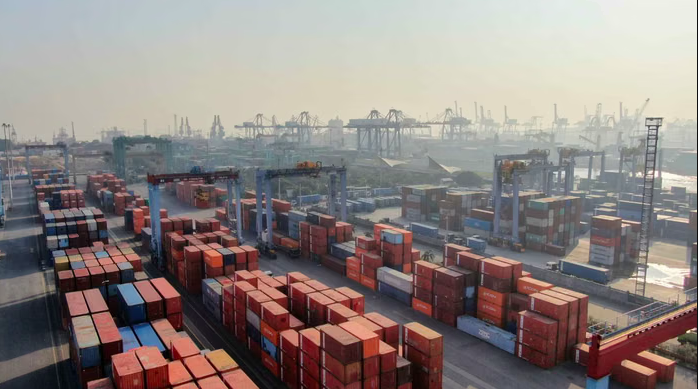
Indonesia’s external buffer in April 2026 has continued to narrow amidst a surge in imports that is outstripping export growth. According to the Central Bureau of Statistics (BPS), the trade balance surplus was recorded at only approximately US$89.1 million (equivalent to Rp1.591 trillion), a sharp decline from the US$3.32 billion surplus recorded in March 202cap6.
Although Indonesia has maintained a surplus for 72 consecutive months, the current condition indicates a narrowing gap between exports and imports. Josua Pardede, Chief Economist at Bank Permata, noted that the April 2026 trade surplus serves as a warning signal that Indonesia’s external buffer is thinning. Detailed figures show April 2026 exports stood at US$25.30 billion, while imports reached US$25.21 billion.
Pardede assessed that this situation is not caused by weakening exports, but rather by imports growing more rapidly. The surge in imports was primarily driven by the post-Eid al-Fitr economic normalisation, increased demand for raw materials and capital goods, and rising global energy prices. On an annual basis, imports in April 2026 rose by 22.49%, with oil and gas imports surging by 82.52% and non-oil and gas imports increasing by 14.11%.
From January to April 2026, cumulative imports of raw materials rose by US$6.46 billion, capital goods by US$2.74 billion, and consumer goods by US$1.03 billion. While these increases reflect ongoing economic activity, they are simultaneously eroding the trade surplus. Conversely, export performance remains relatively strong, with non-oil and gas exports growing by 23.36% to US$25.30 billion in April.
Structurally, the trade balance is supported by a non-oil and gas surplus but pressured by an oil and gas deficit. Between January and April 2026, the total trade surplus of US$5.64 billion was comprised of a US$14.16 billion non-oil and gas surplus, offset by an US$8.52 billion oil and gas deficit. Additionally, the trade deficit with China reached US$8.03 billion, largely due to imports of machinery, mechanical equipment, and electronic supplies.
Pardede highlighted that Indonesia’s external resilience remains heavily dependent on the ability of non-oil and gas exports to cover the energy deficit. He also noted that a weakening Rupiah increases import and production costs more rapidly than it boosts export volumes, making exchange rate stability crucial for controlling inflation and maintaining the trade balance.
While some import increases are considered productive as they relate to raw materials and capital goods that could support long-term industrialisation, there are risks to the manufacturing sector. The Indonesia Manufacturing PMI for May 2026 showed a sharp rise in production costs alongside a decline in production volume for the third consecutive month, indicating that import costs and currency volatility are squeezing industrial margins.
Pudji Ismartini, Deputy for Methodology and Statistics at BPS, confirmed that imports between January and April 2026 rose sharply by 13.40%. This was driven by both oil and gas and non-oil and gas sectors, with oil and gas imports specifically increasing by 17.58% during this period. Significant growth was also noted in the import of machinery, electrical equipment, and aircraft components.