
Indonesia's Energy Resilience Ranks Second Best in the World, Bahlil Reveals the Secrets
Jakarta, CNBC Indonesia - JP Morgan, the American financial services giant, has placed Indonesia in second position out of 52 countries as the nation with the best energy resilience in the world amid geopolitical turbulence.
This is recorded in the JP Morgan report Pandora’s Box: the global energy shock of 2026. JP Morgan mapped 52 of the world’s largest final energy-consuming countries, representing 82% of global energy consumption.
So, what is the secret behind Indonesia’s energy resilience?
Minister of Energy and Mineral Resources Bahlil Lahadalia assesses that the JP Morgan report is driven by several factors, including diversification of energy sources that reduces dependence on other countries.
Bahlil emphasises that optimising local natural wealth, from coal to palm oil, has strengthened the national energy foundation amid global geopolitical shocks.
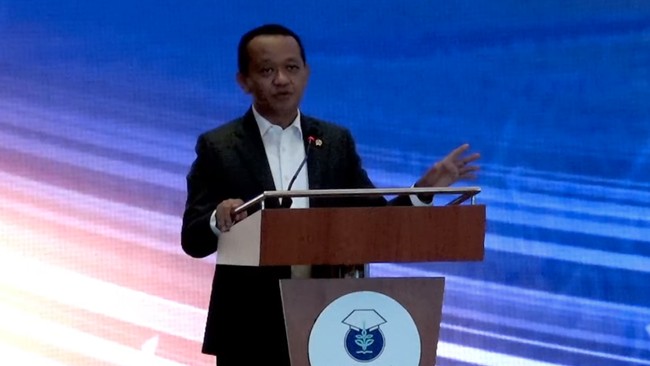
“Even in the current economic and geopolitical conditions, JP Morgan has released data cited by several media outlets, stating that out of 52 countries surveyed, Indonesia ranks second after South Africa as the country with the best energy resilience,” he said at the Synergy of IPB Alumni for the Nation event, quoted on Monday (4/5/2026).
The government itself has decided to continue using coal as one of the main energy sources due to its abundant domestic reserves.
Bahlil views the availability of coal as a shield or survival mode for Indonesia so that the public is not burdened by high electricity prices resulting from following uncertain global energy trends.
“We have extraordinary coal reserves. I decided to say let’s proceed with coal. This is about survival mode. We’re talking about efficiency. We shouldn’t sacrifice our people with high electricity prices,” Bahlil explained.
The Fuel Oil (BBM) sector also marked a new history in 2026, where Indonesia will stop importing diesel this year. This is driven by the implementation of a biodiesel blending programme into BBM at 50% (B50), scheduled to take effect from 1 July 2025. This biodiesel blend increases from the current 40% (B40).
Not only the biodiesel programme, the reduction in Indonesia’s diesel imports this year is also supported by the Balikpapan Refinery Development Master Plan (RDMP) project, which was officially operationalised in January 2026.
“For diesel, in the history of our nation in 2026, alhamdulillah, we no longer import diesel because it’s all domestic. Biodiesel from the B10 roadmap to now B40 and in July becoming B50 is a way to convert and substitute our imports,” he added.
Besides diesel, the government also plans to cut petrol (gasoline) imports. He revealed that national petrol consumption reaches 40 million kilolitres (kl) per year. With the operation of RDMP Balikpapan, this can increase domestic petrol production by up to 5.7 million kl of petrol, thus reducing the share of petrol imports.
“With the RDMP we operate, it produces 5.6 million to 5.7 million (kl) of petrol. That means our imports now are down to 20 million. And these imports are not from Middle East countries. So there’s none from countries passing through the Strait of Hormuz for BBM,” he stated.
Furthermore, the government is preparing a mandatory blending of petrol with bioethanol or E20, targeted to take effect in 2028. This programme is projected to cut petrol import volumes by 8 million kilolitres per year through the utilisation of corn, sugarcane, and cassava.
“I will make E20 mandatory on the orders of the President. If we make ethanol E20, the mandate in 2028 is eight million. If now we import 20 million, with a 20% mandate, it’s reduced by another 8 million. So imports are down to 12 million,” he disclosed.
Indonesia has also secured reserves for the next year through diversification of suppliers to regions including Africa and Russia. With this stock certainty, the government guarantees that there will be no price increases for subsidised BBM and 3 kg LPG at least until the end of 2026.
“Finally, we took from Russia last time. In Russia, we’ve secured one year, it’s clear. I promise all of you, even until 31 December, even if the ICP price is US$100 (per barrel), insya Allah, the prices of subsidised BBM and LPG will not rise. That’s what we protect, and that’s the order from President Prabowo,” he stressed.
JP Morgan Report
JP Morgan, the American financial services giant, in its report Pandora’s Box: the global energy shock of 2026, mapped 52 of the world’s largest final energy-consuming countries, representing 82% of global energy consumption.
In this study, major producer countries such as Iran, Qatar, Russia, and the United Arab Emirates were excluded from the list because they receive large subsidies from domestic production.
The main focus of this study is how sensitive a country is to spikes in oil and gas, and how strong its buffers are through domestic gas, coal, renewables, and nuclear.
This study uses several parameters such as useful final energy (EJ), the extent of oil and gas imports from the Strait of Hormuz, the scale of oil import share against primary energy, oil consumption and gas import share against primary energy, coal share, nuclear and domestic renewables share against useful final energy, total protection factor, and oil concentration for road transport as a share of primary energy.
Indonesia is assessed as one of the countries relatively more resilient to global energy shocks, especially when oil and gas prices surge due to wars, geopolitical conflicts, or world supply disruptions. In the calculation of the total protection factor, namely the portion of useful final energy less exposed to global oil and gas price shocks, Indonesia