
Indonesia's Egg Production Boom Floods Farmers' Stock with Surplus
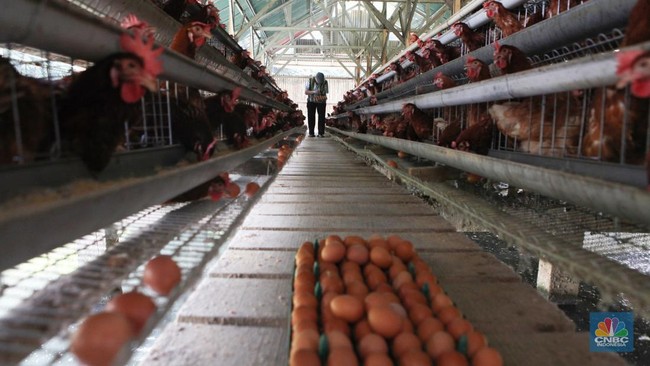
The price of layer chicken eggs at the farm level is under pressure. The Ministry of Agriculture (Kementan) acknowledges that national egg production is currently abundant, following a surge in the laying hen population over the past year, resulting in a market flood of supply.
The Director General of Livestock and Animal Health (PKH) of Kementan, Agung Suganda, stated that the price of layer chicken eggs at the farm level has recently fallen below the government’s Reference Purchase Price (HAP).
“The purpose of today’s meeting is to address the stabilisation of egg prices at the farm level, which have recently dropped slightly below the reference price set by the government,” Agung said when met after a meeting at his office in Jakarta on Tuesday (12/2026).
Agung noted that the national average price for layer chicken eggs stands at Rp24,500 per kilogram (kg). However, in major production centres such as Java, prices have fallen even more sharply due to pressure.
“The prices vary. Nationally, the average price of our eggs is around Rp24,500 per kg, because some islands have slightly higher prices. But in production centres like Java, in East Java province, the price is quite low at around Rp22,500 per kg, followed by Central Java at about Rp23,000 per kg,” he explained.
In contrast, the government’s Reference Purchase Price (HAP) for layer chicken eggs at the producer or on-farm level, based on regulations from the National Food Agency (Bapanas), is set at Rp26,500 per kg.
According to Agung, the price decline is triggered by a significant surge in national egg production in 2026. Kementan records project this year’s production to reach 7.3 million tonnes, while national demand is around 6 million tonnes.
“Thus, there is still a surplus of approximately 800,000 tonnes nationally, or about 13% of national demand,” he said.
He mentioned that fluctuations in egg prices are a recurring trend every year. However, this time, the increase in laying hen population is much higher due to growing interest among farmers in expanding operations, spurred by the Free Nutritious Meals (MBG) programme.
“This trend of fluctuations actually repeats every year. Even for layer chicken eggs from 2025 until now, prices have been relatively more stable, with good egg prices, and indeed due to attention and high interest from industry players in building layer chicken farms because of MBG, so the laying hen population in 2026 has seen a significant increase,” he clarified.
Agung revealed that the rise in laying hen population this year is approaching 30% compared to last year.
“Yes, the increase compared to year-on-year in 2025 is quite high, around nearly 30%,” Agung said.
According to him, the population growth occurred because many local farmers built new coops to capture opportunities from demand under the MBG programme and the Nutrition Fulfilment Service Unit (SPPG).
“First, there is interest from local investors to add and build new coops because of SPPG earlier, MBG is a particular attraction,” he stated.
Additionally, the productivity of laying hens has improved due to better genetic quality and animal health. Even the production lifespan of chickens has been extended due to high market demand.
“Second, our chicken genetics are also getting better, with good health and production persistence, and even those usually culled at a maximum of 95 weeks or even 100 weeks are now extended because of high demand. This is also what causes the population to keep increasing,” Agung explained.
He also noted that nearly all day-old chicks (DOC) for layers, or layer chicken seeds, are now utilised for production, unlike previously when only about 60%-70% were used.
While viewing the increase in chicken population as a positive development, Agung warned that farm-level prices must still be protected to prevent farmers from incurring losses.
“This is actually a good and positive thing, but it must be balanced with farm-level prices that also provide benefits for farmers; otherwise, farmers will go bankrupt, while consumer-level prices are actually relatively stable,” he said.
Furthermore, Agung highlighted the nature of egg production, which cannot be stopped at will. As a result, when demand weakens, some farmers opt to sell at low prices to quickly clear stock.
“Because eggs, once they start laying, cannot be stopped ‘oh, they’ll lay in two days’, it doesn’t work that way. They produce every day, and sometimes impatient farmers want quick sales, so they end up undercutting prices, and this is what’s happening in the field,” he explained.
Therefore, the government is urging associations and farmer cooperatives to maintain unity to avoid undercutting each other on prices. The government also hopes the MBG programme can increase egg absorption.
“We certainly encourage the free nutritious meals programme to increase the weekly egg menu, and we ask that the egg purchase price follows the price set by the Bapanas regulation,” Agung said.