
Indonesia's Economy Grows Strongly, Largely Aided by China?
Jakarta, CNBC Indonesia - Indonesia’s economy grew higher than expected in the first quarter of 2026. However, behind this achievement, there is an interesting story regarding China’s increasingly significant role in supporting the domestic economy, as well as challenges to Indonesia’s current account balance.
The Central Statistics Agency (BPS) recorded that Indonesia’s economy grew 5.61% year-on-year (yoy) in the first quarter of 2026. This figure is higher than the 5.39% yoy in the fourth quarter of 2025, while also exceeding the market consensus conducted by CNBC Indonesia at around 5.4% yoy.
From the expenditure side, household consumption remains the main pillar of the Indonesian economy with growth of 5.52% yoy. This performance was supported by the Ramadan and Eid momentum, the shift in Idulfitri holiday timing, and the government’s decision to hold subsidised fuel prices.
In addition to household consumption, a major boost also came from government spending.
Government spending was recorded to surge 21.81% yoy, mainly driven by the acceleration of spending on the Free Nutritious Meals (MBG) programme.
China Becomes One of Indonesia’s Economic Pillars
Amid risks of global economic slowdown, China has emerged as one of the important pillars for the Indonesian economy.
In a report by The Focal Point, also released by BCA, foreign direct investment (FDI) flows from China remain one of the sources of external support for Indonesia.
FDI into Indonesia rose 5.2% yoy in the first quarter of 2026. This increase was mainly driven by investors from China. Meanwhile, new investment commitments from other countries appear to be drying up.
This condition is important because at the same time, foreign investors recorded outflows from the domestic financial market. BCA noted that foreign investors offloaded around US$3.47 billion from Indonesia’s stock and bond markets throughout the year to date.
In other words, when foreign funds in the portfolio market are still exiting, direct investment from China is actually still helping to maintain the story of Indonesia’s economic growth.
BCA assesses that investment from China can help Indonesia’s industrialisation process.
“FDI from China can help Indonesia’s industrialisation process, as it is capable of creating more jobs for each unit of investment compared to FDI from other countries,” BCA wrote in its report.
Based on BCA’s calculations, every US$1 million in Chinese FDI creates around 18.4 jobs. This figure is higher than FDI from other countries, which creates around 17.3 jobs per US$1 million investment.
This is important because Indonesia still faces challenges in labour absorption and household income that is not yet fully strong. With the influx of Chinese investment, there is additional opportunity to support job creation and strengthen people’s purchasing power.
However, BCA also warns that Chinese investment does not automatically make Indonesia’s balance of payments stronger. This is because if Chinese-owned foreign companies become increasingly dominant, some profits could potentially be sent back to the home country in the form of dividends (repatriation).
In addition, the exports generated may not necessarily increase significantly if domestic value added is not also strengthened.
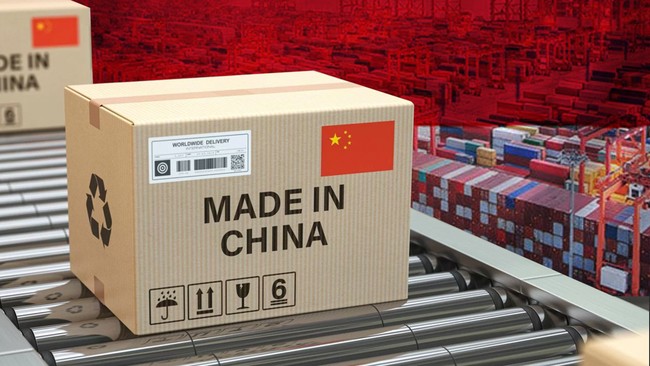
In addition to the investment side, China’s support is also evident from the flow of cheap goods imports into Indonesia.
Amid the weakening rupiah, the influx of cheap imported goods from China can help contain price increases for goods domestically. This condition allows Indonesian consumers to still enjoy relatively stable goods prices.
However, this benefit comes with risks.
Cheap imported goods from China can exacerbate pressure on local manufacturing industries. Domestic companies could find it increasingly difficult to compete with Chinese producers that have larger production scales and more efficient supply chains.
If this condition continues, local producers risk being further sidelined, while Chinese-owned companies could take a larger share of the domestic market.
The Government Increasingly Eyes Yuan Funding
China’s role is also evident from the government financing side.
BCA noted that the Indonesian government has issued yuan-denominated bonds or dim sum bonds to finance the country’s spending needs. This instrument is attractive because the yield on yuan bonds is relatively lower compared to global bonds.
At the same time, the government’s financing needs are increasing. BCA recorded that the benchmark SBN yield rose 77.7 basis points since the beginning of the year, in line with the increasing need for debt issuance.
Government spending on energy subsidies and compensation also jumped 266.5% yoy to Rp118.7 trillion in the first three months of 2026. This condition prompts the government to seek cheaper funding sources, including from the Chinese bond market.
BCA assesses that this situation could encourage the government to be more active in seeking funds from the Chinese bond market.
“Higher debt issuance could encourage the government to continue utilising the Chinese bond market as a funding source, which so far remains relatively isolated from global bond yield increase trends,” BCA wrote in its report.
However, issuing dim sum bonds is not without risks. One of the main risks is currency mismatch or currency misalignment.
This risk arises when the government has obligations in yuan currency, while the country’s revenues are not entirely in the same currency. If the rupiah weakens against the yuan, the cost of yuan-based debt payments could also increase.
BCA noted that Indonesia’s yuan deficit has continued to widen in recent years. Indonesia’s import share from China rose to 37.8% in March 2026, from 28.1% in 2019.
This means that more and more Indonesian imports are paid in yuan. Meanwhile, Indonesia’s commodity exports to China are mostly still paid in US dollars.
With this condition, larger dim sum bond issuances could add to the mismatch risk and ro