
Indonesia’s Economy Ahead of GDP Release: Three Indicators Strengthen in Tandem
Jakarta, CNBC Indonesia – Indonesia’s manufacturing performance strengthened significantly ahead of the announcement of third-quarter 2026 economic growth. The country’s Manufacturing Purchasing Managers’ Index (PMI) surged to 54.0 in October 2026, marking its strongest expansion in more than two years.
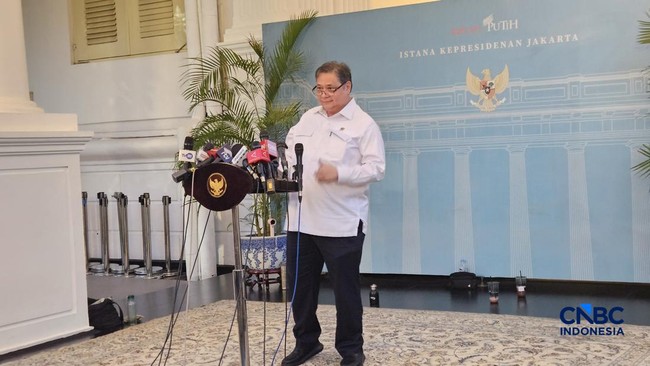
Co-ordinating Minister for Economic Affairs Airlangga Hartarto said the result was one positive sign of Indonesia’s economic resilience amid global uncertainty. Manufacturing growth has also been accompanied by contained inflation and a return to a trade surplus.
“Indonesia’s economic fundamentals remain strong amid global dynamics that are still marked by considerable uncertainty,” Airlangga said in a written statement on Monday (2 November 2026).
Indonesia’s manufacturing PMI rose to 54.0 in October from 52.4 in September. A reading above 50 indicates that manufacturing activity is expanding.
The result marked a second consecutive month of expansion and the strongest improvement in manufacturing conditions since March 2024.
The increase was driven chiefly by a rise in new orders, which grew at the fastest pace in five years. Growth in new export orders also set a record since the survey began in April 2011.
Stronger demand helped production activity grow at its fastest pace since March 2024. Manufacturers also stepped up purchases of raw materials and built up stocks to meet production needs.
Business confidence in the manufacturing outlook over the next 12 months remained firm. The government said accelerating domestic and overseas demand would support further gains in industrial performance.
The external sector also showed positive developments. Indonesia recorded a trade surplus of US$3.36 billion in September 2026, extending its surplus for a third consecutive month.
The surplus was supported by exports worth US$27.59 billion, up 3.68% month on month (mtm) and 11.87% year on year (yoy).
Export growth was partly driven by higher prices for several of Indonesia’s main commodities, including coal, natural gas, palm oil, natural rubber, iron ore and copper.
The government said the export outlook remained promising as downstreaming programmes continued and conditions improved in major trading partners. Efforts to broaden market access include 25 international trade agreements that have been implemented, while another 13 are still under negotiation.
Indonesia is also set to bring the Indonesia-European Union Comprehensive Economic Partnership Agreement (IEU-CEPA) into force, which is expected to expand market opportunities for national products in the European Union.
Imports totalled US$24.23 billion in September. Imports of raw and supporting materials rose 3.12% mtm and 24.65% yoy, while capital-goods imports increased 12.14% mtm and 1.25% yoy.
The rise in imports of both categories reflects industrial demand for production inputs, machinery and equipment to support activity and expand production capacity.
Meanwhile, oil and gas imports fell 7.35% mtm to US$3.27 billion. The government linked the decline to efforts to strengthen energy security, including the implementation of the mandatory B50 biodiesel programme from 1 July 2026.
Inflation remains under control
On price stability, Indonesia’s inflation rate was 3.23% yoy in October 2026, within the national target of 2.5%, plus or minus 1 percentage point.
Core inflation eased to 2.56% yoy, while administered-price inflation stood at 3.24% yoy.
However, price pressures in the volatile food category increased to 5.81% yoy. This was driven by horticultural commodities, particularly bird’s eye chillies, red chillies and tomatoes, amid lower production as El Niño extended the dry season.
The government said it would strengthen preparations for disruptions to food production and distribution, particularly ahead of the Christmas and New Year period. Planned measures include optimising water management and irrigation networks, adjusting planting patterns, making use of productive land and strengthening early-warning systems.
Inter-regional distribution co-operation will also be strengthened by making better use of Regional Co-operation Agreements (KAD), alongside monitoring food prices and availability.
Airlangga said the government would continue providing financing instruments and incentives to strengthen production capacity and investment, including the People’s Business Credit (KUR), Agricultural Machinery Credit, Labour-Intensive Industry Credit (KIPK) and Housing Programme Credit.
The government is also promoting workforce skills through apprenticeships and vocational training to meet industry needs.
“The government will ensure inflation remains under control so that people’s purchasing power is protected and businesses have certainty as they conduct their activities,” Airlangga said.
These indicators provide a positive backdrop ahead of the release of Indonesia’s third-quarter 2026 economic growth figures on 5 November. However, the PMI, trade and inflation data do not in themselves show the size of gross domestic product (GDP) growth during the period.
Source: jawawa.id (https://jawawa.id/newsitem/indonesias-economy-ahead-of-gdp-release-three-indicators-strengthen-in-tandem-1793667088)
Originally published by CNBC Indonesia (https://www.cnbcindonesia.com/news/20261103070733-4-781725/ekonomi-ri-jelang-rilis-pdb-3-indikator-ini-kompak-menguat), translated from Indonesian